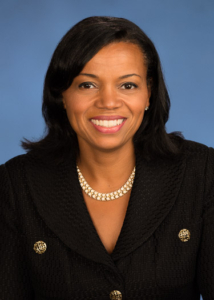
 “Be Bold and Take Risks to Be an Agent of Change”
“If you expose people who are smart and hard working to opportunities – and provide them with an access point to begin a career – success follows,” says Goldman Sachs’ Erika Irish Brown.
As Goldman’s new Chief Diversity Officer, Brown is responsible for driving inclusive culture initiatives and efforts related to the firm’s recruitment, retention and advancement of diverse professionals.
She notes she is genuinely passionate about promoting diversity and inclusion in the financial services industry. “The sense of purpose I have for my work drives me every day.”
A Beneficiary and Proponent of Diversity and Inclusion
Brown’s first introduction to financial services came via a year-long internship as a college student, which was offered specifically to students from underrepresented minority groups by a state-run bond agency. She describes the internship as a huge win given her alma mater – the State University of New York at Albany – did not send a high volume of graduates to Wall Street at that time.
This internship helped her land an analyst role at Lehman Brothers, which she says was a life-changing opportunity. “Very often, people ask me, why am I so committed to diversity and inclusion?” says Brown. “One reason is because I got my start on Wall Street as a beneficiary of what we now call a diversity and inclusion program.”
After working in investment banking at Lehman, Brown went on to issue bonds for the City of New York and served as a Presidential appointee at the US Treasury in the Clinton administration, ultimately earning her MBA from Columbia University and serving in roles at Morgan Stanley and Black Entertainment Television. She enjoyed the financial markets, the fast-paced nature of her work and the variety of people she was able to work with, but added: “It was a different time – gender, ethnic diversity was low.”
Brown took an interest in the diversity and inclusion (D&I) space, serving as a recruiting liaison for both on-campus and experienced hires – on top of her day job as a banker.
Prior to the financial crisis, Brown began her first ‘official’ diversity-focused role, once again, at Lehman, where her team focused on enhancing diversity at the vice president level and above. Post-crisis – and a brief stint on the Obama administration’s Treasury transition team – Brown joined Bank of America, where she built a team focused on executive diversity recruiting. From there, she went on to serve as Bloomberg’s chief diversity officer, building the company’s D&I platform from the ground up.
“Being considered a subject matter expert on diversity globally has made me very proud,” says Brown. “This is not easy work, it is not easily measured and you have to be bold and take risks in order to be an agent of change.” This risk-taking has led Brown to Goldman Sachs, where she has a large, global platform to influence diversity.
Evaluating and Developing New Approaches at Goldman Sachs
“It was important for me to come in and listen, learn and talk to people,” says Brown of her approach to her new role at the firm last year. “I wanted my expertise to be informed by the culture here.”
After connecting with stakeholders across regions and divisions and gaining a global perspective, she now feels well informed to have opinions, make assessments and execute on the best practices and strategies that will work for Goldman Sachs.
Brown outlines some of the many opportunities in the D&I space she hopes to focus on in the coming months:
- Enhance the Goldman Sachs brand as an employer of choice in diverse communities;
- Embed D&I practices into all aspects of the Talent process;
- Advance the firm’s inclusive culture and work environment; and
- Ensure accountability for furthering D&I at every level
Her team has the support from CEO David Solomon and the firm’s Global Diversity Committee. Brown notes that it is crucial to have senior leadership setting the tone – particularly when diversity impacts each and every area of a company, from business performance to client engagement.
“Today, no topics are off the table in the workplace, and people expect to bring their authentic selves to work,” says Brown. “I’ve seen firsthand that this approach has been adopted at Goldman Sachs as well.”
Recommendations From a Life-Long Learner
Describing her roles at several investment banks and why young women should pursue financial services careers, Brown says, “The skills sets you develop in a short period of time, the amount of responsibility and high bar for expectations, and the seniority of people – both internally and clients – that you engage with is empowering.”
Her advice to women as they progress in their careers is to continuously innovate and be life-long learners.
“Ask yourself – are you pushing the envelope, taking risks and being ambitious,” says Brown. “We should all reflect upon our legacy and ensure we make a difference in our workplace – it can be anything from launching a new product to creating opportunities for others.”
Outside the office, Brown continues to push for change in her community. As vice chair of the Bedford Stuyvesant Restoration Corporation, she works to ensure the Central Brooklyn community has access to housing, education and economic development opportunities, arts and cultural activities and capital for small business owners.
Brown stresses: “giving back is important to me – anything I can do to contribute and give back to others, I’ll do.”
And, a mother to three sons, Brown also keeps busy on the slopes, skiing in the winter with her family and cheering on from the sidelines of elite AAU basketball games. “We’re very active as a family, and our time together is so important and a priority to me,” she says.

Defy Conventional Leadership Wisdom to Achieve Breakthrough Performance
Career Advice, Guest ContributionLeadership is experiencing a metamorphosis today.
Its tried-and-true competencies are being tested (and sometimes even crushed) in our chaotic, always-on, hyper-connected, and competitive world. Conventional wisdom simply doesn’t have the same impact in the context of this new business environment.
Their strategic choices were oddly counter-intuitive, undeniably successful, and downright fascinating. Here are six behaviors that break the mold.
1. Shaking off the age-old bias for action and perfecting the use of the strategic pause.
Successful leaders in the modern era seem to have adopted a new habit. Instead of making action the default for every challenge, these leaders are pairing that alternative with an opposite response. It’s not about replacing action, which we know is a necessary leadership ingredient. We still need to reach our goals, meet deadlines, and produce results. This is different.
They think of it as developing a companion habit that celebrates being rather than doing. It involves a strategic pause. A mental time-out. Space for their brains to percolate. Whatever we call it, this new habit requires consistently taking some time away from the chaos of business to let ourselves think.
2. Escaping from the prison of their own perspectives and passionately seeking out cognitive diversity.
Modern leaders know that their own decision-making doesn’t come from a mentally neutral position, so they push themselves to uncover other angles. Not a polite, obligatory surveying of the crowd to reach consensus, but a mold-breaking, eyebrow-raising exploration to prove themselves WRONG.
These leaders aren’t just finding success through an openness to new ideas; they passionately seek them out. They value cognitive diversity and invite team members to challenge them with radical alternatives. They let go of the need to validate their own perspectives, and they focus all of their energy on finding the best solution to meet shared goals. No matter where those solutions might originate.
3. Ditching the need to let hard data drive every decision and welcoming the insights of soft intelligence.
Trailblazing leaders today have recognized the tendency to be held hostage by information overload. Even though it feels unnatural, they give themselves permission to break free from their dependence on data. Do they still value the facts? Definitely. They just work to gain a broader context about its meaning. They’re willing to be informed by data but not ruled by it.
Leaders who are open to the idea of Whole Data—a more comprehensive view of the facts— stretch beyond the usual quantitative boundaries to incorporate intangible elements. They better serve their teams and their customers by paying attention to stories and narratives, emotions and attitudes, worries and complaints, risks and vulnerabilities. They search for the qualitative information that paints a more vivid picture.
4. Dropping their dependence on the usual routine and letting go of outdated tasks and deliverables.
Today’s forward-thinking leaders have realized that everything consuming their time must earn the right to be on their to-do lists. To establish that competition, they have adopted a new approach that defies their normal logic.
Most leaders have a competitive streak that pushes them to take on more rather than do less, but they are seeing the wisdom in that concept. Narrowing their focus to expand their perspectives. Minimizing their actions to maximize performance. Doing less to achieve more. Through the ingenuity of letting go, they are finding abundant success.
5. Defeating the drag on their communication and creating positive experiences that expand their influence.
Modern leaders embrace the idea of disrupting their typical approach to communication. They start in reverse. Instead of trying to determine what information needs to go out, they concentrate on the end result. What impact do they want to make? What are the challenges and perspectives of their audience members? What experience would they like to create?
With that in mind, they peel away all the layers of complexity that have been clogging up their communication and get down to messages that are authentic and engaging. They present them in novel ways. They aren’t afraid to open a window into their motives and rationale. And they create a meaningful, compelling experience that communicates in a more powerful way.
6. Committing to metaphorically resigning their roles as experts and approaching tasks with the spirit of a beginner.
Modern leaders are accelerating their careers by breaking free from the expert trap. They no longer allow themselves to remain captives of their expertise. They are finding the courage to change the tired, old narrative with a new attitude, some genuine vulnerability, and the never-ending desire to learn.
Success for these leaders means deliberately putting themselves in positions to humbly learn and grow. Every single day. They have learned to value questions just as much as the answers. And, perhaps more importantly, they work hard to ask the right questions—many of which start with, “What if…?”
While these exciting new principles are remarkably effective, the most compelling thing about them is the way they are applied. It’s a selective process. Not a simple swap of out-with-the-old, in-with-the-new. There’s a firm acknowledgement that the old rules aren’t completely obsolete. The most successful leaders have a knack for knowing when to stick with the traditional approaches and when to break away. They’ve adopted a new brand of wisdom, and they know when to use it.
About the Author
Sara Canaday is a leadership expert, keynote speaker, LinkedIn Learning instructor and author. She works with leaders and high-potential professionals from organizations around the world to expand their capacity to innovate, influence, engage, and perform. Her new book, Leadership Unchained: Defy Conventional Wisdom for Breakthrough Performance, is now available on Amazon. For more information, please visit SaraCanaday.com.
Voice of Experience: Busisiwe Mathe, Partner/Director, Risk Assurance Cyber Security and Privacy; PwC
Voices of Experience“I believe that there was a lesson I needed to learn in everything I have experienced in my career,” she says.
A Varied Career Brings Success
Mathe began her career with PwC in 2004 and throughout her tenure has garnered experience in external and internal audits, technology transformation projects, business continuity management, cybersecurity and privacy, including stints abroad in the New York and Atlanta offices.
As the chairman of the South Africa PricewaterhouseCoopers Governing Board, Mathe serves as a member on the PwC Africa Governance Board and currently oversees the firm’s Africa Cyber and Privacy business.
It’s a crucial line of business, considering the prevalence of cyberattacks, including ransomware, that have increasingly plagued companies both globally and locally in the last 18 months.
While the attacks used to be concentrated to one specific sector or industry, they have become more widespread across all industries, and are moving from information technology into the operational technology environment. That concern was noted in PwC’s 22nd Annual Global CEO Survey, which showed cyber threats staying among the top 5 risks identified by CEOs.
Helping Women Achieve Success
Mathe believes that one of the top barriers for women in the industry is actually based on a false notion—the fact that most women view it as a technical industry where you have to have earned a technical or IT-related degree. However she finds that to be restrictive, as cybersecurity has both technical and non-technical aspects and thus offers a wide range of career lines one can follow. But that assumption leads to a second challenge, which is that the lack of women in the industry means that it is harder for young woman looking to enter the profession to find mentors or others to look up to.
She encourages women considering the industry to realize that the sky is the limit, and the variety of positions offered make cybersecurity a fantastic place to thrive. And she encourages her peers to focus on mentoring the younger generation—making it a priority to support STEM initiatives or even start their own to encourage women pursuing these important fields.
PwC is a supportive place in that sense, as Mathe underscores that the PwC Africa leadership team is firmly committed to diversity and inclusion, having adopted the Global Inclusion Index locally as a tool to continuously assess progress. In addition, all partners and staff take mandatory unconscious bias training, focusing on four dimensions of diversity: gender, race, sexual orientation and generational diversity. That has paid off in more women achieving leadership roles; in fact 45 percent of the partners named in the most recent cycle of promotions were women.
A Full Life Outside Of Work
“My family is my foundation; I would not be where I am had it not been for my strict, yet loving, father who told me at a very young age that I could achieve anything I put my mind to, and my mom who played a significant part in the woman, wife and mother I am today,” Mathe says. She carries out those lessons with her own family, which includes a supportive husband, whom she calls “one of her biggest cheerleaders,” and eight-year-old twin boys.
She also coaches and mentors students and young professionals through partnerships with organizations like Youth Leadership and Entrepreneurship Development (YLED) and the DreamGirls Academy. “I enjoy mentoring and coaching both at work and outside work by partnering with NGOs that empower young girls in believing and shaping their dreams,” she says.
Happy International Women’s Day 2019. Does Change Start Here?
Career Tip of the Week!, NewsCelebrations and recognition of women and women specific issues are being highlighted today around the world and inside corporate offices. Celebrating and making people aware of amazing women and their accomplishments is excellent. Shedding light on social, economic or cultural issues that do not get enough attention is also great. Better to have it, than not have it for sure.
However, does change happen because of it? No, change requires more than a day of talking and a hashtag (which by the way is officially #balanceforbetter which hints at two things, balance of power, not just more balance for women)
But, when all is said and done, it is just a hashtag that means pretty much zero when it comes to actual behaviorial change or any action for anyone whatsoever. Now that we have named the elephant in the room on the sheer vacancy of going through the motions of pretense, perhaps we can talk real talk about change?
Awareness is the first step. But, only the first step in change.
How do we achieve parity. equality, equity or meritocracy?
I like the #biascorrect idea that Catalyst is motioning this IWD (International Women’s Day). Stereotypes limit us. Anyone who has ever been stereotyped will tell you that. Catalyst provide resources to address that bias and in this instance, convey that words matter.
What is less discussed, are the false positive stereotypes and head starts that many women and many men but not all, give to men as leaders and heads of teams, families, power structures generally. That is the balance of power piece we really need to discuss.
What can you do?
Recognize that you probably implicitly have bias. We all do. I coach people to examine their paradigms regularly, as your mental model is formed via your life experiences and their context. That means, you probably are operating off ideas that your family and society told you was the “way it is” and that way it was, was steeped in notions of one gender’s needs being met before others.
Socialization, not brain differences feed into cognitive process whereby we place evaluative meaning on everything. Men are not from Mars and Women are not from Venus. We are all from Earth. The backlash we are seeing is due to people trying to maintain a historically granted place of power and is not surprising. The protection of the patriarchy by women, is to do with their socialization under men’s rules and women’s place in the structure of society so far, secure but secondary so fear on an unknown alternative prevents change and fuels racism, nationalism, and is why we see sexism by women against women.
We need to educate everyone on the benefits of equality and equity as the patriarchy is a system not a gender or a person and does not serve very many people other than the bad guys ( their reckoning is here, though) in this modern world.
It is only when we stop our bias cognitively, and make efforts to behaviorally change that we can be freed from false expectations around diversity parties, celebrations and hashtags actually changing anything. Stop asking the women to balance for better and start asking everyone to stop believing everything they think to be true. Test assumptions for best results.
Enjoy this satire piece in The NY Times today. I could not agree more.
Enjoy the day, however you spend it.
Op-ed: To Achieve #balanceforbetter in the Workplace, Reinvent Family Leave Policies
Op-Ed, Women's History MonthIcelandic primary school children born in the 1970s and ‘80s expressed disbelief when told that a man could be President.
Their mental map didn’t include little boys aspiring to the presidency — because all they’d ever known was a female president. It’s a favorite anecdote of mine because it flips common gender stereotypes while cementing their power.
Gender equality leads to better outcomes for everyone, a theme International Women’s Day elevates this year with their #balanceforbetter theme. At PwC, we approach IWD as another opportunity to challenge stereotypes. The most limiting stereotype at work is that women are predestined to be caregivers. Outdated family leave policies lie at the root of gender inequality in the workplace and beyond. Until they’re refreshed to give individuals and families more choices, women will continue to make up a minority of leaders.
PwC’s US CEO, Tim Ryan, recently said, “Together a new employer-employee relationship can expand what the old one did for decades, create shared prosperity and hopefully build better and more meaningful work and lives for millions.” Expanded family leave and a simple but intentional change in nomenclature will anchor this transformed relationship, paving the way for true gender equality in the workplace.
PwC found that the expectation of work-life balance is exactly the same between male and female millennials; research shows that men and women experience similar levels of work-life conflict and that fathers experience more work-life conflict than mothers. I can say anecdotally that the men I know take their caring responsibilities just as seriously as the women; and that my colleagues and friends without kids don’t value their family, friends, or time any less than those with kids. PwC’s cutting-edge research on engagement drives home the point that the most successful leaders of tomorrow must discover how to deliver great performance by helping people individually thrive.
Beyond the essential birth and recovery period that women must continue to take, women and men should have equal access to time off and flexibility in coming back to work after the birth or adoption of a child. Furthermore, all employees should be offered a minimum amount of leave to care for the people they love. Employees are unique in their needs and the most successful companies will offer benefit choices that work for everyone. Companies and governments should be racing towards inclusive family leave policies, not plodding towards them – and some are beginning to show significant progress.
Culture Matters but Policy Helps
Territories leading in family leave policies are — not coincidentally — also top of the World Economic Forum’s Gender Equality Index. Iceland, a perennial leader on the Index, grants three months of non-transferable parental leave to both mothers and fathers and an additional three months of leave to couples to share as they choose. Its success lies in the uptake: about 90% of Icelandic fathers take the leave.
Netflix offers 52 weeks of paid family leave to women and men (and, with 41% female employees is one of tech’s leaders in gender equality across its staff population); Google and Facebook offer equal family leave to women and men. Last year, PwC US introduced six weeks of fully paid parental leave for all employees, with about 72% of new fathers using the full amount. Employees also have the option to implement a phased return to work after parental leave, allowing new parents to work 60% of their contracted hours at full pay for four weeks following a paid parental leave of absence. Other types of caregivers can receive four weeks of paid leave in order to care for certain family members with serious health conditions. PwC UK offers eligible parents of either gender 22 weeks of full pay and is encouraging more dads to feel like they can take it. Breaking through assumptions about men’s role in families and changing attitudes will be key to capitalizing fully on the good policies that already exist.
To be sure, gender equality is a complex issue with children socialized from a young age to play into narrow roles – and this calcifies the stereotypes that play out later in life. Even in countries with longstanding progressive parental leave – like Sweden – deeply embedded gender stereotypes from sources, namely, the media, hinder gender equality progress.
Globally, women continue to bear the bulk of unpaid care work. Leave to care for children and other loved ones matters now as it has never before because the workforce has transformed, while policies and even norms have stagnated. Many leave policies are woefully out of date, constructed to serve a majority of mothers who didn’t work outside the home and a majority of fathers who were happy to leave domestic duties to their wives. Around the world, family leave policies vary dramatically, with some countries lacking any mandated paid parental leave (United States), and others offering up to three years (Germany, Eastern Europe). In the UAE, new fathers get two days of paid leave, while in South Africa and India they get five. Research shows that new mothers are penalized financially at work, while new fathers are rewarded and these outdated or unfit leave systems perpetuate that trend. It’s not the fact of a woman having a child that hurts her career, but the assumptions that she is less competent and less willing to take on high-profile assignments.
When these policies were crafted, zero percent of corporate workers had caring responsibilities. Today, according to a recent HBR study, seventy-five percent of all workers have care responsibilities, regardless of gender, and regardless of whether they are single or coupled. Families have also evolved: same-sex, single parents, and blended families are exponentially increasing. It’s important to note that leave policies shouldn’t be limited to caring for children, but can and often do also encompass caring for partners/spouses, parents, grandparents, nieces/nephews, or other close family members. Many corporations don’t directly address leave for anyone other than children.
The imperative is there
According to a 2016 study, only 36% of companies have a global parental leave policy covering multiple types of leave, 94% include maternity leave, 76% include paternity leave, and 73% included leave when adopting children. Our leave policies are no longer fit for purpose.
We must provide more support and choices for our diverse workforce and use the term family leave to describe anything other than a woman’s short-term medical leave, when recovering from childbirth. Family leave is not only a gender-neutral term, but covers a wider swathe of employees and accounts for the changing family and household dynamics of today’s world.
About the author
Dale Meikle is the Global People Experience Leader at PwC International
Connect on LinkedIn
Follow on Twitter @dmeik
Effective Networking for Female Professionals: The Old Girls Club?
Career Tip of the Week!, NewsIt is Women’s History Month and International Women’s Day this week (Friday 8th March, 2019) so tune in for hard hitting editorial on women’s advancement at work, like we do the other fifty weeks of the year also.
According to a new study published last month, women should be networking with other women as well as men if they want to land more prestigious and better paid jobs. This study of suggests women need a women-only inner circle and a larger, well-connected network generally. The study analyzed the peer networks and job placements of 728 students at leading university, representing two class years, from an MBA program in 2006 and 2007. All of the graduates landed leadership jobs, so the (well respected) researchers ranked the positions according to prestige and other factors. The subjects studied consisted of 542 were men and 186 women, which is roughly consistent with the researchers’ findings that women make up about a quarter of business school students nationwide. The conclusion being that a person’s network composition regarding gender split can predict the career success of women. Wired magazine broke down the study and talked to the study authors and interpreted the study with the main message being women and men who are connected to other well-connected peers across their social network do better. In addition, it is extrapolated that women thrive from “gender-specific private information and support.” And men do not need insider information to thrive and advance because, wait for it ‘work is built for them’. Words that interested me from the study’s lead author, Northwestern University data scientist, Brian Uzzi, he goes on to state,
“Quite frankly, most of the jobs are still male-dominated and therefore the kind of private information that’s so important to help women get ahead isn’t as important to men’s advancement,”
Despite Brain Uzzi being possible the leading network expert, a respected expert in social psychology with a very respectable body of work that no one can argue with and some really good advice, it is hard to accept that his conclusion from just final job outcome is the end of the story.
For me, it is very much the opening of the conversation around bias, gender stratification and gender roles, because people decide if the men and women of this study get hired and people negotiate offers for salaries. That is to say, a man and a woman could have made the same connection at the same networking mixer, but the man got hired.
But, if we take this study at face value, then we can conclude that this is not new news as we know women have to work twice as hard at networking just as they do with other areas.
Uzzi shares his opinion on how he feels women should behave via his interpretation only of the results,
“When it comes to networking, women need two things and men only need one, so for every one contact a man makes, a woman has to split her time between the contact that’s going to give her market information and the contact who’s going to give her private information. If you’ve got to split the time between the two, you’ve got to be very smart about the kinds of choices you make.”
It is not a revelation that women have to work harder or are given less credibility for the same thing, or are dinged for same traits. Nor is it a shock to most of you that you do get the scoop from other women, because it could be friendship or a deeper phenomenon involving “out group” dynamics. Call it what you will, because what is real that we pay the same money for those MBAs so we need a way to ensure we get the same Return on Investment as literally the next guy. And for the love of golf, do not ask us to play unless you want to and even then, you are not one of them.
A step backwards?
What this research does not talk about is what men can do to prevent women from having to make choices. You can be a good man yet not be a man who advocates for women to have equal pathways to success.
Then, #metoo comes along with the shouts of “not all men” which of course is entirely valid because we all know some really great caring men who understand consent and respect and where the lines of proper behavior lie. The problem with the “not all men” chant is that it can silence the nuance of useful conservation around “although you do not, but by virtue of a legacy power structure you probably could be you were inclined to, therefore how do we ensure the bad guys are stopped by a new structure so you do not ever have to feel lumped in with them, because you are in fact part of the solution”. Instead, out of fear many men have taken a step back from interacting with women at work. Not helpful. Just actually more indulgent of a privilege to withdraw of a historically dominant group instead of facing the work that has to be done. Some people do not have that privilege to say no without consequence.
Networking past the biases and fear
Most networking information is entirely based on men networking with men with male examples given as an argument for basing your connection on hobbies and passions. Herminia Ibarra’s work clearly delineates the differences between personal, operational and strategic networks and is worth a read.
In this era of strong gender roles still being perpetuated by most people, men and women alike (granted glimpses of hope around understanding the negative effects on boys as well as girls of the patriarchy and toxic masculinity), it no shock that men continue to network with each other in the way they have always known how, excited primal physical arousal states usually with sports and competition. Which is why we have to believe there are physiological differences without believing we are beholden to them. We all have the ability to disrupt our cognitive process with a behavior change. That goes for women too. Start with your own biases. How much do you do love the patriarchy? Odd question you might think, but really look at to what extent do you favor men and boy’s needs over those of women and girls? This question is not about whether you like men or whether you believe in raising strong daughters or whether your husband does the dishes. It is a question about your own value sets, deep, intrinsic ones that are probably buried in your unconscious and then how that affects your conscious and unconscious behaviors.
Why do you go to women for information and perhaps comfort but not for promotion, stretch projects and general greatness? Why do men get immediate credibility and do you give it freely while in parallel asking women to prove themselves?
As we enter the hoopla, ceremony and celebration of International Women’s Day, the question to ask yourself is where are you on this spectrum of consciously and unconsciously endorsing for men because they are men, because it’s a spectrum we are all on.
Voice of Experience: Beth Renner, National Director of Philanthropic Services, Wells Fargo Private Bank
Voices of ExperienceAs a mentor, Beth Renner knows that women often need to find their voice—and when they do, it can be a powerful booster charge to their career.
As she recounts, she was recently working with a long-term mentee who had finally applied for a position. When Renner had asked why she had hesitated, the mentee said she believed she didn’t have the entire skill set, but as they walked through the skill set and experience, it became clear that the position was a perfect fit. “Sometimes the biggest challenge is the messages we tell ourselves.”
Finding the Ideal Niche to Blend Personal and Professional Interests
Renner’s clear confident voice has brought her a 28-year career in the financial services industry, during which she has essentially touched every part of a financial services company. She started on the retail bank side as a personal banker; then was a credit officer with a small business lender; went into the fiduciary side as a private banker and trust manager, where she subsequently oversaw the fiduciary investment and brokerage side; and for the past eight years has worked in philanthropic services, where she currently has $26 billion in charitable assets under management for clients.
“The lifeblood of our business is the advice we provide our clients around their donations and assisting nonprofits in making sure they are sustainable,” Renner explains. Having always been personally involved in charitable work with both her time and treasure, the chance to marry that in her professional life is the achievement of which she’s most proud.
“For me it’s not about achieving a certification or designation, but about what I do every day, and I’ve really found a home for myself in this area that allows me to align my personal and professional values,” she says.
A Sea Change in the Philanthropic World
As the country prepares for an impending generational “wealth transfer,” Renner finds several themes consistently emerging. First, as a matriarch or patriarch who is naturally at the maturing point is engaging in legacy planning, they are asking how they can ensure that their values will be represented. The goal is to engage multiple generations from the family in their philanthropic pursuits.
Others are wrestling with the question of how much to leave their kids and wondering how to engage philanthropy as a tool to stave off entitlement.
“Donors are viewing themselves as an investor in these causes more than ever before, and we are adjusting the advice we provide them to create a more disciplined process.” To that end, she has helped develop a series of philanthropic planning modules that they are currently honing through focus groups, and she looks forward to rolling them out. “It’s a pleasure to be able to work more deliberately on these issues and adjust our business to how our clients are telling us they need counsel.”
Renner has become attuned to the absolute value of listening with intention and mindfulness which is helping inform this new initiative. When her father passed away shortly after she turned 50, she hit a point of reflection. “It causes you to look at things differently, and one of the things that has stuck with me is the art of listening and how it helps you understand others and yourself. Being mindful means that if I’m in a situation where I’m listening to clients or my team and find myself having an internal reaction, it spurs me to dig deeper to figure out where it’s coming from.”
Finding a Mentor Helps Your Career Path
One thing Renner learned from her mentor early on in her career was to focus on developing transferrable skills. For example, you don’t just want to be an expert in credit analysis, but you need to know how to solve complex problems. “In any position, consider what skills you can learn that you don’t yet have or want to cultivate,” she says.
And today she encourages women to be intentional about mentoring other women. “Don’t wait to be asked; when you see someone with potential, proactively reach out to them,” she suggests. That’s because we all are a collection of our past experiences and to give someone that gift of your accumulated knowledge will allow them to make progress faster.
She takes that outlook to her work on Wells Fargo’s Women’s Team Member Network, a diversity and inclusion employee resource group she finds valuable for its focus on broadening everyone’s lens around diversity and how to foster and develop it.
Her outside philanthropic pursuits are a perfect match for her professional life: She is absolutely passionate about the American Red Cross, and is the national chair of the women’s giving group called the Tiffany Circle. The group has flourished in five different countries, and in her role she helps develop the strategy around mobilizing this women’s segment. “A lot of the work I do at Wells Fargo helps the Red Cross with their fundraising and stewardship because I can share national trends and the emerging role that women are playing in philanthropy,” Renner says.
Erika Irish Brown, Chief Diversity Officer, Goldman Sachs
Voices of Experience“If you expose people who are smart and hard working to opportunities – and provide them with an access point to begin a career – success follows,” says Goldman Sachs’ Erika Irish Brown.
As Goldman’s new Chief Diversity Officer, Brown is responsible for driving inclusive culture initiatives and efforts related to the firm’s recruitment, retention and advancement of diverse professionals.
She notes she is genuinely passionate about promoting diversity and inclusion in the financial services industry. “The sense of purpose I have for my work drives me every day.”
A Beneficiary and Proponent of Diversity and Inclusion
Brown’s first introduction to financial services came via a year-long internship as a college student, which was offered specifically to students from underrepresented minority groups by a state-run bond agency. She describes the internship as a huge win given her alma mater – the State University of New York at Albany – did not send a high volume of graduates to Wall Street at that time.
This internship helped her land an analyst role at Lehman Brothers, which she says was a life-changing opportunity. “Very often, people ask me, why am I so committed to diversity and inclusion?” says Brown. “One reason is because I got my start on Wall Street as a beneficiary of what we now call a diversity and inclusion program.”
After working in investment banking at Lehman, Brown went on to issue bonds for the City of New York and served as a Presidential appointee at the US Treasury in the Clinton administration, ultimately earning her MBA from Columbia University and serving in roles at Morgan Stanley and Black Entertainment Television. She enjoyed the financial markets, the fast-paced nature of her work and the variety of people she was able to work with, but added: “It was a different time – gender, ethnic diversity was low.”
Brown took an interest in the diversity and inclusion (D&I) space, serving as a recruiting liaison for both on-campus and experienced hires – on top of her day job as a banker.
Prior to the financial crisis, Brown began her first ‘official’ diversity-focused role, once again, at Lehman, where her team focused on enhancing diversity at the vice president level and above. Post-crisis – and a brief stint on the Obama administration’s Treasury transition team – Brown joined Bank of America, where she built a team focused on executive diversity recruiting. From there, she went on to serve as Bloomberg’s chief diversity officer, building the company’s D&I platform from the ground up.
“Being considered a subject matter expert on diversity globally has made me very proud,” says Brown. “This is not easy work, it is not easily measured and you have to be bold and take risks in order to be an agent of change.” This risk-taking has led Brown to Goldman Sachs, where she has a large, global platform to influence diversity.
Evaluating and Developing New Approaches at Goldman Sachs
“It was important for me to come in and listen, learn and talk to people,” says Brown of her approach to her new role at the firm last year. “I wanted my expertise to be informed by the culture here.”
After connecting with stakeholders across regions and divisions and gaining a global perspective, she now feels well informed to have opinions, make assessments and execute on the best practices and strategies that will work for Goldman Sachs.
Brown outlines some of the many opportunities in the D&I space she hopes to focus on in the coming months:
Her team has the support from CEO David Solomon and the firm’s Global Diversity Committee. Brown notes that it is crucial to have senior leadership setting the tone – particularly when diversity impacts each and every area of a company, from business performance to client engagement.
“Today, no topics are off the table in the workplace, and people expect to bring their authentic selves to work,” says Brown. “I’ve seen firsthand that this approach has been adopted at Goldman Sachs as well.”
Recommendations From a Life-Long Learner
Describing her roles at several investment banks and why young women should pursue financial services careers, Brown says, “The skills sets you develop in a short period of time, the amount of responsibility and high bar for expectations, and the seniority of people – both internally and clients – that you engage with is empowering.”
Her advice to women as they progress in their careers is to continuously innovate and be life-long learners.
“Ask yourself – are you pushing the envelope, taking risks and being ambitious,” says Brown. “We should all reflect upon our legacy and ensure we make a difference in our workplace – it can be anything from launching a new product to creating opportunities for others.”
Outside the office, Brown continues to push for change in her community. As vice chair of the Bedford Stuyvesant Restoration Corporation, she works to ensure the Central Brooklyn community has access to housing, education and economic development opportunities, arts and cultural activities and capital for small business owners.
Brown stresses: “giving back is important to me – anything I can do to contribute and give back to others, I’ll do.”
And, a mother to three sons, Brown also keeps busy on the slopes, skiing in the winter with her family and cheering on from the sidelines of elite AAU basketball games. “We’re very active as a family, and our time together is so important and a priority to me,” she says.
Change Your Mindset To Change the World (and Your World)
Black History Month, Career Tip of the Week!As we close out our Black History Month coverage this week, and in a direct follow up to my Op-ed on mental constructs regarding Race and how to talk about racism.
I ask how can you ensure your network is not just full of people like you, who hold the same constructs and therefore everyone can easily have confirmation bias? Bad for business with potential ‘groupthink’ coming into play, and bad for personal growth.
I am going to ask you to check whether you walk the talk on having an inclusive network.
Does your network consist of people who look, think and act like you, in every way? I am here to ask what can you gain by broadening your horizons?
How can you ensure you are getting to know perspectives that are different from yours? Equally, how can you explore enough when you are getting to know someone, to find out if that person who do not look like, can actually be very similar? How can you not presume or make assumptions based on stereotypes? It is hard because you brain “goes” there and research from the fields of neuroscience and social science’s “ladder of inference” can be shared with you in one sentence here. Simply put, your brain tricks you into thinking you have seen this before and you know what this is about. Guess what? You don’t know what is coming next, whether it is your brain seeing four red cars and subliminally telling you the next car will be red. Or whether your brain tells you that leaders are always better if they are tall white men even if you don’t know the person himself but in concept only. Or you do know the person and you dismiss their flaws and give unearned credibility to them due to concepts.
My point is, appearances can be deceptive. We are all made up of complex identities, no one is simple or one dimensional and we all have a gender (male is a gender too), ethnicity (maybe we need a new word as it implies white protestant as a benchmark baseline ), orientation (straight is an orientation too), nationality, work position, parent or not parent status, even golfer or not golfer status. Most of us, have had some affiliation to a legacy or current dominant group. We can go through life like that, easily. I had very little perspective for example of what it meant to be a Catholic growing up in Belfast as my class and religion meant I was never really stopped by army or police or had to deal with thugs and gangs and any resemblance of poverty. Bombs yes, they were everywhere and random, but the everyday drag and bias of being in the minority and less powerful group in my society, no. Yet, my mindset was one of scarcity, fear, paranoia and being aware to this day of the so-called “other”. I am not saying I am freed 100% from my sectarian constructs – maybe 99%, but I know that i see parallels in the USA with race and that is why I know for sure that people can take the diversity journey and grow. As Maya Angelou said, “when you know better, you do better.”
So, where do you start?
Step 1: Take the time to understand your values because values are espoused versions of your implicit beliefs. Chances are you are running the same old program that was handed to you in childhood via your direct environment, family structures, institutions such as school and church/temple/mosque, and the overall society you were born into and whatever norms that group had in play.
Step 2: Write out every construct you have been told such as “Trust is earned” or “X, y, z is the way it is”. What do you tell yourself when you are in varying situations as who to hire for the project, who to cut from the project, and who to promote? What do you tell yourself when you are stressed at work and having less than optimal interactions?
Challenge the and every single line by asking yourself simple questions such ‘Do I believe this, truly?’ or an advanced version of this could be ‘How else can I look at this?’ or ‘Is this still working for me now?’ and “how is this actually something that was given to me by my father/mother/granny, and is not actually how i feel at this time?”
If you would like to work with me as a coach on personal and professional growth and renewal, with real insights for you, about behaviors and the context of the operating system you are in. Please book a free exploratory time with me. Life is too short to carry outdated constructs around. Grow! Whether it is individual, or organizational change, it does not happen without awareness as the starting point.
Voice of Experience: Valerie S. Peters, CTFA®, Senior Vice President and Head of Relationship Services; Abbot Downing
Black History Month, Voices of Experience“When I entered the corporate world over 20 years ago, I believed that it was possible to achieve anything with hard work and discipline, and I still believe those are key ingredients to success,” says Valerie Peters, who serves as operations leader for Abbot Downing, a Wells Fargo business serving ultra-high-net-worth clients.
Her career path has proven the value of focusing on a goal….and working to achieve it.
Each Experience Leads One Step Closer to Career Goals
Peters started her career in retail banking as a customer service phone representative and then transferred to the commercial real estate division, where she was selected for the management trainee program. She immediately felt drawn to the wealth management arena during a rotation in the trust area, and with that eventual role in mind, she began looking for opportunities that would help her build the skills she needed.
She took a role managing a team of client service professionals supporting wealth management clients with their banking, investment and fiduciary servicing needs; from there, she moved on to become a manager within a trust center and eventually transferred to the division that served ultra-high-net worth clients. Her time working in client-facing, trust services and operational roles were each stepping stones that helped prepare her for her current position as operations leader for Abbot Downing.
In her quest for continuing education, Peters counts achieving her designation as a CTFA (Certified Trust and Financial Advisor) several years ago as one of her proudest moments. “I had spent several years working in the fiduciary area, and earning the CTFA was a culmination of the time I spent gaining work experience, as well as obtaining knowledge through the various trust school programs I have been fortunate enough to attend,” she says.
Sponsors and Mentors as a Key Ingredient to Success
Along the way, Peters has found that sponsors and mentors are crucial and has appreciated the support they have given. She has also looked externally to find role models to emulate; one of her personal role models is Ursula Burns, who came from modest beginnings to become the first African-American woman to lead a Fortune 500 company. “I have long been inspired by her hard work and dedication,” Peters says, citing her strong work ethic and commitment to learning the ins and outs of business through a variety of roles.
Over the years, Peters has participated in a number of programs geared towards retaining diverse talent, including women, naming the Diverse Leaders Program as one of the most impactful. “The whole time I participated in the program, I felt that I was valued not only for what I do within the organization, but also for who I am and how the perspectives and insights gained through life experience shape my thoughts, ideas and values,” she says.
When Peters is away from work, she values time spent with her family—a favorite escape is spending time at the beach unwinding and enjoying the ocean. “We try and get away as often as possible when the kids are on break from school,” she says.
Why Relocating Can Boost Your Career—And How to Make It Work For You
Career AdviceBy Cathie Ericson
Whether you’re employed at your company’s headquarters and want to find out more about working in a branch office—or vice versa—relocating within your company can boost your career in a myriad of ways.
It shows you’re a team player if you’re moving to fill a necessary role and bolsters your network of champions as you showcase your skills by working with others in various functions, departments and locations.
The reasons for relocation vary: One survey from Impact Group found that while nearly one-quarter relocated for a promotion, more than half said they were doing it for personal career development.
According to a Robert Half poll, 62 percent of respondents would relocate for a job opportunity—and that might be wise, considering that nearly half find they would receive better pay and perks through a move.
Many of those relocaters are women: A Wall Street Journal article reported that women accounted for nearly a quarter of moves by North American employers in 2016—up from 17 percent in 2009, according to surveys of employers by Atlas Van Lines Inc.
Sometimes the relocation is strictly for professional gains, such as your desire to learn new skills or work with new teams, but other times it’s for a personal reason, whether you want to be closer to family or have always wanted to live in other region. Whatever the reason, here are five ways to make the relocation seamless.
1. Explain why it’s in your company’s best interest.
Whether you want to work in a different division or want a change of scenery, it’s important to make your case carefully if it’s a relocation that you’re requesting, as opposed to one that’s been offered to you. Do some clandestine research on how other relocated colleagues have fared elsewhere in the company—did it propel their career or did it put them on the slow track to nowhere? That can help you determine if it’s a wise career move before you even get started.
And then conduct similar research to help you build your case. Find out how your background and skills can be parlayed into helping your division or location of choice achieve their goals and prepare to make a business case to prove your point.
As Erica Perkins, director of human resources business partners at Glassdoor, explains, “Don’t ask for something if you haven’t researched whether or not it’s feasible. Find out what your employer policy is on location transfers and (if international) global mobility programs and assignments/expatriation.”
You’ll also want to make sure you’re not professionally pigeonholing yourself “by taking on a specialist role,” Jennifer Petriglieri, an assistant professor at INSEAD, tells Harvard Business Review.
2. Learn more about the culture of the office and the location.
Ideally the firm will sponsor a trip for you to do some reconnaissance before making your decision, but if not, consider funding the trip yourself—you don’t want to complete all the paperwork and have your family uprooted only to find out that the office is significantly smaller than you had expected, located in a less-desirable area or has a culture that’s far different from your current one.
“Visiting your new office location at least once before you commit, reaching out to new coworkers via email or LinkedIn, or inquiring about the different types of culture-building activities offered to employees (or lack thereof) are just some examples of ways to vet a new opportunity,” recommends Phoebe Licata, an employee engagement consultant.
And utilize the power of social media to find out more about the city in general if you’ve not spent significant time there to make sure that it offers the ambience you prefer, whether that’s for cultural activities, outdoor adventures or a burgeoning restaurant scene.
If you are unable to visit, see how much information you can glean from coworkers—ideally you have a contact in the office who can be candid—or talk to other colleagues who regularly interact with those in the potential location. They might be able to give you important intel that can solidify your decision—or at least ensure you are prepared once you arrive.
3. Negotiate a compelling redo package.
The Robert Half survey found that more than one-third of companies have increased their relocation packages in the past five years, but it’s important to learn who will shoulder the various expenses. Among the aspects to consider are:
Also make sure to research the cost of living in the new location; if it’s significantly higher, you might want to ask about a bump in pay or subsidy commensurate with those expected higher expenses.
This is also the time to confirm whether it’s a permanent or temporary assignment and what recourse you have if things don’t go as planned.
4. Consider a “trailing spouse” if you have one.
As Matthew Bidwell, an associate professor at Wharton, explains in the Harvard Business Review article, “It’s not just what does this mean for your career, but what does this mean for our family?” he says.
Companies are realizing the importance of a happy family: The same Atlas survey found that more than 60 percent of employers provided job-hunting aid for spouses or partners in 2017, nearly double the 33 percent who did so in 2007.
And in addition to inquiring about the assistance your employer might offer, think through other networks or opportunities your partner can tap, whether it’s through their current job or LinkedIn connections. See if there are others in your new office who might be families with the industry and have contacts to share.
Making sure your family is on board with the move is a key part of your eventual success.
5. Embrace the adventure.
Whether the relocation was your idea or was something “strongly recommended” by your employer to advance your career, look at it as an incredible opportunity to try something different, meet new people and further enhance your career and your value to your company by bolstering your network and your skill set.
“A career is long; we can all afford a few adventures, and we have plenty of time to experiment and explore,” notes Petriglieri.