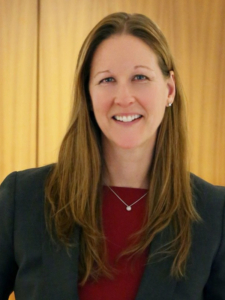
“In the moment, you might think that your path in life doesn’t seem clear. It might seem like it’s going in a direction that’s not what you had planned,” says Wells Fargo’s Kelli Hill, based in Minneapolis. “I’ve learned to go with it and have confidence that life will take you right where you need to be.”
From unexpected career and personal turns to crossing the finish line at an Ironman Triathlon, Hill shares on navigating towards growth and fulfillment.
Trusting A “Zig-Zagging” Career Track
“Prior to joining Wells Fargo over eight years ago, I would have described my career path as a bit of a zig-zag road. That’s the way that I thought of it.”
While at the University of Minnesota Law School, she wanted to become a public defender. But Hill remembers sitting in a tax class one day and turning to the student next to her and saying, “Isn’t this fantastic?” The reaction she received was quite the contrary.
That was the moment she suspected this might be the field for her.
Out of law school, Hill took a job in public accounting at Deloitte & Touche. She left Deloitte (now Deloitte Tax) to practice law and spent most of private law practice in the trust & estates and business transition planning groups at Minneapolis-based, Fredrikson & Byron, PA. She enjoyed the work, the firm and her colleagues, and was learning a lot, but felt like something was missing.
“I didn’t want to look back and say, ‘I was a successful attorney and worked at a terrific firm with so many talented colleagues, but was never really completely fulfilled.’” reflects Hill.
Hill left private law practice to run the tax, trust and legal group of a single-family office headquartered in St. Paul, Minnesota. It was during her time at the family office that Hill discovered the benefits and impact that having a financial plan and, specifically doing strategic wealth planning, can have on high net worth families.
When she joined Wells Fargo as a senior wealth planning strategist in 2012, she began to see congruency in the experiences she’d accumulated and where she was going, eventually rising to a Senior Director of Planning in Wealth Management.
“I thought to myself, ‘my entire career path has been tailor-made for this role and this experience,’” says Hill. “It was no longer a zig-zag to me.”
Working with Individuals and Families
What Hill loves most about her work in wealth management (and wealth planning, in particular) is supporting and advising clients on personal and financial decisions that are otherwise difficult to make, to greater outcomes than you might even imagine.
“As a professional, when you help somebody to make financial decisions, it has a qualitative impact that often far outweighs any tax dollars saved,” she says. “It can have such profound impacts on their lives and, when that happens, the appreciation and gratitude is overwhelming.”
As an exemplary moment of this, Hill recalls working with a family to transition their business to the next generation. Her work led to conversations that, as a family, they had not previously been able to confront.
“We had this moment where they actually told each other how they felt about the business and their desired places in it,” remembers Hill, “I will never forget it.” Beyond ultimately being able to identify solutions that enabled the family to achieve their financial goals, Hill recalls this moment and how important to the family their work together had become.
Being Open and Receptive to Mentorship
“I would not be in the position I am today without having had the benefit of supportive mentors and sponsors,” Hill attests. “I’ve worked with some pretty wonderful people in my career, especially while at Wells Fargo. In fact, most of the mentors and sponsors with whom I’ve had the privilege of having were/are managers of mine.”
If you want to attain strong mentorship and sponsorship, whether you are the mentor or mentee, Hill recommends listening, being receptive and open, and most of all—being yourself. Early in her career, Hill recalls a mentor saying to her “don’t try to fake it, people will know.”
“I always try to be open to feedback, even if it stings a little. I want to continue to improve and work on my professional and personal development,” she notes. “The individuals who have become my mentors and sponsors have pointed out that my openness to feedback and focus on self-improvement are characteristics they enjoy most about working with me. The other is my being authentic, being me.”
Hill says her professional self is just who she is. These days, that includes embracing the realness of her seven year old daughter wanting to say hello to her colleagues on a Zoom call.
“This is me,” says Hill. “I always try to be my authentic self. To really connect with people —your colleagues, your clients —you have to let them see you. I’ve learned that to be a great leader, it’s a good thing to be vulnerable, authentic, natural. To be you.”
Hill also recommends implementing the advice you receive.
“It’s one thing to solicit and ask for advice and guidance,” says Hill. “It’s another thing to actually take it, and I do my best to do so and will continue to.”
Growth Through Change And Adversity
On a personal level, Hill values personal growth through challenge as well as learning through making mistakes.
In her early thirties, she experienced an unexpected divorce that shook her world.
“I took the opportunity to work through a big change in my life very seriously,” says Hill. “I remember saying, ‘This is an opportunity for me to really figure out who I am.’ It impacted my life tremendously, it was traumatic—and yet I would do it all over again, every bump, every hurdle. My life experiences have helped shape who I am today and, as painful as some may have been to go through, I appreciate them all.”
In both personal and work life, Hill is aware the road of transition can be a time of discomfort and challenge, but keeps focused on the vision.
On an organizational level, Wells Fargo has embarked on an evolution to create greater consistency around bringing financial products, services and solutions to all clients through a more horizontal structure. While the work will result in “a more effective and efficient organization for our clients and shareholders, the change can be challenging.”
“When we look back six months from now, we’ll see how we’ve transformed and know that it is right where we are supposed to be.” Hill tells her team.
Trusting Your Own Strength
Hill never for a moment doubted her own vision of being personally successful. Though she came from a single-parent household with modest financial means, Hill is proud of being the first in her family to go to college and then on to law school, which was the beginning of her career path.
While recovering from that divorce years ago, she remembers a moment of personal empowerment that taught her she was capable of anything.
A few years into her career, she was a self-confessed coach potato who realized it was time to change. The first time she put on a pair of tennis shoes and ran a single mile, it took her 14 minutes. But she was thrilled.
Then, she was hooked—training up to participate in marathons and eventually an Ironman triathlon.
“I remember crossing the finish line of the Wisconsin Ironman and thinking, ‘There is nothing I can’t do’” beams Hill, who also met her husband through the triathlon community, with whom she is raising their daughter.
Her contagious enthusiasm has encouraged several others on the running path, and she keeps up a morning workout which she loves, though being a mom is now her number one priority.
Her favorite time with her daughter is bedtime reading. It began with she and her husband reading to their daughter when she was an infant and now it’s listening to their daughter read to them—and Hill wouldn’t trade it for any finish line, not these days.
Abbot Downing, a Wells Fargo business, offers products and services through Wells Fargo Bank, N.A. and its various affiliates and subsidiaries. Wells Fargo Bank, N.A. is a bank affiliate of Wells Fargo & Company.

Your Negative Emotions Can Guide You to Value-Based Actions
Career Advice, Career Tip of the Week!“Effective leaders are mindful of their inner experiences but not caught in them. They know how to free up their internal resources and commit to actions that align with their values,” writes Dr. Susan David and Christina Congleton in Harvard Business Review.
You Can’t Negate Negative Emotions
David, Harvard Medical School psychologist and author of the award-winning book, Emotional Agility, shares in her TED Talk that a third of us either judge ourselves for having “bad emotions” like sadness or anger or grief, or try to push these feelings down.
“Research on emotional suppression shows that when emotions are pushed aside or ignored, they get stronger,” says David. “Psychologists call this amplification.”
Indeed, research indicates that fighting against thoughts on addiction only magnifies them, restraining thoughts can create more stress and suppressing negative emotions spawns more emotional eating than admitting the emotions are there.
David and Congleton have found that executives and leaders can get “hooked by” negative emotions— buying into them, avoiding situations that evoke those feelings and limiting themselves. Or, by denying the negative thoughts and rationalizing them away, even pushing themselves into situations that aren’t aligned with their values.
Ultimately, suppressing or “fixing” negative emotions often ends up in cycling through the same reoccurring trigger areas of challenge for years.
The Benefits of Feeling What You Don’t Want to Feel
“The conventional view of emotions as good or bad, positive or negative, is rigid. And rigidity in the face of complexity is toxic,” says David. “We need greater levels of emotional agility for true resilience and thriving.“
Positive emotions are simply those we tend to “find pleasurable to experience”—such as joy, satisfaction, love, serenity, interest or amusement. Whereas negative emotions are simply those we don’t find pleasurable to experience—such as fear, anger, disgust, sadness, rage, loneliness and annoyance. Neither of these definitions imply the effect of having the emotion is entirely positive or negative within us, just that we judge experiencing it as so.
Apparently, a 3:1 positive/negative emotional experience ratio is necessary for a sense of flourishing, but the balance plays a part.
“One idea in the study of emotion and its impact on psychological health is overdue for retirement: that negative emotions (like sadness or fear) are inherently bad or maladaptive for our psychological well-being, and positive emotions (like happiness or joy) are inherently good or adaptive,” writes June Gruber.
So-called negative emotions have an inherent value. Negative emotions can foster detailed and analytical thinking and less stereotypical thoughts. Feelings like sadness can increase focus and help us to learn from mistakes and assess social situations better.
Negative emotions can facilitate us to go deeper into self-understanding and empathy. Being willing to experience them can build emotional resilience. They help us to evaluate our experience and detect when an area of life feels off and needs our attention.
Experiencing and accepting emotions like anger and sadness are important to our mental health. Mindfulness training has been helpful in overcoming anxiety disorders, not because it eradicated negative feelings but it trained participants to accept them.
Research has shown the ability to hold mixed emotions together at once precedes improvements in well-being, even if it’s unpleasant or difficult. Across a study of ten years, frequent experiences of mixed emotions were strongly associated with relatively good physical health and that increases in them weakened age-related health declines.
“We find that psychological well-being is not entirely determined by the presence of one type or kind of an emotion,” writes Gerber, “but rather an ability to experience a rich diversity of both positive and negative emotions.”
From Emotional Data to Values-Aligned Action
David urges us to realize that emotions are data that “contain flashing lights to things that we care about”—when we get clear on precisely what we are feeling and can respond by taking steps that are value-aligned.
“Emotions are data, they are not directives,” she caveats. “We can show up to and mine our emotions for their values without needing to listen to them.” Rather, we pay attention to how they point to what we value.
David and Congleton suggest four practices derived from Acceptance and Commitment Therapy (ACT), originally created by Dr. Steven C. Hayes.
Recognize You Are Stuck.
Recognize your own patterns. Where are you caught in rigid, repeating mental loops—your thoughts like a broken record inside that is insistent on replaying? Does the loop feel familiar from the past, like situations you’ve felt before that triggered and created similar contraction? These loops only deplete your mental resources. Notice if you often feel undervalued, for example.
Identify Thoughts and Feelings.
Label your thoughts and emotions distinctively to create emotional distance and clarity of the emotional data. If you feel you have to be available all the time for work, then you can get perspective by stating “I’m having the thought that I have to be available all the time for work.” Then you can look at what you feel and want to do.
Rather than saying “I’m sad” and being drowned by the emotion, you can say “I’m noticing that I’m feeling sad,” and create enough space to look at the data. This is a mindfulness practice that can improve behavior, well-being and promote beneficial changes in the brain.
Dr. Marsha Linehan, creator of dialectal behavior therapy, emphasizes that validating emotions requires accurate—observing and describing the event, thoughts and emotions, perhaps how it feels in your body—not interpretation or assumptions, which can invalidate and cause distrust in your internal experience.
“When he interrupted me for the second time, I felt anger and felt tightness and heat in my chest” is an observation. “I shouldn’t be so sensitive” is not.
Accept and Observe.
Rather than suppress or try to control your thoughts or emotions, even if you can’t rationally justify them or they don’t match how you think of yourself, allow them to be present. Breath ten deep breaths to check in. Rather than making them feel better, this is about making room for your raw emotions to reveal. What is going on internally and externally, and what is the energetic quality of your feelings?
If you can get underneath the emotion, are they giving you a clear signal of something that matters, for which you could respond differently?
Act in Alignment With Values.
“You don’t get to have a meaningful career or raise a family or leave the world a better place without stress and discomfort,” says David. “Discomfort is the price of admission to a meaningful life.”
When you can treat your emotions as data, you can create choices of how you respond to them to act in a way that aligns with your values.
Rather than be absorbed by or pulled into reaction by your emotions, you can be guided by your values, which is a primary focus of executive coaching. You can consider what actions will bring you closer to and further from them.
“When you take values-based actions, you will eventually arrive at a choice point,” tweets David. “Will you move toward your values and act like the person you wish to be, or will you move away from your values and act against them?”
By Aimee Hansen
Linda Descano, CFA®: Executive Vice President, Red Havas
People, Voices of Experience“But it also means that through our tracks, we can leave a footprint behind to follow,” she remarks, “so other people not only avoid our pitfalls, but also accelerate because they build on our lessons and experiences.”
In this interview, Descano shares some footprints to follow.
Allow Intrigue To Guide You
“My career path has been anything but linear,” says Linda Descano, based again in Philadelphia after thirty years away. Instead she has let intrigue and excitement guide her.
“For me, it’s been about finding opportunities to learn…and finding interesting problems to solve with smart people who want to somehow improve the world or make a difference,” she reflects.
Following that spark of intrigue began in university, when she took a geology class to fulfill her science elective for her English Communications degree, then switched her major.
After pursuing graduate studies in earthquake prediction, she pivoted to work on ways to make K-12 STEM education more hands-on, and then joined a team that was developing a ‘brain’ to drive autonomous underwater vehicles.
Descano then joined an environmental consulting practice which led her to eventually become a member of the environmental affairs team at Citi predecessor Salomon Inc. in 1994. She leveraged her understanding of environmental and social issues to join a socially responsible investment program at Citi, which was one of the first—if not the first—on Wall Street.
Descano then leapt to help launch Women & Co. in 2003 within Citi, an award-winning online financial lifestyle resource for women, eventually serving as President and Chief Executive Officer.
In 2012, she became Managing Director and Global Head of Content and Social at Citi. In 2015, Descano pivoted yet again and went from the brand side to the agency side, joining Red Havas as Executive Vice President in 2015.
“My entire career has been questioning, listening and hearing about challenges—friction in the system, opportunities to grow, trends reshaping customer preferences and needs—and being willing to raise my hand and get involved,” says Descano. “I’m always looking to find a way to learn and grow myself.”
Define Your Own Parameters
Early in her journey, Descano experienced professors and colleagues who judged her potential as less than she knew herself capable of—whether due to her Italian heritage, her Catholic upbringing, her weight, her gender, not having a finance degree or not having an MBA.
Time and again, she resisted having others box her in, cultivating inner resilience while growing in self-awareness and managing her own triggers and sensitivities.
“It taught me that people will always see you with perceptions and judgments,” she notes. “And it’s up to each of us to decide—will we let others define the sandbox in which we operate, or will we blow it apart and carve our own path?”
She recalls saying to one such colleague, “I might not have an MBA from Harvard, but I do have an MBA from the ‘School of Hard Knocks.’ So between my brute experience and your Ivy League education, we should together be able to create a stellar program.”
“You have to decide who is going to own and set the parameters for your career and make your choices—don’t put them on autopilot,” she advises. “You have to be the navigator of your career. I set out to become a Managing Director, and that’s exactly what I did.”
Be Intrapreneurial In Your Leadership
“Execution is a passion of mine,” says Descano. “I’m always very focused on ‘I understand the strategy, but how do you execute flawlessly and what’s the right organizational structure?’”
No matter what organization she is a part of, Descano assumes the mindset of the “intrapreneurial executive.”
“When you think of an entrepreneur, you think of people with a lot of flexibility and they’re adaptive. They act as owners. They take initiative. They lean in,” says Descano.
“So as I think of being an ‘intrapreneurial executive,’ I bring that same sense of acting like an owner to the organization I work for. I’m going to be constantly thinking about ways of improving the business,” says Descano. “I act like I own it, as if it’s my investment. It’s working with that same sense of responsibility and drive to make it grow.”
Descano has valued the leaders—both at Citi and Red Havas—that gave her the green lights to create and test and do things differently in order to bring more value to the consumer and community.
“If you just put your head down, you will lift your head up one day and the world around you will have changed and you have not, so how could you be adding value?” says Descano. “It’s so important to deliver, but I believe you have to keep looking around, looking up, looking down, looking sideways— because the world is changing. You have to evolve and grow and adapt.”
Value the Value of Your Network
With incredible female role models in her family, Descano also internalized the importance of helping others and paying it forward.
Outside of her ‘day job,’ Linda has served on the board of numerous organizations dedicated to advancing women and girls, including Step Up, Girl Scouts of the U.S.A., and New York Women in Communications (NYWICI). A past president of NYWICI, she remains an active board member and currently serves as the Treasurer.
“I’ve made it a point throughout my career to spend part of my personal time and money investing in paying it forward with women and girls, mentoring both informally and formally.” says Descano. “Sharing your fortune and facilitating opportunities, that’s how you help people move forward.”
Descano considers running Women & Co.— a business focused on supporting women to be their personal best— for over a decade to be the highlight of her career.
In today’s knowledge economy, Descano also advises that the network you build by supporting others is your greatest asset.
“When I’m faced with a challenge and issue, I have a tremendous network of people I can call on to get the benefit of their experience, insights and knowledge,” says Descano. “Part of the power and value that I bring to an organization’s table is my network and relationships.”
Whether it’s getting a 101 on a new industry for a new business opportunity, connecting a client to several women she trusts in a new field they are entering, or recruiting a speaker, her network has been absolutely invaluable to her.
When you are there for your network, you also create a net for yourself.
“When you show kindness, when you’re willing to help others, even if just to listen to them,” notes Descano, “then the days you fall, the days you aren’t the best you could be, the days you get displaced by circumstance, you have all these people that are softening your fall and supporting you, almost like a spring back up.”
Remember We Are All Human
Much of Descano’s work today is designing transformational communications for organizations during times of change—which has never been more salient than now.
One of the big focuses at Red Havas that animates her is person to person (P2P) communications, or bringing the humanity and empathy back to the forefront of communications.
Remembering that we are all human—no matter if you’re talking to employees, customers or a business—is one topic featured in the monthly podcast she has launched as part of a team, Red Sky Fuel for Thought, providing insight into the communications landscape.
When she’s not being an intrapreneur or supporting other women, Descano can be found reading, or listening to True Crime podcasts in her kitchen while making a couple dozen stromboli for her family.
By Aimee Hansen
Interdependent Leadership: We Need More than Independent Leaders
Career Advice, Career Tip of the Week!As citizens of the Western patriarchal world that idealizes individualism, we are conditioned to strive for independence as the bastion of strength.
But as Covey touched on in the Maturity Continuum back in the classic The 7 Habits of Highly Effective People, independence is not the ultimate arrival point.
Evolving from independence to interdependence is a pre-requisite of stepping into being a true leader and creating human fulfillment in all of our relationships.
Personal Development Journey to Interdependence
First of all, interdependence is neither dependence nor codependence. Only independent people can evolve to be and choose to be interdependent.
Our culture idealizes independence as the ultimate success, when it’s not. Consider the self-made man or do-it-yourself or the exalted lone hero’s journey.
Dependence (You)
When we become caught at the dependence state of maturation, we rely on others or the situation to meet our needs for safety and pleasure, to take care of us, and to take charge or create changes we want.
We abdicate responsibility for our lives to others to develop a victim mentality. It can be insidious, too.
As Dr. Michele Brennan writes, “Evidence of this is seen in individuals who cannot make decisions for themselves, they are afraid to speak their minds, or to advocate for themselves because they need someone to lead them.”
Independence (I)
When we individuate towards independence, we take responsibility for the thoughts and actions required to meet our needs and wants as we’ve identified them. We are self-sufficient and self-reliant.
While we must arrive here to break our dependence, remaining as an island in an interconnected world is not the highest expression of success, consciousness or fulfillment.
Independence focuses only on your needs and desires, can quickly fall into scarcity mindset, and does not place supporting others and being supported as core.
At the independence mindset, we’re also prepared for others to lose so we can win. We’re more likely to feel others are in competition or detractive to our goals.
A recent meme emphasis has been “Ultra-independence is a trauma response”—and that could be seen as an individual, national and cultural wound.
Interdependence (We)
Interdependence “comes with the self actualization that we are strong to stand on our own but we are wise enough to understand there is even greater strength in developing a community,” writes Brennan.
At the level of interdependence, we realize that our personal growth and fulfillment is not distinct from, or at odds with, lifting others up, but rather in accord with it.
As Michael Timms writes, “Interdependence is the understanding that your welfare and ultimate success is inextricably connected to the welfare and success of those around you.”
Beyond accountability for yourself, you take accountability for our inherent interdependence and your personal impact on the greater whole.
This is the “we” phase – as written in PM Today – “where the independent adult chooses to increase their circle of concern beyond themselves, to include ever widening groups of people.”
Individuals and organizations that come from this place view themselves as one part of a system of many interconnected parts, all impacting on each other.
How We See Ourselves and the World
Research shows that people with a self-construal as an independent entity will view internal attributes as core to who they are—their “traits, abilities, values and attitudes.”
Whereas people with an interdependent self-construal will view “close relationships, social roles and group members“ as central to their sense of self—personal meaning is contingent upon belonging to the interrelated whole.
Independence mindsets are overall associated with Western European and North American cultures and interdependence mindsets with East Asian and Latin American cultures.
When it comes to perceptual tendencies, people with independent mindsets pay more attention to the focal element of a scene (a bridge in a forest). People with interdependent mindsets pay attention to the context of the whole scene (forest with bridge).
In research, this means that a Westerner will notice small changes to the focal element (bridge) faster. Those from East Asian cultures will notice changes to the context faster (forest). The changes we don’t notice are called our change blindness.
Breaking from strict cultural divides, researchers found that it’s possible to nudge our perception to view the world more interdependently. Even by attuning to the interdependent pronouns “we” and “our” and “us” rather than “you” or “I” or “me” in articles, Westerners became more sensitive to detect the changes in the bigger picture.
The frames through which we think and think of ourselves impact how we perceive the world. The more we focus on our interconnection, the more attention we pay to context and the bigger picture.
Leading From Interdependence
Independent level leadership may refuse to take responsibility for problems or try to shoulder it all alone, may focus on being the solo hero, may raise executive salaries to exorbitant levels, may focus on the organizational win without considering the true ripple effect of the means.
“At best, independent people who choose not to progress to the next level of maturity will be valuable individual contributors,” according to The Ghannad Group, “and at worst, they will contribute to the counterproductive creation and maintenance of silos that prevent effective collaboration.”
“The moment you step from independence into interdependence in any capacity, you step into a leadership role,” wrote Covey.
Ghannad Group writes that “achieving interdependence requires intentionality and insight, courage and humility”—and embodying an interdependent, transformative leader mindset requires “abundance mentality”, “empathy and understanding”, and a “servant’s heart.”
At the interdependent leader level, you grow to adopt some of Covey’s approaches: Your philosophy of human interaction is win/win, seeing life as “cooperative not competitive”— seeking solutions and agreements that offer mutual benefit for all stakeholders concerned, because it’s always the most effective approach.
You seek to understand a situation before seeking to be understood and demonstrate real emotional intelligence. You foster synergistic group collaboration, which allows the collective whole to be greater than the sum of the independent parts and gives birth to new creativity and paradigms.
You seek solution-space for problems which are not your direct responsibility such as crisis, because they are impacting upon the whole.
Interdependent leaders come from a place of acceptance, curiosity and abundance mindset rather than judgement, fear and scarcity thinking.
You have confidence in “being enough” so that you can humbly call on the unique gifts and talents from everyone without judgment, raising everyone up as you rise in your leadership acumen to create the most synergistic, creative and expansive solutions.
You’re dependable, but it’s not about you. Being interdependent as a leader means the strength of knowing your own talents and embracing the vulnerability that nobody can be or do it all themselves.
We need each other and embracing the accountability of that interdependence is the most effective, fulfilling and mature path for humanity—and leadership.
By Aimee Hansen
Happy Martin Luther King Jr Day 2021: Celebrating Black Women at Work!
NewsIf you or someone you know should be nominated to tell their career story on TheGlassHammer around our digital campfire in 2021 to inspire others, we would love to hear from you.
Please enjoy these articles in which each amazing professional gets to tell their story and how each individual has had to navigate the journey as women of color. There are themes like the importance of self-advocacy, sponsorship and organizational commitment to reducing barriers and systemic issues. In particular, Black women already face more barriers to advancement than most other employees, and now, they are shouldering much heavier burdens. Black women are more than twice as likely to say that the death of a loved one and incidents of racial violence across the U.S. have been overwhelming challenges during the pandemic. According to the Women in the Workplace study, now Black women say they cannot bring their whole selves to work and are more than 1.5 times as likely to say they do not feel like they have strong allies at work.
LeanIn and other sources suggest that to better support Black women, companies need to take action by addressing these distinct challenges head-on and fostering a culture that values Black professionals in the workplace. Companies need to emphasize that discriminatory behaviors and microaggressions against Black women will not be tolerated. Also, giving Black women a voice in shaping new company norms, can provide unique perspectives and experiences when creating a more inclusive workplace culture.
1. Veronica Willis, Investment Strategy Analyst at Wells Fargo Investment Institute
Willis discusses a career shift into investment strategy, finding her own stride as a leader, and what the remote working environment has taught her so far.
“I’ve learned a lot of strategies about productivity during this working-from-home time due to COVID-19. I’ve also learned a lot about what really is high and low priority, so now I know what to focus on and I will take this back to the office with me.”
2. Melanie Priddy, the Chief Talent Officer at Katten
Priddy speaks about the value of connections, the need to merge professional development with diversity, and the importance of self-advocacy.
“At the end of day, relationships are the key to everything, regardless of what industry you’re in, or what your profession is.”
3. Beverly Robinson, Client Service Consultant at Abbot Downing
Robinson discusses how she is a woman both of influence and advocacy.
“As an African American woman in Corporate America, I’ve learned that I cannot afford to be thin-skinned when my ideas are usurped, re-mixed or claimed by others. There’s an art to being a woman of diversity, inclusion and advocacy.”
4. Afua Richardson-Parry, Senior Medical Manager at Pfizer Ltd.
Richardson-Parry had always strived to be a hands-on person, prone to learning new things in keeping with the pace of a dynamic and changing healthcare ecosystem.
“Knowing what you’re best at and what others can and should do instead of doing it all yourself allows you to be your best.”
5. Shani Hatcher, Financial Advisor at Wells Fargo Advisors
Hatcher shares how taking a compassionate approach to wellbeing and family time, especially during the current pandemic, has become extremely useful.
“The best thing about my job is helping people. It is humbling that I can be there for my clients during difficult times, I don’t want them to feel alone. I, too, am an individual and a mother dealing with the pandemic, so I tell them we can get through this together.”
6. Devlyn Lorenzen, Business Support Associate at Wells Fargo Advisors
Lorenzen talks about how a turning point in her career helped her develop a renewed confidence and determination.
“Take charge of your own narrative and find people who will speak up for you.”
7. Kacy J. Gambles, SVP Regional Manager of Investment and Fiduciary Services for the East Bay and San Jose California Regions at Wells Fargo Private Bank
Being an African American executive, Gambles discusses her journey in the financial services industry and how proud she is to be navigating the journey as a woman of color every day.
“Be bold, be brave and just be you. Don’t shrink to please the people around you.”
8. Melandee Jones Canady, Delivery Executive at AARP
Over the years, Canady has learned that if you’re not upfront about letting people know your accomplishments, it opens the door for others to create your narrative on your behalf.
“I wish I had been more vocal early on; I was a doer quietly performing my work, until someone pulled me aside and said I needed to start broadcasting more of my achievements.”
9. Claudine A. Chen-Young, Partner at Katten
Chen-Young shares her attention has shifted focus toward mentoring and sponsoring women associates in meaningful ways on a broader scale, an emphasis she continues today.
“What drives me is the impact I can have on other people.”
We look forward to hearing from you and hope that the spirit of Martin Luther King Jr. will inspire us and the words of Maya Angelou will be something we live by today and always because there is so much truth to her proclamation of “When you know better, you do better.”
Walk the talk! Everyday.
Contact Allie@theglasshammer.com if you want to be considered for a profile or editorial submission
Veronica Willis: Investment Strategy Analyst, Wells Fargo Investment Institute
Movers and Shakers, PeopleWells Fargo’s Willis discusses a career shift into investment strategy, finding her own stride as a leader, and what the remote working environment has taught her so far.
Moving Toward Investment Analysis
A Chicago native, Willis graduated from Washington University in St. Louis, majoring in mathematics with a concentration in statistics and a second major in Spanish language and literature.
After joining Wells Fargo in 2012, she put her quantitative prowess into application in researching and running quantitative models for developed and emerging countries, commodities and currencies.
From working in heavy quantitative analysis, she began to investigate the strategic side and felt herself pulled in that direction.
“I realized the writing side was interesting to me,” says Willis. “I began to explore the research and strategy side, especially around commodities. And while the quantitative work still mattered, I found my interests were going in a different direction.”
In 2015, she began to move into research and recommendations around asset allocation with the head of asset allocation, bringing strategic market insight into advising investors on how to minimize risk and maximize success, in alignment with their investment goals.
Currently she is part of Wells Fargo Investment Institute, focusing on clients of Wells Fargo’s Wealth & Investment Management division —where much like bridging the rich diversity of her two university majors, she combines an aptitude for quantitative and qualitative insight.
Becoming a Leader
Willis is proud of the new tax efficient asset allocation models that launched on December 1, a project she worked on throughout this year and for which she took the lead.
“It’s been a great opportunity to show my leadership abilities,” reflects Willis. “It’s really amazing we were able to get this completed in this complicated year.”
As she takes on new leadership opportunities and challenges, Willis is coming into stride with the gear-shift that rising to leadership asks of her.
“As a leader, I’m excited to learn how to take the lead in projects, how to manage peers and take ownership,” she says. “That can be a fine balance if you move from working with people as peers to then being in charge of a project. I struggled a little with the shift at first.”
However as she ventured into this territory, Willis quickly gleaned?? that real leadership is never a one-size-fits all approach, but a matter of listening and attentiveness.
“I think the key is to figure out how people want to be managed, style-wise,” says Willis. “Some people want autonomy and to be left alone. Some people want a lot of check-ins. As a leader, you need to meet them in the style that is best for them.”
Willis is now enjoying expanding her experience in people management.
“I want to be a leader who develops people on the team,” she says, “I want to guide them in their careers, especially now in this remote work environment, as teams are geo-diverse, and there’s just not the opportunity to catch up in the office as there once was.”
Attuning the Work-Life Balance
Willis finds that the remote workplace has prompted her to increase mastery of her time management and prioritization skills.
“I’ve learned time management working from home,” says Willis, who produced a massive amount of intensive research during the volatility in the spring. “I used to pull long days and check emails outside of the office constantly. I realized when I was working from home that I had to draw some boundaries and stop at a certain time.”
Stepping away from the office, Willis has found it easier to curtail the 24/7 availability habits and instead create a better work-life balance.
“It’s very easy to stay logged in, checking and replying to emails, long after the work day has finished,” says Willis. “I’ve learned it’s okay to turn off the work phone, and I plan to continue to have the off-time delineation when we go back to the office.”
Mentoring and Supporting Others
During the first year of her career with Wells Fargo, Willis had a formal sponsor who advocated for her and still does to this day.
Willis has found that mentorship is very valuable in building up her transferable skills, and she wishes to pass that support onto others.
“My mentor helped me find my voice to help others and build my skills,” she says. “I mentor people who are now going through the same program that I myself started my career in.”
Outside of work, Willis also serves on a young professional board at the Saint Louis Crisis Nursery, focused on stopping abuse and neglect of children. She supports the organization in creating a safe space for kids to come and providing help-line support for overwhelmed parents in need.
Be Willing to Discern and Expand
If she could say anything to her younger self, it would be to practice discernment and own your ‘no’s’ as much as your ‘yes’s’ in alignment with valuing your time and professional goals.
“It’s okay to say no to some requests,” she reflects. “I was always saying ‘yes’ early in my career, and I would tell my younger self to be more selective, especially if you’re trying to build a specific skill-set.”
Her advice to others is not to let your past interests or roles define the latitude of your future possibilities.
“Don’t necessarily box yourself in — you don’t have to be what you studied in college. You can explore new things that interest you and that you have passion around,” Willis encourages. “It’s okay to build those skill, and then it’s okay to follow your passions and grow.”
Risks
All investing involves risks including the possible loss of principal.
Disclosures
Wells Fargo Investment Institute, Inc., is a registered investment adviser and wholly-owned subsidiary of Wells Fargo Bank, N.A., a bank affiliate of Wells Fargo & Company.
The information in this report is for general information purposes only and is not intended to predict or guarantee the future performance of any individual security, market sector or the markets generally.
The information contained herein constitutes general information and is not directed to, designed for, or individually tailored to, any particular investor or potential investor. This report is not intended to be a client-specific suitability or best interest analysis or recommendation, an offer to participate in any investment, or a recommendation to buy, hold or sell securities. Do not use this report as the sole basis for investment decisions. Do not select an asset class or investment product based on performance alone. Consider all relevant information, including your existing portfolio, investment objectives, risk tolerance, liquidity needs and investment time horizon.
Wells Fargo Wealth and Investment Management, a division within the Wells Fargo & Company enterprise, provides financial products and services through bank and brokerage affiliates of Wells Fargo & Company. Brokerage products and services offered through Wells Fargo Clearing Services, LLC, a registered broker-dealer and non-bank affiliate of Wells Fargo & Company. Bank products are offered through Wells Fargo Bank, N.A.
Great Listening Is Still A Two-Way Conversation
Career Advice, Career Tip of the Week!Empathetic listening is an essential component of influential leadership—it fosters better connections, supportive relationships and increased commitment.
Not only does listening require a willingness to listen, but also understanding of both the spoken and unspoken messages, as well as active engagement with the speaker’s opinions and ideas.
If you’ve made a practice of simply not speaking while listening, or parroting back the speaker’s points, it’s time to redefine what good listening looks like.
Listening in a Zoom Office World
Previously, our multi-tasking technology was one of the distractions that made listening more difficult in the workplace. Now, technology has become the workplace itself.
As we conduct most of our group conversations online, we are more inclined than ever to zone out, whilst active listening is even more important to meeting cohesion.
According to Sarah Gershman in Harvard Business Review, President of Green Room Speakers, within a virtual meeting, we are especially subject to the “Ringelmann effect” – the bigger the group for a task, the less responsibility each person feels in making the effort a success and the less personal effort each exerts.
While this effect occurs in an in-person meeting too, the online office amplifies the tendencies to tune out and talk over each other. Whether leading the meeting, one of many participants or engaged in a one-on-one, your quality of listening still matters.
Strategies for doing your part in creating meeting cohesion include:
Good Listening = A Conversation That Elevates
In Harvard Business Review, co-researchers Jack Zenger (CEO) and Joseph Folkman (President) of Zenger/Folkman, assert that good listening is not what most people think: simply not talking over others, making affirming facial expressions and sounds, and repeating back what was heard.
While it’s also not a ping-pong of contrasting viewpoints or oneupmanship stories, zipping your lips is not the golden standard of listening.
Rather, the researchers found that great listening experiences feel like an elevating conversation. The best listeners are more like “trampolines” than “sponges.”
“They are someone you can bounce ideas off of — and rather than absorbing your ideas and energy, they amplify, energize, and clarify your thinking,” writes Zenger and Folkman. “They make you feel better not merely passively absorbing, but by actively supporting. This lets you gain energy and height, just like someone jumping on a trampoline.”
Qualities of a Good Listening Experience
The researchers found these core components of good listening experiences.
Good Listening:
Leveling Up as a Listener
A good listener doesn’t have an agenda—instead, park your own needs, wants and self-concept. Mistake one can be to self-identify as a good listener. Instead, take ‘yourself’ out of the way.
You can skill up by asking yourself these questions, related to levels of listening, which may also lay the trust foundation for making suggestions:
Extra Tips From Listening Leaders
According to Enterprisers Project on being a better listener, CEO Chris Kachris of InAccel suggests to take a page from reflective parenting: “Don’t try to reject or beautify their concerns, their stress, and their worries. Don’t try to convince about your opinion without first understanding their worries.”
Dr. Bahiyyah Moon, president and chief data officer of Polis Institute, advises, “The most important rule of listening is the 3-1 ratio. Listen three times longer than you talk. The next rule is to ask more than you respond. Typically people have a comment after another person speaks. Great leaders follow up with questions.”
Ed Jaffe, founder of Demo Solutions, shares, “It is not just listening, it is trying to see the problem from the side of someone else, and understand why they are saying it. You do not have to validate the idea, but you must validate the person.”
“Listening is the key to asking the right questions” says Nicki Gilmour, the head coach of Evolved People Coaching and Founder of theglasshammer.com. “Tuning in to people requires hearing not just the content of what they are saying, but listening for the meta messages of what is really going on to help people identify what really matters.”
Ultimately, leveling up your listening can only create better connections, and enable you to become a more empathetic and expansive leader.
By Aimee Hansen
Kelli Hill: Senior Director of Planning, Central Region, Wells Fargo Private Bank
People, Voices of Experience“In the moment, you might think that your path in life doesn’t seem clear. It might seem like it’s going in a direction that’s not what you had planned,” says Wells Fargo’s Kelli Hill, based in Minneapolis. “I’ve learned to go with it and have confidence that life will take you right where you need to be.”
From unexpected career and personal turns to crossing the finish line at an Ironman Triathlon, Hill shares on navigating towards growth and fulfillment.
Trusting A “Zig-Zagging” Career Track
“Prior to joining Wells Fargo over eight years ago, I would have described my career path as a bit of a zig-zag road. That’s the way that I thought of it.”
While at the University of Minnesota Law School, she wanted to become a public defender. But Hill remembers sitting in a tax class one day and turning to the student next to her and saying, “Isn’t this fantastic?” The reaction she received was quite the contrary.
That was the moment she suspected this might be the field for her.
Out of law school, Hill took a job in public accounting at Deloitte & Touche. She left Deloitte (now Deloitte Tax) to practice law and spent most of private law practice in the trust & estates and business transition planning groups at Minneapolis-based, Fredrikson & Byron, PA. She enjoyed the work, the firm and her colleagues, and was learning a lot, but felt like something was missing.
“I didn’t want to look back and say, ‘I was a successful attorney and worked at a terrific firm with so many talented colleagues, but was never really completely fulfilled.’” reflects Hill.
Hill left private law practice to run the tax, trust and legal group of a single-family office headquartered in St. Paul, Minnesota. It was during her time at the family office that Hill discovered the benefits and impact that having a financial plan and, specifically doing strategic wealth planning, can have on high net worth families.
When she joined Wells Fargo as a senior wealth planning strategist in 2012, she began to see congruency in the experiences she’d accumulated and where she was going, eventually rising to a Senior Director of Planning in Wealth Management.
“I thought to myself, ‘my entire career path has been tailor-made for this role and this experience,’” says Hill. “It was no longer a zig-zag to me.”
Working with Individuals and Families
What Hill loves most about her work in wealth management (and wealth planning, in particular) is supporting and advising clients on personal and financial decisions that are otherwise difficult to make, to greater outcomes than you might even imagine.
“As a professional, when you help somebody to make financial decisions, it has a qualitative impact that often far outweighs any tax dollars saved,” she says. “It can have such profound impacts on their lives and, when that happens, the appreciation and gratitude is overwhelming.”
As an exemplary moment of this, Hill recalls working with a family to transition their business to the next generation. Her work led to conversations that, as a family, they had not previously been able to confront.
“We had this moment where they actually told each other how they felt about the business and their desired places in it,” remembers Hill, “I will never forget it.” Beyond ultimately being able to identify solutions that enabled the family to achieve their financial goals, Hill recalls this moment and how important to the family their work together had become.
Being Open and Receptive to Mentorship
“I would not be in the position I am today without having had the benefit of supportive mentors and sponsors,” Hill attests. “I’ve worked with some pretty wonderful people in my career, especially while at Wells Fargo. In fact, most of the mentors and sponsors with whom I’ve had the privilege of having were/are managers of mine.”
If you want to attain strong mentorship and sponsorship, whether you are the mentor or mentee, Hill recommends listening, being receptive and open, and most of all—being yourself. Early in her career, Hill recalls a mentor saying to her “don’t try to fake it, people will know.”
“I always try to be open to feedback, even if it stings a little. I want to continue to improve and work on my professional and personal development,” she notes. “The individuals who have become my mentors and sponsors have pointed out that my openness to feedback and focus on self-improvement are characteristics they enjoy most about working with me. The other is my being authentic, being me.”
Hill says her professional self is just who she is. These days, that includes embracing the realness of her seven year old daughter wanting to say hello to her colleagues on a Zoom call.
“This is me,” says Hill. “I always try to be my authentic self. To really connect with people —your colleagues, your clients —you have to let them see you. I’ve learned that to be a great leader, it’s a good thing to be vulnerable, authentic, natural. To be you.”
Hill also recommends implementing the advice you receive.
“It’s one thing to solicit and ask for advice and guidance,” says Hill. “It’s another thing to actually take it, and I do my best to do so and will continue to.”
Growth Through Change And Adversity
On a personal level, Hill values personal growth through challenge as well as learning through making mistakes.
In her early thirties, she experienced an unexpected divorce that shook her world.
“I took the opportunity to work through a big change in my life very seriously,” says Hill. “I remember saying, ‘This is an opportunity for me to really figure out who I am.’ It impacted my life tremendously, it was traumatic—and yet I would do it all over again, every bump, every hurdle. My life experiences have helped shape who I am today and, as painful as some may have been to go through, I appreciate them all.”
In both personal and work life, Hill is aware the road of transition can be a time of discomfort and challenge, but keeps focused on the vision.
On an organizational level, Wells Fargo has embarked on an evolution to create greater consistency around bringing financial products, services and solutions to all clients through a more horizontal structure. While the work will result in “a more effective and efficient organization for our clients and shareholders, the change can be challenging.”
“When we look back six months from now, we’ll see how we’ve transformed and know that it is right where we are supposed to be.” Hill tells her team.
Trusting Your Own Strength
Hill never for a moment doubted her own vision of being personally successful. Though she came from a single-parent household with modest financial means, Hill is proud of being the first in her family to go to college and then on to law school, which was the beginning of her career path.
While recovering from that divorce years ago, she remembers a moment of personal empowerment that taught her she was capable of anything.
A few years into her career, she was a self-confessed coach potato who realized it was time to change. The first time she put on a pair of tennis shoes and ran a single mile, it took her 14 minutes. But she was thrilled.
Then, she was hooked—training up to participate in marathons and eventually an Ironman triathlon.
“I remember crossing the finish line of the Wisconsin Ironman and thinking, ‘There is nothing I can’t do’” beams Hill, who also met her husband through the triathlon community, with whom she is raising their daughter.
Her contagious enthusiasm has encouraged several others on the running path, and she keeps up a morning workout which she loves, though being a mom is now her number one priority.
Her favorite time with her daughter is bedtime reading. It began with she and her husband reading to their daughter when she was an infant and now it’s listening to their daughter read to them—and Hill wouldn’t trade it for any finish line, not these days.
Abbot Downing, a Wells Fargo business, offers products and services through Wells Fargo Bank, N.A. and its various affiliates and subsidiaries. Wells Fargo Bank, N.A. is a bank affiliate of Wells Fargo & Company.
2020 Year In Review: Are We Ready for the Bigger Questions in 2021?
NewsIn this annual year in review, TheGlassHammer considers the major updates that we’ve witnessed for women, diversity and inclusion.
Women’s Representation in Leadership in 2020
First of all, a quick glance at leadership statistics. Based on 2019, an “all-time record” of 37 women were represented among Fortune 500 CEOs, three being women of color. Nearly 93% of top companies are still steered by men, with few black men present.
The Global 500 includes 13 businesses run by women, none being women of color. Over 97% of the world’s top businesses have men at the helm. When it comes to boardrooms seats globally, women held 16.9% of seats though research cites women’s board presence as a business imperative.
Although VC-backed founder teams that include women hire 2.5 times more women, raise more in capital and generate more revenue, 2020 has brought a dip to the already marginal amounts of Venture Capital funds going to women founders (only 1.8% as of September 30th, down from 2.6% in 2019)—with industry speculation that funders are ‘playing it safe’ within their staid networks.
Korn Ferry also observed that global firms have in many ways leaned towards freeze mode rather than opportunity and innovation during the “giant pause,” especially in leadership.
Meanwhile, continued lack of women in tech and tech leadership contributes to rendering women invisible by design in our world.
COVID-19’s Big Impact on Gender Equality
Though many women we’ve interviewed have felt fortunate for the work-life integration of remote working and the Zoom living room office, this sudden shift was brought by collective trauma and simultaneous to at-home care-taking and education responsibilities.
More broadly on a global scale, we’ve tipped into a staggering regression in gender equality that is getting lost in the conversation.
The World Economic Forum declared COVID-19 “the biggest setback to gender equality in a decade.” UN Women reported that “While everyone is facing unprecedented challenges, women are bearing the brunt of the economic and social fallout of COVID-19”—which is widening the gender poverty gap and the gender educational gap.
Women are disproportionately employed in the industries most impacted by the pandemic, and their jobs are 1.8 times more vulnerable than men’s, according to McKinsey’s study of pandemic gender impacts.
While women make up 39% of overall employment, they accounted for 54% of job losses as of May 2020 – an employment exodus so overly female that it’s been dubbed a “shecession.”
“As COVID-19 has disproportionately increased the time women spend on family responsibilities,” write the McKinsey researchers in Harvard Business Review, “women have dropped out of the workforce at a higher rate than explained by labor-market dynamics alone.”
In the US, women are taking on 1.5 to 2.0 extra hours of family responsibilities per day – including at home education responsibilities. For many the multiple changes are off-setting mental health, physical well-being and work-life balance.
A Deloitte Global research survey which polled 400 working women around the globe found that 82% found their lives had “been negatively disrupted by the pandemic” and 70% of those women were “concerned about their ability to progress in their careers.”
Deloitte found that among women who had experienced shifts in their daily routine from the pandemic, 65% had more household chores and a third had bigger workloads. Among these women, those shouldering 75% or more of caregiving responsibilities tripled (from 17% to 48%).
The research also found that women without caregiving responsibilities were experiencing different kinds of stressors, more likely to feel they needed to be always “on” and available at work (53% vs. 44%).
These women reported feeling overwhelmed more so than their caregiving peers (58% vs. 41%) – which highlights a need for women to create their own healthy boundaries despite the normalized, technology-enabled business culture of 24/7 availability.
Both teams of researchers push for policymakers and business leaders to “take action now” to curb the impact on women, as the “do nothing” scenarios show far graver gender equality and economic impacts.
Women’s Leadership In Headlines in 2020
While the floor is being seriously shaken on gender equality on a global level, women have featured in the leadership headlines of 2020.
The death of U.S. Supreme Court Justice Ruth Bader Ginsburg (RBG) on September 18th, amidst the presidential election campaign, closed a 27 year stint and preceding judicial legacy that included redefining gender roles, challenging sex-discrimination, supporting women’s reproductive rights, voting for same sex marriage and confronting other social inequities. The loss of RBG has thrown the future balance of the highest court decision-making into question.
In RBG’s words, ”Women’s rights are an essential part of the overall human rights agenda, trained on the equal dignity and ability to live in freedom all people should enjoy.”
The Supreme Court replacement was a woman considered to be of conservative ideology, Amy Coney Barrett. This gives us pause as it is a great example of the conflict that arises when we try to hold competing ideas in our head. In this case the happiness of another woman in the seat adjacent to the notion that she may not rule in the interests of women’s rights with a track record to show such tendencies.
Meanwhile U.S. Senator Kamala Harris collected yet another breakthrough first in her expansive leadership career when she became the first women US vice president-elect this November.
As a multiracial woman, she will also be the first Black person and person of South Asian descent to hold the office – with hopes that she may become the first women US president.
And it’s no surprise that Catalyst CEO Champions for Change who pledged to support women and women of color into leadership are leading in bringing more gender and racial equity into leadership.
Where Do We Go In 2021?
A paradox of the events of 2020 is that some conversations have become so divisive they can barely be approached, while other social injustice topics have finally been put on the table where we cannot look away from them—especially, systemic racism.
If we want real change, more conversations need to be put on the unavoidable table, no matter how much vulnerability they bring up or how hard they are to confront, within and between us.
As a culture, we are arguably becoming more conscious of the many aspects of cultural social architecture we have been complicit in accepting as normative – down to the level of making visible the microaggressions that uphold racism.
Many top executive women who have spoken to us this year are emphasizing taking diversity and inclusion out of its departmental silo. As a side dish discussion, it’s at best lip service.
What will the leadership numbers look like when we review the board and executive levels of 2020?
And regardless, we are still talking year after year about top business leadership in the 90th percentiles of men and far too few people of color, as we report on “record highs” that are only micro-progress.
Can we talk about that?
Right now, we are witnessing a drop in women employment so fast that it’s crippling any progress on global gender equality. A few women making headlines in leadership will not offset that.
Do the ethics of companies and leadership still carry a paradigm that depends on this gap?
Can we talk about that?
As we enter into 2021 having already adopted the language of the “new normal,” the question increasingly becomes what do we want to make it?
Will we be willing to make the invisible even more visible? What questions are we willing to ask? Instead of being caught in crisis response, are we ready for real cultural re-envisioning?
What values are at the center of a “new normal” and where is it taking us? What connects us, what divides us, and can we find our way back home?
Where do we need to stop telling the same narrative and further stand up, from within ourselves?
Are we ready to find out, together?
By Aimee Hansen
Melanie Priddy: Chief Talent Officer, Katten
People, Voices of ExperiencePhoto provided by Gittings Photography
“At the end of day, relationships are the key to everything, regardless of what industry you’re in, or what your profession is,” says Melanie Priddy.
Katten’s Chief Talent Officer speaks about the value of connections, the need to merge professional development with diversity and the importance of self-advocacy.
Becoming a Business Professional in Law
“I wish I could tell you this was the plan all along, but sometimes the careers we find are ones we fall into,” says Priddy, about being a people-oriented business professional within the legal industry.
Upon graduating from the University of Virginia School of Law, she started her legal career as a practicing lawyer at an Am Law 50 firm.
After a few years as a transactional attorney, Priddy gravitated toward recruiting attorneys for law firms and counseling law students on their career options. She went to work for a staffing firm and then a university and found that she loved advising others on making choices to navigate their career in line with their ambitions.
Priddy joined Katten in 2008 as an attorney recruiting and development manager in the firm’s Los Angeles office, where she managed professional development programs for associates for a few years. She worked at a couple other law firms before she returned to Katten in 2018 as Chief Talent Officer based in the Washington, DC office where she oversees administrative areas including human resources, attorney recruitment, professional development, and diversity and inclusion with an eye on hiring, career growth opportunities, diversity and inclusion efforts, and retention of both attorneys and business professionals.
Diversity and Development Are Inseparable
“To me, diversity and professional development are closely tied,” says Priddy.
At a previous firm, she led recruiting strategies and managed training programs. She took the initiative to expand her role by launching a diverse lawyer mentoring program. She became the Development & Diversity Manager and implemented programs to advance diversity and inclusion within the firm. At a subsequent firm, Priddy was able to incorporate her work in professional development programming with her interest in making workplaces more diverse and inclusive.
“I honestly pressed for it, rather than sitting back and waiting for someone to tap me on the shoulder,” says Priddy. “I had to say, ‘I think I would be really good at this combination of roles, and let me explain how and why they should be combined for me to be successful, and what I could do.’ That set the stage for me to be in the role I have now at Katten.”
She’s committed to offering diversity and development support at every level, and integrating it into the decision-making process at law firms.
“My approach has been that diversity is part of every discussion—when you are talking about recruitment, about development, about choices people are making with regards to business or client development or opportunities around training,” states Priddy.
From the top down in law firm hierarchy, diversity should be top of mind.
“One of the things we always talk about is that everyone is responsible for improving diversity in the legal field,” she says. “The diversity professional brings the opportunities and the resources to others in the law firm or legal industry, but everyone is responsible for ensuring a diverse workforce. When you look at it that way, then you’re really going to make progress.”
Priddy emphasizes Katten’s successful participation in the Mansfield Rule, which sets benchmarks for women, attorneys of color, LGBTQ+ attorneys, and attorneys with disabilities to account for at least 30 percent of the candidate pool considered for leadership and governance roles, equity partner promotions, formal client pitch opportunities, and senior lateral positions. This initiative, coupled with the firm’s newly launched Kattalyst Sponsorship program aimed at retaining and advancing diverse associates and income partners, works toward the goal of increasing representation of historically underrepresented attorneys in law firm leadership.
Invest in Relationships and Self-Advocacy
Priddy stresses how important it is to nurture relationships and curate a support network for career guidance.
“When I started in my career, as many people do, I thought if you just keep your head down and work hard, everything will be okay. You’ll advance and be rewarded,” she reflects. “What I’ve come to realize over time is the importance of developing relationships—obviously with the people you’re working with and for, but also outside of your immediate circle and within the industry itself.”
She advises others to network within various organizations that align with their interests at all stages of their careers. For example, she has been involved with the National Association for Law Placement (NALP), previously serving on the board of directors and most recently as chair of the nominating committee, which solicits nominations for elected positions, slates members for officer and director positions and administers the election process.
She also stresses the importance of advocating for yourself to achieve your goals.
“As women, often there’s a tendency to downplay your success, your role or leadership skills, whether with a boss or with a group,” she says. “But someone else can’t speak up for you on your behalf, if you don’t do it for yourself first.”
Bring Your Whole Self
“A lot of times as women of color, we bring just a part of ourselves to work and we leave a broader sense of who we are back at home,” she says.
Priddy feels that this year’s remote work environment is helping to break down some barriers with her colleagues.
“Our personal and professional lives are so blended because we’re at home, and you hear my dog barking and you see my kids going through the background—and I’m getting my job done,” says Priddy. “I would say in some respects, because of tearing down these walls, I’m more connected to people now than I was in person.”
She adds, “I see how important it is to bring some vulnerability into the workplace so people feel like they can connect and share and get to know you.”
Supporting Personal and Professional Integration
Priddy has been instrumental in Katten’s efforts to destigmatize mental health issues and to draw attention to substance use disorders within the legal profession by joining the American Bar Association’s well-being pledge and launching a firm-wide wellness program, Katten Well-Being 360: Live Well, Work Well, Be Well to support attorneys and employees with information, training, and helpful resources.
She’s proud of being a mother of two sons, ages 10 and 13, modeling for them a world where they grow up with a mother who has a seat at the table where high-level decisions are made.
Under Priddy’s leadership, Katten created a Parents Affinity Group as a resource and support network for working parents at the firm to connect and discuss approaches to dealing with the COVID-19 pandemic. She also worked with firm leaders to get the parental leave policy expanded to a 12-week, gender-neutral paid leave, with an extension of 8 more weeks for a total of up to 20 weeks for birth mothers and those who have exceptional circumstances, such as adoptive and surrogate parents.
In this virtual environment, her team is also tasked with seamlessly bringing on new attorneys and employees without daily in-person interactions with co-workers and supervisors. “How do you onboard and integrate new people, or create relationships when you’re never in the same room physically together?” Priddy said. Her answer: offer productive programs that build relationships.
For example, she helped roll out a more elaborate mentoring program involving mentoring circles to foster a sense of connection at the firm, as well as a coaching program covering career development topics, goal setting and development of an action plan for summer associates and first-year associates who joined Katten during the pandemic.
These creative solutions appear to be cultivating connections—whether virtual water cooler moments or shared creative nights from home. With less travel, she finds her colleagues are more available than ever to get on the phone.
Outside of work, she’s enjoying more time at home with her family, cycling on her Peloton bike, and perfecting her green thumb, checking on her tomatoes in the garden. A proponent of integration where it serves better results, Priddy is embracing the experience of blending her home and professional life.
By Aimee Hansen
Caring for Children With Learning Challenges as a Working Parent
People, Thought LeadersIn this Q&A, Erin Garcia, a Vice President in Controllers in Dallas, shares how she supports and advocates for her two sons while working at Goldman Sachs.
What are some of the obstacles you have encountered managing both your sons’ learning challenges?
Erin: One of the greatest challenges was explaining to each of my two sons, Cason and Cohen, how their learning and mental health challenges differentiate them from their classmates.
After his dyslexia diagnosis in second grade, Cason began losing self-confidence in reading. I explained to him that his brain is unique and that there is a special way to teach him, and we were making sure he got the specific help that he needed. Since he is a big sports fan, it helped to point out some successful athletes also happen to be dyslexic.
Cohen, on the other hand, didn’t want special attention. He didn’t want to make a big deal out of his having ADHD, nor did he want to be pulled out of class like his older brother.
Listening to their concerns helped me address their needs, advocate for them successfully, and get them both the help they needed.
What have you learned about yourself through these experiences, including most recently during the pandemic?
Erin: Before receiving their diagnoses, my children and I had a number of arguments because I thought they were being lazy with school and didn’t want to try hard enough. Once we received their diagnoses, I felt badly for having been so hard on them. I learned to be more patient.
In the early stages of the pandemic, we just tried to survive! Toward the end of the school year, there wasn’t a lot of structure so it was a “work on your own pace” sort of schedule. We fit in school whenever we wanted, which was helpful for me as I was balancing my own responsibilities in the Fund Accounting department. Once the current school year began, there was more of an adjustment. The boys have a firm schedule to follow and have to be present in live and virtual meetings with their teachers for most of the day.
We have to do what is best for our family, and every situation is different.
How do you ‘recharge’ your batteries to meet the competing demands of work-life-parenting, and what advice would you share with other caregivers?
Erin: I talk to my friends who are also mothers, and colleagues and mentors who have experienced similar situations. My oldest started middle school this year, which has been a big adjustment. We are all navigating unchartered territory these days, especially working parents. The more we share our stories with each other, the more we feel like we are not in this alone. We are all doing the best we can.
I also have to remind myself that I need a break sometimes, and that’s okay. Everyone should take things one day at a time. Some days are good, but then you will occasionally have that rough day where a progress report comes home reflecting a low grade in a class. Our kids need to know that they are accepted and loved by everyone around them, on good days and on tough days.
How have you managed conversations with colleagues at the firm about your experience as a caregiver?
Erin: For me, honesty is the best policy. A lot of my colleagues have younger children, so these days I try to regularly check in (and made a point to do so when everyone went exclusively remote for work) and continue to be an advocate for working parents.
What would you like people to know about what it’s like to care for loved ones with mental health or learning challenges?
Erin: I think the more we talk about it, the more we educate everyone around us. It was important to me to explain to my oldest son that there is nothing wrong with him. He is intelligent. Once he understood that, he gained the confidence he needed and started engaging more in school.