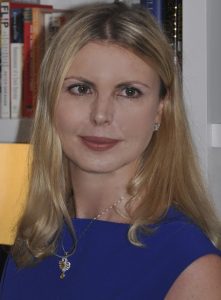
 To be an effective leader, you need to know what you don’t know, says Katina Stefanova, CEO and CIO of Marto Capital. “When we go to college, the educational system teaches us to know the right answer to any question, but the ability to adapt and accomplish results comes from knowing what we need to learn. We need to focus our time on what we don’t know and don’t see, which is an incredibly important quality for any leadership position.”
Creating Success in the Financial Services Industry
Originally from Bulgaria, Stefanova came to the United States at the age of 18 with a one-way ticket purchased by her Grandfather and $200 in her pocket. From that, she built a career that eventually led to becoming founder and CEO of Marto Capital, an emerging multi-strategy asset manager.
After arriving in America, she attended Brigham Young University as an undergraduate then entered the finance and technology field. “I was in the right place at the right time, on the West Coast during the dot-com boom,” she says.
She began her career in Arthur Andersen’s M&A division, then worked for AdRelevance, where she led international business development for this media startup (which was eventually sold to MediaMetrix). Following the sale, she moved to London to become Director in IBM’s Business Strategy team in the EMEA region.
When she returned to the United States, she switched to the asset management industry, earning her master’s degree from Harvard Business School and joining Bridgewater, where she spent nearly 10 years in investment and senior management roles as the company rapidly grew.
Along the way, Stefanova’s most profound learning experience has been working with amazing mentors during the most formative parts of her career, including Bridgewater’s Co-CEO Eileen Murray and Founder Ray Dalio.
Introducing A New Paradigm With Her Firm
Two years ago, Stefanova left Bridgewater to start her current firm, which is on the vanguard of the alternative asset management industry. She considers her work building Marto Capital, as not just a “job,” but a calling. “If my team and I do it right, it will be great for investors and the industry.” And she adds, “This a tough industry, but I want what I do today to be meaningful not only to me, but to my daughter.”
The industry was in need of a new way of thinking. She sees a giant misalignment of interests between many alternative asset managers and investors – particularly a lack of transparency and a lack of alignment of economic incentives. This disconnect has led to a culture of mistrust between asset managers and their clients. Katina’s goal is to rebuild that sense of trust through its solutions and business model.
“Historically, when you consider successful asset management firms and financial institutions, you think of optimizing for financial capital,” she points out. But at Marto, they add social capital into the equation. Through that prism, they are working to address current problems such as underfunded pension systems by implementing smarter investing for pensioners and retirees.
“Everything else follows if you keep positive social outcomes as your goal,” she says. “We are here to make money for our clients, but we also are focusing on operating with a level of integrity and transparency that allows us to avoid prevalent ethics issues.”
She believes that women are particularly well suited to this model, because of their empathy and ability to look at clients holistically, based on the belief that it is as important to have a positive impact as it is to make money.
Remaking the Industry for Women
The lack of network and support in the industry can be a barrier for women. “The decision makers who manage alternative assets are still white men over the age of 50, and that makes it difficult for those who are not in the group,” she says. “It’s still a cliquish industry and even women with capabilities and experience find that our networks are not at that level.”
Unfortunately, that lack of role models, combined with the reputation of the asset management industry’s insensitive culture, may be one of the reasons that young women she talks to are shying away from the industry.
But she says that’s a mistake. “Collectively, as female leaders in the industry, we need to focus on changing and elevating the culture. Don’t be afraid to enter because it’s a fantastic place where you can have a lot of impact and be a trailblazer.”
And as women like herself rise through the ranks, she sees the immense opportunity for her experienced peers to start businesses and take leadership positions in asset management firms. “It’s crucial that we not take ourselves out of the game, even though it’s difficult, because it’s worth it when we succeed.”
She believes that this generation is the one who can make the difference, given their critical mass: If women assume more leadership roles over the next five or 10 years, it will help make up for the way the industry has historically lagged behind others in the presence of women in leadership positions.
Altruistic Endeavors Outside of Work
With two children, ages 13 and six, Stefanova aims to combine work and home life for optimum fit. But that doesn’t mean that she doesn’t continue her trailblazing efforts, even outside of work.
Stefanova sits on the board of technology startups that are relevant to the asset management space and acts as an angel investor in tech firms.
She also maintains board positions with three important organizations: Women Sphere, which helps support women in STEM fields; One Heart Bulgaria, which works with orphans and children who are less privileged in her home country; and Aspire, which helps prepare high school and college students around the country for the work world.

Voice of Experience: Hannah Grove, Chief Marketing Officer, State Street
LGBT celebration, Voices of ExperienceWith roots aligned in marketing, public relations and communications, Grove has worked across Europe and America, first for smaller entrepreneurial companies and for the past 17 years in the global marketing group of State Street. While there, she is proud that she has helped evolve the marketing organization from a service function to one that is more proactive and integral to the company’s success.
“Our service is inextricably linked to business success, so we have developed this into a strategic function that’s deeply embedded in the client experience. It’s an achievement that we’ve built over time, through an amazing team. One of my secrets to success is hiring people who are better than me.”
One of the key strategies she has helped implement is an effective social media platform, an important tool that allows a company to engage in two-way dialogue and offers the ability to listen and customize messages by audience. “Corporate speak is vanishing, as there’s a push toward personalization, relevance and context. It’s a more viral, authentic approach and has tremendous possibilities, even in a B2B setting,” she says, adding that the team’s motto is getting the right content to the right person at the right time.
At the same time, there’s no denying that transparency can be overwhelming in the complicated and complex financial services industry, and yet focusing on openness and education can go a long way toward restoring the reputation of the industry at large.
Speak Up to Move Up
Reflecting on her career, Grove says she wishes she had known earlier that it’s ok to say “no.” She believes that women fall into the trap of wanting to take on everything to prove themselves and while it can be a good instinct, you have to put yourself on a “budget” or else you will easily become overwhelmed by a “go-to” reputation.
She also urges women to ask questions. There’s no way you can understand everything in the industry – in her experience, questions are a sign of curiosity and engagement, and you should want to surround yourself with people who ask questions and aren’t afraid to disagree with you.
In addition to asking questions, women should be sure that they make their voice heard at meetings. “Don’t ever be at a meeting where you don’t have a speaking role; I’ve never seen a man sit silently at a meeting,” she says. Even if your role at a meeting is to be an observer as a learning experience, she says there is always still a way to contribute, whether you’re asking a question or making a comment.
Finally, the advice to speak up extends to speaking up about your career. “I can’t tell you how many times women have come to me because their career isn’t moving as they’d like – maybe they’ve been overlooked for a promotion or don’t feel they are receiving a salary commensurate with their contributions. But when I query whether they have asked for what they want, nine times out of 10 they haven’t, and people aren’t telepathic,” she says. “And if you don’t get what you think you deserve, often you start resenting it and you quit in your mind. The reality though is that you’ve done that to yourself; you haven’t had it done to you.”
Championing Inclusion and Diversity as Corporate Values
Grove is part of State Street’s “Leading Women,” a group of 14 executive vice presidents who act as both a support network and a business strategy network. As part of their outreach, they are focusing on sponsorship of the next cadre of senior female leaders to help them develop and establish the gravitas, networking and visibility they need to feed into the pipeline. Through those women paying it forward, they expect they will touch 2,500 women across the country.
The company also has a global Professional Women’s Network with a dozen chapters that focus on networking, personal brand, public speaking and other professional skills.
For more than five years, Grove has acted as the executive sponsor for State Street Pride and Friends, the company’s LGBT employee network, which has seven chapters globally. Grove has been named to the OUTstanding LGBT Leading Ally Executives list, by OUTstanding in collaboration with the Financial Times. The lists recognize business leaders who are outspoken and unwavering in their support for LGBT people in the workplace and professionals who go above and beyond their day jobs to improve the working environment for LGBT employees.
“State Street has a real commitment to diversity and inclusion that manifests itself from our CEO on down; it’s not just a check box acitivity,” she says, as evidenced by the fact that the company earned a perfect 100% on the 2016 Corporate Equality Index (CEI), a national benchmarking survey and report on corporate policies and practices related to LGBT workplace equality, administered by the Human Rights Campaign Foundation.
Giving Back
Grove, who has been married 23 years, has a high school senior and loves to travel with her family. She is also active in Women’s Lunch Place, a day shelter for women and children in Boston that strives to give women back their dignity, serving 200 guests a day.
As president of the board, she and her daughter volunteer every second Saturday. “It’s amazing how much poverty is in our cities which is why I am passionate about this cause. If you ever think you have a bad day, it really puts your life in perspective.”
Save
Is it good or bad for your career to change your name?
Career Advice, Work-LifeKeeping it private
Hyphenating it
Embracing it
Resilience: Why “Storms” Are Critical to Leadership Development
Career Advice, LeadershipResilience is important. The late Elizabeth Edwards, American attorney and health care activist once said: “Resilience is accepting your new reality, even if it’s less good than the one you had before.” In today’s world of relentless innovation, changing business models, increasing expectations from the workforce, and market surprises, accepting our new and evolving realities through resilience building is now more important than ever.
In a 2014 report by Sarah Bond and Dr. Gillian Shapiro, 99.9% of the respondents said that resilience was “important” to their career success with 56% saying it was “essential”. A separate survey over 520 executives across 20 countries found that 71% of them rated resilience as “extremely important in determining who to retain”. Yet resilience is hard; there is no recipe or quick fix to building resilience. While numerous surveys have found that resilience is a common trait amongst some of the most effective leaders – not just in business but education, politics and other fields – there is no simple handbook to guide aspiring leaders around how to develop resilience. Bond and Shapiro found that only 10% of their research participants felt that their organisations placed enough emphasis on resilience being a differentiating factor in career success. For business leaders looking to identify and develop talent this is important; future leaders who are able to deal with surprises and setbacks, learn key lessons and readjust in a dynamic landscape are more likely to lead effectively and ensure business success.
Women: the (slight) resilience edge
Bond and Shapiro set out to understand if there were any differences between the way man and women view resilience. Surprisingly, they found little difference; 62% of men said they wanted to be more resilient compared to 71% of women. Across both groups, 53% saw themselves as resilient “all or almost all of the time” in their workplace. This subtle difference is supported by the findings of the aforementioned Accenture survey; the leaders identified women as slightly more resilient with 53% reporting women to “very to extremely resilient” compared to 51% identifying men in this category.
While the report didn’t identify significant differences in how resilience is viewed, the researchers found that women were seen to be doing more to support their female colleagues in developing their resilience through specific programmes that broaden and enhance the roles and projects they are assigned, and preparing them for more senior positions. This is encouraging news given the recalibration of gender representation required at most organisations.
The resilient leader
So if both men and women want to become more resilient and better leaders, and women are actively supporting other women to become more resilient, why is it so hard for organisations to develop more resilient leaders?
This year’s Roffey Park report found that organisations need to focus more on “talent preparedness” – investing in a combination of formal and experiential development to address the leadership capability deficit. Aspiring leaders too, many of whom are millennials now, are looking for opportunities to become the best leaders they can be yet organisations are falling short of their expectations around development opportunities. According to a recent Deloitte survey, 63% of millennials believe that their leadership skills “are not being fully developed”.
It’s time for organisations and today’s leaders to act on this insight. Crises come and go, and understanding that the skills required to whether the storms are not just essential to future survival of organisations but also critical to personal development. The life coach and author Tony Robbins describes great leaders as those who “inspire themselves and others to do, be, give and become more than they ever thought possible.” We can all point to leaders who aren’t just good but great; they continue to lead and inspire despite the challenges thrown at them and seem able to bounce back even when it seems impossible.
Building up the resilience bank
The good news is that resilience is “learnable”.Steven Snyder’s HBR article highlights why it is so important to get it right and how others have done so in the past by maintaining a positive outlook, accepting that learning through challenging situations is part of the journey, and acknowledging that it will be difficult.
While there’s no handbook with all the answers, there are a few steps aspiring leaders can take to start building up their resilience bank.
Engage with resilient leaders: Business leaders have good reason to focus on resilience when designing leadership development programmes but also by encouraging senior leaders to share their war stories – the experiences and day to day challenges which help them build up their resilience. Of course aspiring leaders also have a proactive role to play in identifying and engaging with those leaders that inspire them to understand how they too can expose themselves to key developmental opportunities.
Practice mindful resilience: Managing challenging situations and demonstrating resilience requires a strong sense of self awareness and mental control. As Harvard Business School professor Bill George reaffirmed through his interview with the Dalai Lama, practicing mindfulness is a key part of building resilience. Some military schools have developed training programmes which focus on resilience building through mental strength exercises.
Be open to learning (and vulnerability): The founders of Global Health Corps (GHC), a non-profit organisation, wrote in last year’s Stanford Social Innovation Review about the importance of creating “vulnerable community” in building resilience – a community in which programme participants felt able to open up to their peers which facilitated the learning process. As for results, “85% of GHC alumni report that their fellowship experience improved their resiliency skills”.
Pick yourself up, dust yourself down, and keep going.
Career storms – the difficult project, the challenging market environment, the missed promotion – tend to come when we least expect them, so being able to see beyond the immediate challenge is key. It is how you choose to react to these situations that define your long term career success. Persistence and a continued commitment to learning means that we are better able to deal with these surprises.
In the words of one of the best known leaders – Martin Luther King Jr. – “the ultimate measure of a man is not where he stands in moments of comfort and convenience, but where he stands at times of challenge and controversy.” It is our ability to bounce back from challenges and obstacles that will determine the extent of our success.The next generation of leaders deserve the chance to build their resilience and becoming more inspiring and effective leaders for future leaders.
How do you become an inclusive manager? Create Psychological Safety for your Team
Career Advice, Career Tip of the Week!So, let people talk, let them tell you about their lives and let them flow. For some of us (I know I am guilty of this) like to stay on task and to draw boundaries around topics when digression and tangents feel out of control, but maybe, just maybe try out this way of being in your next meeting.
By Nicki Gilmour, Executive Coach and Organizational Psychologist.
Contact nicki@theglasshammer.com if you would like to hire a coach to help you navigate your career
Voice of Experience: Bettina Huser, Executive Director, UBS Geneva
Voices of ExperienceBuilding a Career in Banking
Huser began her career studying law but decided to go another direction and joined a graduate banking program where she simultaneously began working in wealth management as an assistant to a private banker. There she learned a great deal about the business and client service, which paved the way for her to spend her career in the sector in different positions, including discretionary portfolio management and advisory services in various financial companies. She has currently been at UBS for five years as an investment advisor for UHNW customers of the Near East region.
This career path is very fulfilling to her, as she enjoys the close relationships she builds with customers — giving them advice, following markets and staying well informed about what’s happening in politics and the economy, which allows her to make wise investment decisions.
Ongoing changes in the industry have led to new regulations that require constant attention. “My challenge is to stay ahead of those developments in an environment that is more and more complex for investing also.”
However, she knows that adapting to these changes is a necessary element of success; in fact, she advises young women that the most important thing to do to build your career is be open to what is new, from new people to new ways of working. “You have to be comfortable with the unexpected.”
Overcoming the Balance Challenge
Over the years, Huser has found that the challenges of being a woman in a male-dominated field are not related to the work itself but rather the environment and expectations. While she has never felt that she was treated differently than men in work-related matters, she acknowledges it is challenging to find success in your professional and personal life simultaneously.
The job requires long hours, which means many women have to choose if they want to have a career or family because it is hard to have both. “You are expected to work hard, of course, and if something comes up you need to stay late at night, which can be difficult if you have a family,” Huser says, noting that many of her male colleagues have a wife at home, which allows them to travel and be present with clients in a way that can be more challenging for women.
She finds that although every woman experiences different challenges and pursues a different lifestyle, she has learned that sometimes you have to work even more than the men do to be considered for promotions.
In fact, balancing that demanding work with raising a daughter is the professional achievement she is most proud of – demonstrating that as a woman you don’t have to choose between a professional career and a family but can successfully do both.
Huser has enjoyed raising her 17-year-old daughter and appreciates that she will grow up in a world where she can pursue any dream she has. In addition to her ongoing balance of home and work life, Huser also takes time to travel and read and is interested in causes related to the environment and animal protection.
Voice of Experience: Katina Stefanova, CEO & CIO, Marto Capital
Voices of ExperienceCreating Success in the Financial Services Industry
Originally from Bulgaria, Stefanova came to the United States at the age of 18 with a one-way ticket purchased by her Grandfather and $200 in her pocket. From that, she built a career that eventually led to becoming founder and CEO of Marto Capital, an emerging multi-strategy asset manager.
After arriving in America, she attended Brigham Young University as an undergraduate then entered the finance and technology field. “I was in the right place at the right time, on the West Coast during the dot-com boom,” she says.
She began her career in Arthur Andersen’s M&A division, then worked for AdRelevance, where she led international business development for this media startup (which was eventually sold to MediaMetrix). Following the sale, she moved to London to become Director in IBM’s Business Strategy team in the EMEA region.
When she returned to the United States, she switched to the asset management industry, earning her master’s degree from Harvard Business School and joining Bridgewater, where she spent nearly 10 years in investment and senior management roles as the company rapidly grew.
Along the way, Stefanova’s most profound learning experience has been working with amazing mentors during the most formative parts of her career, including Bridgewater’s Co-CEO Eileen Murray and Founder Ray Dalio.
Introducing A New Paradigm With Her Firm
Two years ago, Stefanova left Bridgewater to start her current firm, which is on the vanguard of the alternative asset management industry. She considers her work building Marto Capital, as not just a “job,” but a calling. “If my team and I do it right, it will be great for investors and the industry.” And she adds, “This a tough industry, but I want what I do today to be meaningful not only to me, but to my daughter.”
The industry was in need of a new way of thinking. She sees a giant misalignment of interests between many alternative asset managers and investors – particularly a lack of transparency and a lack of alignment of economic incentives. This disconnect has led to a culture of mistrust between asset managers and their clients. Katina’s goal is to rebuild that sense of trust through its solutions and business model.
“Historically, when you consider successful asset management firms and financial institutions, you think of optimizing for financial capital,” she points out. But at Marto, they add social capital into the equation. Through that prism, they are working to address current problems such as underfunded pension systems by implementing smarter investing for pensioners and retirees.
“Everything else follows if you keep positive social outcomes as your goal,” she says. “We are here to make money for our clients, but we also are focusing on operating with a level of integrity and transparency that allows us to avoid prevalent ethics issues.”
She believes that women are particularly well suited to this model, because of their empathy and ability to look at clients holistically, based on the belief that it is as important to have a positive impact as it is to make money.
Remaking the Industry for Women
The lack of network and support in the industry can be a barrier for women. “The decision makers who manage alternative assets are still white men over the age of 50, and that makes it difficult for those who are not in the group,” she says. “It’s still a cliquish industry and even women with capabilities and experience find that our networks are not at that level.”
Unfortunately, that lack of role models, combined with the reputation of the asset management industry’s insensitive culture, may be one of the reasons that young women she talks to are shying away from the industry.
But she says that’s a mistake. “Collectively, as female leaders in the industry, we need to focus on changing and elevating the culture. Don’t be afraid to enter because it’s a fantastic place where you can have a lot of impact and be a trailblazer.”
And as women like herself rise through the ranks, she sees the immense opportunity for her experienced peers to start businesses and take leadership positions in asset management firms. “It’s crucial that we not take ourselves out of the game, even though it’s difficult, because it’s worth it when we succeed.”
She believes that this generation is the one who can make the difference, given their critical mass: If women assume more leadership roles over the next five or 10 years, it will help make up for the way the industry has historically lagged behind others in the presence of women in leadership positions.
Altruistic Endeavors Outside of Work
With two children, ages 13 and six, Stefanova aims to combine work and home life for optimum fit. But that doesn’t mean that she doesn’t continue her trailblazing efforts, even outside of work.
Stefanova sits on the board of technology startups that are relevant to the asset management space and acts as an angel investor in tech firms.
She also maintains board positions with three important organizations: Women Sphere, which helps support women in STEM fields; One Heart Bulgaria, which works with orphans and children who are less privileged in her home country; and Aspire, which helps prepare high school and college students around the country for the work world.
Lean into Confidence
Career Advice, Next LevelAnd it shows. Women hold more than 50 percent of college degrees and more than 40 percent of MBAs, according to the KPMG Women’s Leadership Study, but less than 5 percent of Fortune 500 companies have female CEOs. Somewhere in the stretch between college and high-level positions, women get lost.
Young women enter the workplace full of confidence, with 43 percent aspiring to top manager roles. However, after a mere two years on the job, these levels drop to below 25 percent. There’s something that happens after women enter the workforce that steals away their enthusiasm.
It may be easy to say, “Yes, but women take a long break mid-career to have children.” Trust me – I have 3 kids, ages 4-8, and am compassionate for the unique type of stress working mothers face. Did having children require me to push pause on my career?Absolutely not.Does being an executive make me a better mother?For me, it does. My career completes me and sets a wonderful example of a strong woman for my three young boys.Recently, Marissa Mayer announced that she would not be taking a full maternity leave.I applaud her for being confident enough in herself to make that decision under intense public scrutiny.I have no doubt that her children are cared for and loved, and I am certain that her girls will grow up to be incredibly proud of the strong, female leader they get to call mom.
Leaders are created at a young age, and young girls aren’t encouraged to lead the same way that boys are. The “ban bossy” movement has been targeting this social phenomenon by giving parents the tools they need to embolden their daughters.
Of course, that’s all great for the women of the future, but what about us? What about those of us in the workforce striving to become CEOs of our own companies? We can’t wait around for the next generation to change what we want changed for ourselves.
If you feel as though you’re being held back in your career by a lack of self-confidence, do the following three things:
1. Define Your Own Success
Not everyone wants to be CEO of a Fortune 500 company. That’s ok. Maybe you want to grow your own company, or run a nonprofit, or be a mentor. It is important to define your own success early on in your career. Following a path predetermined by society will only make you unhappy in the long run. Really spend time thinking about your long-term goals.
This will ultimately make big decisions easier further on in your career. When you’re offered a new position, or you take on a new job, you can measure it against your long-term career goals and decide if it’s helping you move in the right direction.I was recently asked to run for Congress, and, as attractive as that may sound, it wasn’t compatible with my career goals.Not only did that make turning down that opportunity easier, it made me more self-assured in my decision.
2. Support Other Women
Women get a bad rap for not supporting other women. We’re sometimes envious of the way men can bond and connect in a way that women feel they can’t – we call it the “boy’s club.”
In reality, things aren’t actually as far off for women. Columbia Business School conducted a study and found that the “Queen Bee Syndrome,” in which women in power are more critical of female subordinates, is actually a myth.
Women do have a strong network that’s just as good as any boy’s club. Spend time cultivating your relationships, and support the women around you.
3. Stay Hungry
The best way to boost your own confidence is to excel at what you do. Never settle for just completing a task when you can blow it out of the water. Take on projects that are outside your comfort zone, and constantly work toward making yourself better.
Society is changing for the next generation, but you have to make change happen for you. Work at being self-confident, and others will be confident in you too.
By Melissa Beck
4 Reasons to get involved in your women’s network (or other Employee Resource Group at work)
Career Advice, Career Tip of the Week!This week I am going to outline what you should do in your network (and why you should join it)
More on this all summer long.
Voice of Experience: Nili Gilbert, Co-Founder & Portfolio Manager at Matarin Capital Management
Voices of Experience“My best advice is that women should appreciate the benefit of taking measured risks, those you can understand and manage,” says Nili Gilbert, co-founder and portfolio manager at Matarin Capital Management, citing starting the firm as one of those measured risks.
“You have to believe in yourself to ensure that you don’t shrink in the face of challenges,” she says, adding that the goal isn’t to look for the course without them, but instead to rally and meet them.
Innovating in the Financial Industry
Gilbert’s interest in financial markets dates back to when she was a young girl in Switzerland and was curious about the different currency markets she encountered while traveling. She designed her own related field of study while attending Harvard, earned her MBA from Columbia Business School by age 24 and joined Invesco.
There she met the team with whom she’s been working ever since. They founded Matarin Capital Management in 2010, taking pride in the fact that at that time they’d been together for almost a decade, managing more than $25 billion as a team at Invesco.
“Our team has always operated under the investment philosophy that human emotions drive markets, and so our strategy to make money is to trade on the dislocations that these emotions create and to deliver our clients a more stable return,” she says.
Cofounding and helping build Matarin is the professional achivevement she’s most proud of and one that reflects her initial career inclinations. Gilbert wrote in her business school application that she dreamed of one day founding a financial services company. “I said that I hoped to create a company that would help shape values in the industry and so starting Matarin was a seminal moment,” she says.
The firm was established based on values and a longer-term view. “We realized there are thousands of asset managers out there, and the world doesn’t need just another hedge fund. That’s why we set out to build something that is different and that has purpose, something that would be an enduring business.”
The firm is continuously engaged in a variety of research projects to support its investment strategies. Some of the research that Gilbert is most engaged with at this time includes a review of valuation as a market timing tool. She notes that it’s tricky to use valuation to determine the future direction of the S&P, for example, because the market index can stay overvalued for a long time before it corrects.
A second project the firm is undergoing is a consideration of how the advent of negative interest rates may change basic assumptions about how macroeconomics work, as they look at a combination of theoretical viewpoints and historical observations.
Winning as A Team
Gilbert says that one thing she’s learned over time is that success doesn’t come from individual contributions, but rather from a strong team as a whole. She says their team sets goals as a group and achieves as a group which is why the people you team up with are so critical to your career.
Since all five of the principals at Matarin have previously been senior professionals at large, well-respected firms, they know that there can be a better way to work, away from the typical silos. In that setting, portfolio managers only have control over their returns but that’s not the sole factor affecting client well-being. She appreciates that the firm’s approach gives them the ability to control what strategies are appropriate, what fees should be, how to manage communications and when to close funds that have reached capacity.
“There are some very technical questions in the industry that for us start at the core with conversations about values,” she says, adding that while some cultures are focused on asset accrual, Matarin chooses to set goals in terms of dollars of added value generated for clients over time.
Making the Industry Positive for Women
The industry will benefit when women see more women like themselves in it, which will show them the path to success, she believes. That’s why Matarin tries to stay visible with its principals acting as mentors and speaking at conferences, including involvement in “100 Women in Hedge Funds.”
Since the portfolio management space is such a performance-oriented business, it can be quite meritocratic, which makes it an excellent career for women. “Investment performance can be a great equalizer. Women who deliver strong returns can have long and fruitful careers in the industry,” she says. “Because of the emphasis on performance, women should be attracted to the industry as a place they can excel.”
She says that diversity as a whole is important for any business, and her firm supports diversity in skill sets, gender, culture and backgrounds. She emphasizes that they hire based on merit but never before they’ve considered a diverse pool of potential candidates.
“If you have a good mix of viewpoints around the table, you can embark on a professional debate that puts your ideas in the best form so you can test and vet them from different perspectives.”
Work and Home Combine for a Positive Life View
Gilbert serves as a member of the board of directors and chairs the finance and investment board for the Synergos Institute, an international development organization focused on poverty alleviation. She says the group identifies breakdowns in the system which cause or perpetuate poverty, and helps to implement leadership initiatives and structural changes to repair them.
An avid traveler, she and her husband just returned from their honeymoon in French Polynesia.
Gilbert says her ability to work hard comes because of one belief. “When you do something you love, it helps you build resilience to make it through the hard days, and it makes the good days better, too.”
Mover & Shaker: Teresa Burrows, Director, Program Manager, TIAA
Movers and ShakersThe Path to TIAA
Burrows is no stranger to change. After graduating from the University of Pennsylvania where she studied economics, Burrows took a different path from her educational background and went to work for Andersen Consulting as a consultant where she was in a variety of roles from software developer to business analyst. Building upon the experience she had at Andersen, Burrows next became a business analyst in the Information Services division of Putnam Investments. After encouragement from her manager to expand and change her role, Burrows soon moved into project management and program delivery, ultimately leading the technology strategy and delivery for International and Institutional Defined Benefit systems.
In 2005, a former manager presented Burrows with the opportunity to relocate to Charlotte NC to come to TIAA and work with her doing IT program delivery. Since joining, she has helped implement numerous technology initiatives for the Institutional business before landing in her current role as a technology program manager in TIAA‘s new Digital organization. She appreciates the challenging, fast-paced, fluid environment. Burrows is proud of the team that she’s assembled, and their ability to adjust to constantly changing priorities and needs. “It is gratifying that I can inspire and motivate them to deliver great work,” she says.
Right now, she’s excited about a recent organizational change that gives the team an opportunity to take on exciting, new projects in different business areas. “I’m excited to transfer the knowledge that we’ve gained from working on the institutional side of the business to the individual/retail side, while forming relationships with my new partners,” Burrows shares.
Role Models Teach Lessons Along the Way
Growing up, Burrows emulated the hard work ethic of her parents, both of whom were Chinese immigrants and successful entrepreneurs. When she started her career, Burrows assumed that keeping her head down and working long hours would foster success, but she’s since found that working “smart” by using the right tools and working collaboratively within a team is more fruitful.
Along the way, Burrows says she benefited from informal mentors, both peers and managers, even some of whom weren’t her own. They offered advice or perspective and helped her advocate for herself while serving as admirable, empathic and honorable role models. “The best manager that I ever had took the time to understand me, my career aspirations, the team and the business, and those are the qualities I try to portray,” she reflects.
She also knows that it’s important to learn from less-desirable situations, noting a time earlier in her career when issues arose on a key project. Rather than communicate their troubles and asking for help, the project leader was instead only concerned with how that would look. As a result, there were fairly significant issues with the delivery of the project. The situation showed her that when there are problems, you have to ask for help. “When you are transparent and open with your business partners, people can put their heads together to form a solution,” she says, noting that your client is likely to respect that strategy and step in and try to be part of the solution.
She says her success over the years has come from strong relationships she’s built with her team, peers and clients, both external and internal. “You can build the relationships you need to be successful by establishing a culture of respect, truly listening to people, offering empathy, following through on actions and being transparent and honest when there are issues or problems,” she says.
Tackling Gender Issues
Although the financial services industry, and in particular IT, are largely male dominated, Burrows has found her path to be largely unencumbered by gender stereotypes. In fact, one surprising situation she remembers occurred during a project she undertook when she was with Putnam. A Japanese partner firm wanted to build a website to provide investment portfolio account information. “While there were a surprising number of gender and cultural considerations that could have impeded on the project’s success, we were able to take these into account and ultimately it went really well,” she says.
At TIAA, she is an active member of the Women’s Employee Resource Group. She appreciates it as a valuable resource for its webinars and events, but particularly because of the networking opportunities that help her connect with women with whom she may not otherwise cross paths.
Life Outside Work
With two sons, ages 13 and 15, Burrows leads an active lifestyle. The family loves to travel and hike and tries to visit a national park each summer, with an upcoming trip to her home state of Massachusetts planned.