By Nicki Gilmour, CEO and Founder of theglasshammer.com
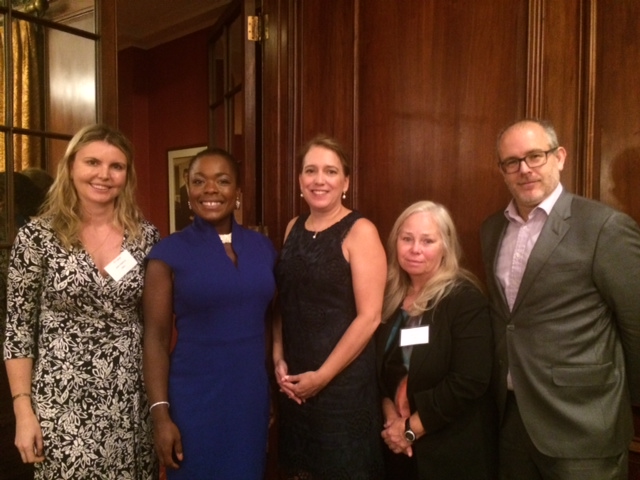
Theglasshammer convened 100 senior women from traditional and alternative investment management companies last Wednesday 1st June 2016 for the 8th Annual Top Women on the Buyside breakfast panel and networking event. Nicki Gilmour CEO and Founder of theglasshammer.com opened the session with a welcome and an urge for the audience to continue to be change leaders for a culture of trust in their firms and beyond so that the industry can continue to attract women as investors and as participants.
The panel consisted of Judy Posnikoff, Managing Director of Paamco, Donna Parisi, Partner and Co-leader of the Asset Management Group, Shearman and Sterling, Nili Gilbert, Co-Founder of Matarin Capital Management, and Katina Stefanova, CEO and CIO of Marto Capital. Antony Currie, Associate Editor of Thomson Reuters Breaking Views moderated the discussion with candid questions that the panel answered with deep expertise to the peer audience as well as a sprinkling of humor at times.
Themes this year included disruption and innovation as drivers of results with the obvious challenges this year being the risk management of political, economic, credit and operational risk issues in this US election year.
It was agreed that volatility is high, uncertainty a constant and alpha diminished with a backdrop of limited historical data on how to invest in an environment of low interest rates. It was also agreed that all types of disruption, good and bad, was rife with developed countries still trying to ignite their economies post credit crisis. Risk would definitely dominate the short and medium term thoughts of investors. Fintech was also mentioned as an important element of future innovation in the industry without real precedents and an uncertain regulatory environment.
Katina Stefanova began with an overview of the macro environment and framed some issues,
“We deal with political, social and economic risks when assessing investments and this year is a unique year as we are at a pivotal point .We live in a world with over $200 trillion dollars of debt and with such uncertainty, it is not surprising that there is political volatility and that becomes a big issue for markets not just for investing but also for people building businesses. There has been a huge amount of disillusionment with traditional investment strategies, and other popular strategies such as risk parity in last few years. Volatility is here to stay and so it’s about figuring out how to navigate volatility and building that into your application.
It is time to develop alternative solutions.”
Judy Posnikoff concurred with the increased volatility issue stating
“The environment is quite different from 30 years ago when investors could achieve high enough returns with one asset class (fixed income). One of the difficulties of today’s uncertainty and meager expected rates of return is that institutions and individuals are having to take on more risk than they would like to in order to meet financing requirements such as pension liabilities.”
Nili Gilbert commented on unusual nature of the current macro environment stating,
“Negative interest rates and deflationary environments should be something that is taken seriously and it is hard to be informed by history on this. Due to a lack of comparable historical precedents, it is necessary to be thoughtful and insightful rather than just look to historical analysis or a purely data driven approach. “
Katina Stefanova agreed that the environment is unprecedented and the biggest risk is that we are at point when monetary policy is no longer effective. She added,
“Central banks have little power to stimulate or slow down economies. It is time for more aggressive fiscal policy and governments are going to have to play a bigger role. “
Donna Parisi picked up this point when asked about the role of regulators and the change of government in November with the moderator questioning could a new President undo the work done by regulators post credit crisis?
Donna commented on the legislative risk that could come from an election cycle,
“I think Dodd Frank is too far down the road, the rules are so deeply embedded regardless of who takes the White House in November and regulators are
not done trying to fix the lack of transparency that exists in the markets.”
Donna also mentioned that from her perspective that upcoming challenges for the industry would be liquidity mismatches and leverage issues.
“Since funds are more and more becoming intermediaries for lending post credit crisis, there are issues around leverage and the role they should play.” She suggested that regulators are worried that asset managers could be the next too big to fail crisis.
“The regulators are still struggling with information gathering despite the huge volume of data that is required to be reported. They don’t feel like they have enough transparent data to adequately assess liquidity and leverage risk and its impact on the broader market.”
Katina joined this point with her comments that regulatory consequences are not always well understood, and in many ways the government has not eliminated risk but rather transferred it to other institutions.
Nili mentioned that changes in the sell side and how it is regulated can ultimately affect stock price movements and have impact for portfolio managers. By way of example, she cited Reg FD (Regulation Fair Disclosure) as an event, which changed how sell-side analysts released communications, and as a result changed the efficacy of “earnings revisions” as a tool for stock price forecasting.
Other topics discussed included opportunities and creating value for the investor such as changing fee structures. Judy and Nili discussed how it was important for investors to have transparency around how much they had to pay in the search for alpha. Nili also shared her philosophy on finding opportunities stating four main concepts as buying fundamentally good businesses, valuation, shareholder friendly management teams and shorter-term catalysts such as price and volume analysis.
“When we were coming out of the financial crisis, it was a great time to be a value investor because in that environment of fear, there were many cheap stocks. Since then, we have seen investors regain their confidence and so it’s not as an attractive a time as before to be a value investor. Momentum investing is an opportunity that we saw do very well in 2015. What works changes all the time and it is crucial to understand behavioral biases in the markets for optimum results.”
Katina concurred, “ We have factors such as technology, a shift in socio-demographics and this economic environment and the current political volatility that creates a great opportunity for disruption. The question is where will that disruption come from? “
Citing Alibaba as an unexpected money management entity that has grown fast. She added, “It is about access, a platform to retail investors will change it all and it will come”.
Donna added that current incumbents in the market had a competitive advantage when it came to FinTech innovation given their regulated status. However, industry incumbents are at a disadvantage when it comes to being true innovators or disrupters. The rising importance of technology in the industry and the scalability of investment strategies as a result create significant risk for something to go wrong and a resulting regulatory response.
With so much to talk about, and with great questions from the audience, the discussion is hopefully continuing in offices across the world as we speak.
Thanks to our panelists and moderator and engaged audience for another great event!

Voice of Experience: Jennifer A. Johnson, Partner & National Leader, Risk Assurance Services, PwC Canada
LGBT celebration, Voices of ExperienceSuccessfully Climbing the Ladder at PwC
As national leader of the Risk Assurance practice in Canada, Johnson oversees about 400 risk professionals across Canada and works with peers across the world. A “lifer” at PwC, she joined the Hartford, CT, office at the age of 22, spending her initial four years largely on the road for client work and enjoying the travel experience. She came out during that time, and decided she wanted to try a bigger city with larger clients, more specialized practices and a more liberal culture. She spent the next six years with PwC US in Boston in the same practice area, ultimately becoming a director.
Her girlfriend at the time, now her wife, Ashleigh, was from Toronto and they moved there due to Ashleigh’s desire to obtain an advanced degree and the fact that gay marriage wasn’t yet recognized nationally in the United States. Johnson took an international transfer in July 2008 as a director and became a partner in 2012, ultimately becoming the national leader Jan. 1, 2016.
Johnson says that is the professional achievement she is most proud of so far, being asked to take on a national leadership role only 17 years out of school and also while juggling a young family at home.
“I’m excited to continue to see the practice evolve as we think strategically and help shape a refreshed vision. My goal is to motivate and drive the entire practice and support the personal growth and achievement of each member,” she says. “Some people are wary of the idea of change, but it drives me.”
Much of that constant change is evident in the dynamic, evolving nature of the spectrum covered by the Risk Assurance practice, helping clients identify, understand and manage risk from regulatory compliance to environmental and technological issues. Her team needs to stay on the forefront.
Setting Yourself Up for Success
Johnson says she always saw herself as a “Type A” personality with a long-term plan, but she now sees that it’s impossible to predict what’s going to come your way and doggedly pursuing a focus means you could end up with blinders on.
“Interesting things that weren’t even on your radar might appear, and you might end up disregarding them if you aren’t open to the possibilities,” she says, citing the opportunity she seized in Toronto. “Moving to another country meant I had to join a new team where I had to re-establish myself and work my way back into a position to be seen as having partnership potential, yet it’s one of the best things I’ve done.”
It can be a challenge for women to step up and take opportunities when they don’t believe they have all the necessary attributes, but that can hold you back.
Earlier in her career, she herself felt that she had demonstrated she was ready for the next promotion even before the traditional time table, but she says that the one step she missed was asking. “I didn’t receive that first promotion and was devastated, but in hindsight I believe I probably should have advocated more and been more vocal.” Even today she reminds her peers to make sure they’re advocating for themselves within the partnership.
She recommends that young women (and men) see themselves as sponges, to take in all the people they meet and models they can emulate. “You will look back and realize that you have learned so much about your career, and yourself personally — what you’re good at and what you’re motivated by and also what you’re not as good at,” she says.
A Welcoming Culture
Johnson appreciates the safe and inclusive environment at PwC. She came out in her second year with the firm to the people with whom she worked closely, which was welcome since she didn’t have the same level of support from her family and friends. “That gave me a lot of self-confidence that has also paid off in the corporate sphere. I am now more likely to voice my opinion, no matter what the subject.”
At PwC, she serves as the executive sponsor of Canada’s GLEE (Gay, Lesbian and Everyone Else) network and is an active champion of HeForShe – UN Women’s movement for gender equality – for which PwC is a founding Impact Champion. She also participates in the PwC Women in Leadership program that supports female professionals who have aspirations to achieve more senior roles within PwC. The group is sponsored by both male and female senior partners, and they also bring in external female professionals to share their experience and perspectives.
A Life Outside of Work
With three kids, including five-year-old fraternal twin daughters Teagan and Quinn, and a 12 week old son, Logan, Johnson appreciates the support of her wife Ashleigh, a nutritionist and stay-at-home parent.
A big believer in finding time for family, career and self; she tries to structure her days so that she begins with some time at the gym for herself, goes to her busy workday, and then arrives home in time to read stories and put the kids to bed.
“You need to know your limits and protect your family and ‘you’ time,” says Johnson.
Save
Save
LGBT Leadership Update: Rising Corporate Activism and Executive Pride
Career Advice, Featured, LGBT celebrationWith June, we turn to Pride Month on the diversity calendar, so let’s focus our spotlight to recent progress on advancing LGBT inclusive business cultures and LGBT executive leadership.
Corporate Activism Defends LGBT Rights
Recently, state law setbacks to the LGBT community (and human rights) have one positive side effect: they’ve led to a collective backlash from companies and employers who have united to defend LGBT rights.
Repeatedly, companies have been asserting to state lawmakers that upholding LGBT rights is a necessary condition for attracting and maintaining the best talent for businesses.
Since North Carolina passed an anti-discrimination law that failed to protect against discrimination based on sexual orientation or gender identity, over 200 business leaders – including CEOs and executives of major companies such as Apple, Bank of America, Citibank, Ernst & Young, Goldman Sachs, Facebook, IBM, Microsoft, and more – have signed an open letter to the state governor calling for a repeal to the “HB 2” law, stating that “such laws are bad for our employees and bad for business”.
Canceled plans by Paypal, Deutsche Bank and performance artists are estimated to have cost the state “tens of millions in dollars of losses”. Meanwhile, companies also joined in activism with an open letter to state leaders in Mississippi to repeal “HB 1523”, which gives individuals or organizations license to discriminate against LGBT people based on religious justification.
In the Harvard Business Review, author Andrew Winston points out that business has been ahead of the public curve when it comes to LGBT rights. Winston notes that over half of Fortune 500 companies were offering domestic partner benefits ten years ago when only 35% of Americans supported gay marriage (and 55% opposed it), and that today corporate adoption of anti-discrimination policies based on gender identity (66% of companies) outpaces public acceptance of transgender rights.
In the case of LGBT rights, Winston argues the moral imperative of non-discrimination in the workplace and the economic motivation to thrive with diverse customers are so understandably linked that business is “pro-actively influencing societal norms.”
LGBT Diversity Associated with Stock Performance
Influencing policy is part of the equation, but building an LGBT-inclusive culture is another thing. When LGBT employees do not feel free to be themselves, when they feel they have to “hide in plain sight”, it’s proven costly not only to employees but to business.
When diversity is celebrated and genuinely fostered, not only individual productivity but company productivity seems to benefit. According to a recent report by Credit Suisse, the stock of companies that exhibit LGBT diversity outperform the stock of companies that do not.
LGBT diversity was factored by companies that have openly LGBT leaders and senior management, are voted as leading LGBT employers, or have many employees in local LGBT business networks.
The LGBT basket of 270 companies outperformed the MSCI ACWI by 3% annually since 2010, as well as outperforming a custom basket of companies in US, Europe and Australia by 1.4% annually.
The correlation of LGBT diversity with performance is important, since according to the report, 72% of senior LGBT executives say they have not come out at work, which is not surprising when it’s still legal to fire someone based on sexual orientation in over twenty states and based on gender identity in over thirty states.
Celebrating LGBT Executive Role Models
Celebrating diversity at the very top, for the first time in the three years since its introduction, a woman topped the 2015 list of the 100 Most Powerful LGBT Executives in the World, named by OUTstanding and the Financial Times.
Inga Beale is the first female CEO of Lloyd’s of London and openly bi-sexual. As she told The Guardian, “It’s not about me. It’s about what you do for other people. For me, it’s so important because you need these role models.”
According to OUTstanding as reported in Entreprenuer, recognition is critical since closeted LGBT employees are 70% more likely to leave a company within the first three years.
The list of LGBT power executives, for which activism outside of the workplace is also taken into account, included several from the finance world, including Accenture’s Sander van‘t Noordende (10), Citi’s Bob Annibale (28), Goldman Sach’s Gavin Wills (36), and PwC’s Andy Woodfield (78) and Mark Gossington (82).
Speaking to the inclusive culture fostered at Accenture, Sander van’t Noordende has said, “Only when people are comfortable in their workplace will they be able to get the best out of themselves,” advising individuals to not only value their difference, but also find a company that values their difference too.
Promoting LGBT C-Suite Leadership
Stanford is also stepping up to encourage aspiring LGBT executives to value their difference. Stanford Graduate School of Business introduced the Stanford LGBT Executive Leadership Program, which will first take place in late July 2016 and is accepting applications until June 24th.
With a focus on fostering authentic and impactful senior LGBT leadership and network building, Stanford states, “This is the only Executive Education program of its kind offered by a leading business school to address the significant gap in leadership for lesbians, gay men, bisexuals, and transgender people in the C-suite.”
According to program co-director Tom Wurster, the one-week training is ideally aimed at “the LGBT executive with a minimum of 10 years professional experience and 5 years of management experience who is preparing to take on more significant leadership roles.”
More visible leadership within more significant leadership roles – out and proud and C-Suite is the call.
Save
Save
Mover and Shaker: Ann Gaboriault, Senior Manager, Accenture Technology
LGBT celebration, Movers and ShakersAnn Gaboriault started as a consultant on Oracle products and quickly specialized in financial systems within the Natural Resources industry, working on different projects across Canada and the U.S., and eventually for two years in Switzerland. When she returned home to Montréal, she took on a new position in Accenture’s Application Outsourcing Practice. “Seven years later, I’m now leading the practice in Montréal, with teams here in Canada, USA, Europe and Asia, currently working on the next generation of Application Outsourcing with few of our global clients. This is an exciting time for us – we’re delivering Application Outsourcing As-a-Service on the Cloud for our clients, helping them become agile, digital businesses.”
When Gaboriault started at Accenture, she believed people pursued short careers in consulting, primarily due to the nature of the work – client services that most times demanded constant travel and the perceived difficulty in finding a work-life balance. “That has proven itself untrue. Over a decade-and-a-half, I’ve realized that needs change over time. Work-life balance is not the same from year to year, but you can always make it work when you have support of leadership that sees your potential.”
Mentoring has been beneficial for Gaboriault who says she’s had different mentors at every stage of her career. “I have a tendency of finding people who are very different than myself, so I get a different perspective on my work and my career path. Mentors have pushed me to do the best I can and to take control of my career. One of my mentors once told me, “Your career can happen to you if you do not take ownership”. Gaboriault has found sponsorship to be very useful specifically when going for a promotion, noting that, “people will sponsor you if they know you and know your work,” and that networking is key to finding the right sponsors.
Finding a balance
Gaboriault believes that “we can have it all, but not all at the same time.” She quickly climbed the ladder to senior manager and then decided a few years ago to pursue, temporarily, a “horizontal career” so she could work locally and concentrate on starting a family. “I thought, my partner can work the crazy hours for a while – she had just started her career as a critical care physician. My goal is to enjoy what I do, grow in what I do, but be home with our toddlers every night.”
As Gaboriault mentions, there are many programs at Accenture that have helped advance her career and spend more time with her family. She notes, “We have a variety of different mentoring programs, learning and professional development courses, training for “High performing women,” flexible work programs. For working parents like myself, we have one year parental leave policy in Canada, which is offered to any parent, and Accenture also offers the opportunity to work locally for one year following return from the birth or adoption of a child.” Gaboriault is on a flexible schedule, currently working around 30 hours a week, which she describes as “a win for myself, my family and my work with clients.”
Taking the lead with the Canada LGBT Employee Resource Group (ERG)
Gaboriault has been involved with the Canada LGBT ERG since its founding in 2007 and strongly believes the ERG is a necessary step toward helping all employees feel comfortable and accepted at work. “Being me 100% of the time, at Accenture but also with my clients, enables me to speak openly about my family and other personal matters. Being out at work has also helped my colleagues and clients feel more comfortable sharing their personal stories, worries, fears, helping our day-to-day business communications feel more human.”
Gaboriault transitioned into leading the ERG when she realized they could have a global impact– helping and encouraging employees from around the world to join the company’s Global LGBT Network, which spans more than 40 countries, and supporting other ERGs in locations where there are unique laws affecting the LGBT community.
“Our goals globally focus on four pillars – training, policies, benefits, and professional development. We train to build awareness and understanding of the LGBT community, create policies to ensure equal treatment of employees regardless of sexual orientation or gender identity and expression, strive to provide benefits that are equal for same-sex and opposite-sex partners, and professionally develop our people to facilitate career growth and encourage networking and mentoring.”
Gaboriault describes the way Accenture is achieving these goals: “Through best-practice programs like our LGBT Ally Program, which allows anyone within Accenture to identify as an advocate for the LGBT community; a dedicated focus on raising awareness and education; and with a strong commitment from leadership to building an inclusive environment.” According to Gaboriault, having support from leadership is crucial. “I think it’s very encouraging when our senior leaders who are LGBT are also out themselves. They’re role models that help us envision ourselves reaching new heights in our careers.”
A strong commitment to inclusion & diversity
Having a diverse workforce of people with different capabilities, cultures, perspectives, abilities and experiences is inherent to the unique way Accenture operates. “Our workforce is a reflection of the clients we serve and our local communities. A commitment to inclusion & diversity is simply how we do things,” says Gaboriault. For Accenture, this commitment is an integral part of living by the company’s core values. “In essence, it’s what makes us “greater than” in all that we do.”
Time with the family
Outside of work, Gaboriault is an avid skier. “I ski thirty plus days per year, great exercise and your mind is off work when going down the slopes at 40km/hour, though I now spend hours on the magic carpet with the kids.”
Save
Things to Negotiate for….Besides More Money
Career Advice, Managing ChangeBe Bold
Sheryl Sandberg discusses many of these points in her book, “Lean In: Women, Work and the Will to Lead.” Don’t be afraid to go to the table knowing what you want for the future of your career. Take charge, as Sheryl writes:
“Taking initiative pays off. It is hard to visualize someone as a leader if she is always waiting to be told what to do.”
That doesn’t mean you should storm through the office door and make outrageous demands, expecting them to be met instantly. Approach the situation with the right information and engage in tactful and professional discussion. Not sure exactly what that means or what those negotiations should entail? Here are six topics to keep in mind, and how you should approach them.
1. Flex Time
In the modern workplace, there are actually more people than you think working outside of the office with more flexible, nontraditional schedules. In a 2013 survey by the research group Catalyst, four out of every five respondents holding graduate-level degrees said they had some kind of work flexibility with their employer – that’s a whopping 81 percent.
In order to secure that type of perk at your next position, you’ve got to go in knowing exactly what you want from the flex time – both the when and the why. Your employer is going to be more keen to accept this stipulation if you have a detailed plan heading into negotiations. Be sure that you’ve cross-referenced any existing flex-time policy with the HR department to cover all your bases.
2. Professional and Personal Development
Make sure your future employer knows about your interest in professional and personal development. Continuing to learn and grow in your chosen profession keeps your skills innovative and creative, which will enrich the working environment for those around you as well. In fact, this type of incentive is among one of the most sought-after additions to an employment package by millennials. Consider asking about family friendly programs that encourage a work/life-balance, one of the most important points for Gen Xers.
3. Promotions
If you find yourself facing your annual review, consider your promotion options. Don’t be afraid to demonstrate how you’ve added value to the company, and why you should be considered for compensation.
Of course this doesn’t just magically happen one day by telling your boss you’re a rock star and should be paid accordingly. You need to work on cultivating a relationship and proving you are a valuable member of the company – these real bosses will give it to you straight.
In fact, a study done by Accenture in 2011 found that 85 percent of employees out of the 3,400 companies it surveyed got something – whether a large increase in salary to some kind of other incentive – simply by asking for a raise.
4. Maternity/Paternity Leave
Unfortunately, this is still an issue. In all the developed nations of the world, the U.S. is currently the only one that does not offer federally mandated parent leave. In OECD’s 2014 family database document, America literally has 0s across the board. You are not guaranteed anything.
Luckily most companies that want to retain talented staff recognize the importance of maternity/paternity leave. You could piggy-back your discussion concerning flex-time as well, and increase your chances of extending time at home with your new addition.
5. Vacation Time
Other than maternity leave, vacation time is also extremely important. Again in the U.S., the average employee has less vacation time than most other advanced economies in the world. Typically, a worker is only entitled to 10 days of paid vacation and six holidays, but even these are not guaranteed – quite different than the 30 days in France or 20 in New Zealand.
As you well know, this is where your bargaining power and value to the company can come in handy to secure more than the 10 days. Use tact, and also offer solutions for the time you are requesting to be away For example, tell your boss “I’ll be out of the office, but regularly checking my emails.
It’s important that you take advantage of complete time away from the office for a recharge. You’ll be more of an asset to your company when you return re-energized and refreshed.
6. Big Project Participation
If you really want to put yourself out there and be bold, ask to swim in the deep water, rub shoulders with the executives and request to work on the interesting projects that are happening in your company. This will help you get noticed, and you can also take the opportunity to cultivate mentoring relationships at the leadership and management level.
By Sarah Landrum
Making sure you are in the running for a promotion
Career Advice, Career Tip of the Week!I can think of three ways to heighten your chances
Here is the kicker. I have done several consulting projects with women’s networks and I even wrote a Masters thesis at Columbia University on how networks can be formally connected to the talent process (sadly, often they are not related to a direct promotional path and interestingly this if often due to the resistance of the women inside the network-which in part is often due to the reason the network exists is to provide a container for shared experiences). So, if you want your membership of a network to be part of your strategy to advance, then make sure it is doing that and ways to tangibly use it include access to senior management, find a sponsor and more that we have covered in the past 4-5 weeks in this column.
By Nicki Gilmour, Executive Coach and Organizational Psychologist
Contact nicki@theglasshammer.com if you would like to hire a coach to help you navigate your career
Voice of Experience: Julie Silverman, Managing Director, Goldman Sachs
LGBT celebration, Voices of Experience“When each person comes out, there’s a meaningful trickle-down effect to everyone around them,” she says. “I come out every day in regular conversation. I talk about my wife and have pictures of my kids all over my office. For me, my identity is very public, and it’s important to me to be able to bring my whole self to work. Being out has allowed me to focus my energy on doing the best job I can and I hope I serve as a role model for those who might consider coming out in the workplace.”
From Restaurants to Banking
Silverman’s path to the financial services industry could be called unconventional. After graduating from Brown University, she began work as a manager at Pastis, a restaurant in New York City’s Meatpacking District.
There, she honed skills that would prove to be highly relevant to her future banking career. “At 23, I was managing a large group of diverse people, an experience that put me on the front line solving problems, from employee dynamics to customer service,” she says. Noting that restaurant staff can be transient, she took an organizational perspective on how to reduce attrition and improve the continuity of service.
She also developed problem solving skills and the ability to stay calm under pressure while working in the fast-paced restaurant environment. “The hallmark of my management style was instituting a degree of fairness throughout the restaurant, and I continue to implement that in my role today,” she says. “Employees may disagree with you, but if they sense you’re fair, they are more likely to respect your decisions.”
After her time at Pastis, Silverman earned her MBA at Stanford with the hope of enhancing her understanding of business. She joined Goldman Sachs as a summer associate in the Investment Banking Division and returned as a full-time associate in 2006. She then served as the business unit manager for Equity Capital Markets and Leveraged Finance, and later became chief of staff for the Mergers & Acquisitions Group and the Financial Sponsors Group. Now a managing director, she is currently head of the division’s junior banker program.
“I’m proud of the work we’re doing to enhance the junior banker experience,” she said. “This population is critical to the success of our business, and we recognize that we need to make changes that will provide these employees with development opportunities and make them excited to come to and stay at the firm.” Changes Goldman Sachs announced late last year to the program include a faster promotion timeline, a rotational assignment to a new group and the help of new technology to improve execution efficiency.
Silverman wishes she realized earlier in her career that investment banking can be very entrepreneurial. She noted that she hesitated to pursue a career in financial services following the completion of her undergraduate degree because she didn’t realize so many options were available. “There are opportunities in banking to develop a variety of different skill sets. You’re building your own business on behalf of the firm, which allows you to be creative, thoughtful and chart your own course in many ways,” she says.
She urges analysts and associates to choose a role that’s intellectually stimulating, but that also allows them to achieve goals outside of work, whether spending time with family and friends or volunteering.
Growing Acceptance of LGBT Issues
In the 10 years Silverman has worked at Goldman Sachs, she says the firm’s continual evolution supporting LGBT issues has experienced a “large shift in a relatively short time.” She notes that while there were previously only two or three people who were out in the Investment Banking Division, these numbers have risen.
She is particularly pleased with the growth of the firm’s Ally program, where senior people across the organization publicly indicate their support for their LGBT colleagues by placing “Ally” signs on their doors, as a way to show employees that this is a place where they can be out and be comfortable.
Although Silverman came out many years ago, she notes that having children requires LGBT people to come out on a continual basis. “When you tell people that you have children, there is still an assumption that you are straight. If you correct that assumption, then the questions start about how you had your children,” she says. “It can put you in the awkward position of deciding how much detail is appropriate to share with a client or new colleague. These are issues we continue to face every day.” Still, she says, it’s important to be able to bring your whole self to work and find an organization like Goldman that is supportive of that.
Giving Back Within and Outside the Firm
Silverman believes that giving back is critically important, and she has been pleased that the firm has given her the ability to balance volunteer work and her career. Giving back helps to keep her grounded. “It offers a great perspective when you can leave your work and do something to help others,” she says.
Internally, she has served on Goldman’s LGBT steering committee and has organized Pride Month activities. She also works with junior women in informal mentoring relationships. “It’s important for senior women to realize that we’ve all benefited from mentorship and now it’s our turn to give it back to those who are coming up at the firm,” she says. “We have to help each other and avoid competition.”
Outside of work she is equally busy with philanthropic efforts, serving as a member of the Junior Advisory Board of the Innocence Project and as vice chairman of the board for the Hope Project, a non-profit work readiness organization in Brooklyn that trains people in poverty to help find sustainable employment. She admires the work of the Hope Project, as the organization not only provides skills training but also teaches mindfulness and the ability to cope with workplace challenges. “It’s intensive, but the results are some of the best in the country,” she says.
And of course, her main priority is being a present and primary parent to her two children, ages six and four, alongside her wife.
Save
Mansplaining: It’s Time to Interrupt
Career Advice, Office PoliticsRecently, Chicago Tribune workplace columnist Rex Huppke declared: “Mansplaining — whether you like the term or not — is real. That’s not up for debate.”
Huppke called it “a slow drip of sexism”. How much is your office environment dripping with it?
What is Mansplaining, exactly?
In The Salon, Benjamin Hart argued that the term “mansplaining” lost its potency, as well as its real utility within gender dynamics discussions, when it became popularly used and broadly defined as a man explaining something to a women in a condescending or patronizing manner.
Hart asserts it’s morphed into an “increasingly vague catchall expression” of “men saying things to, or about, women.”
“Mansplain” is thrown about liberally. Jimmy Kimmel mansplained speech coaching to Presidential candidate Hillary Clinton. The Financial Times recently referred to the EU referendum in the UK as at risk of becoming a “giant exercise in ‘mansplaining’”, due to media domination by male voices. Women called for Trump to mansplain his Clinton “women card” accusation. Even a collection of mansplaining moments shows a diversity of takes on what it is.
Merriam Webster takes a hard line on its specific definition: “when a man talks condescendingly to someone (especially a woman) about something he has incomplete knowledge of, with the mistaken assumption that he knows more about it than the person he’s talking to does.”
Other than a sinking feeling in your stomach and increasing desire to find a conversational back door, what are the tell-tale signs of mansplaining?
1) It feels like a “manologue”
One sure-fire sign you’re being mansplained to: you’re not speaking or discussing. Instead, you are being spoken at or spoken over, often for a frustrating duration of time.
Mansplaining carries a trademark air of wisdom-wielding, knowledge-imparting, and time-taking. You may also have the feeling of being verbally cut-across.
Mansplaining, in a two-step conversational dominance maneuver, often follows immediately after manterruption – “unnecessary interruption of a woman by a man”.
A 2014 informal experiment by empirical linguist Kieran Snyder in a tech workplace found that in conversations of four or more, men interrupted at twice the rate women did, and were three times more likely to interrupt women than men. (Women interrupt women, too.)
Dr. Arin N. Reeves also conducted an observational study across 41 hours of meetings, calls, and panel discussions. Not only did Reeves observe that men interrupt far more, but also that 89.3% of men’s interruptions of women (and only 42.6% of men’s interruptions of men) were intrusive interruptions – “intentionally or unintentionally usurping the speaker’s turn at talk with the intent of ceasing the speaker’s ability to finish organically.”
Women were most commonly intrusively manterrupted on panel discussions, although men weren’t “aware” of doing it. Less than 1/5th of all women’s interruptions of anyone were intrusive.
2) It wasn’t solicited
Mansplaining is not a direct question followed by a direct explanatory answer. That’s just explaining.
Mansplaining is more of an unsolicited espousing of lengthy information and proffered opinions, which seeks to ensnare you in its immanent glow of intelligence, and which may or may not follow a question.
In the Chicago Tribune article, Elly Shariat, founder and CEO of shariatPR, tells of a former boss who pulled her aside to advise on the health implications of her shoe choices, for example.
3) Major assumptions are at play
The biggest thing about mansplaining is that it’s based on a culturally embedded assumption. At the core, men often assume they know more or better than women, and culture mirrors this.
Although she didn’t coin the word itself, mansplaining’s popular origin is attributed to Rebecca Solnit’s 2008 essay entitled “Men Explain Things to Me”, in which she tells about a cocktail party experience where a man asked her a question about her writing and then interrupted her to tell her at length about a very important book that she should read – which turned out to be her book, and he hadn’t even read it, just the review.
Solnit wrote, “Men explain things to me, and to other women, whether or not they know what they’re talking about. Some men. Every woman knows what I’m talking about. It’s the presumption that makes it hard, at times, for any woman in any field, that keeps women from speaking up and from being heard when they dare; that crushes young women into silence by indicating, the way harassment on the street does, that this is not their world. It trains us in self-doubt and self-limitation just as it exercises men’s unsupported overconfidence.”
What can we do about it?
No matter how narrowly or broadly you define it, mansplaining reinforces a power imbalance. It reinforces the male domination of meeting conversations and rewarding of men for talking more.
Here’s a thought: interrupting mansplaining might be a necessary, career-building skill.
In her experiment, Snyder found that women interrupt less and very rarely interrupt men (only 13% of the time). But which women were entirely responsible for that 13% of interrupting men? The only three senior women in the study – who all interrupted men (as well as women). In fact, these women were three of the four biggest interruptors in the study.
Snyder wrote, “The results suggest that women don’t advance in their careers beyond a certain point without learning to interrupt, at least in this male-dominated tech setting.”
The most empowering thing women can do when faced with mansplaining?
Put acquiescence away. Interrupt this nonsense, and be heard.
By Aimee Hansen
The 8th Annual Top Women on The Buyside Event: Overcoming Risks, Managing Volatility and Another New Normal Ahead?
Career Advice, Featured, Past Events, Women on the Buy-SideBy Nicki Gilmour, CEO and Founder of theglasshammer.com
Theglasshammer convened 100 senior women from traditional and alternative investment management companies last Wednesday 1st June 2016 for the 8th Annual Top Women on the Buyside breakfast panel and networking event. Nicki Gilmour CEO and Founder of theglasshammer.com opened the session with a welcome and an urge for the audience to continue to be change leaders for a culture of trust in their firms and beyond so that the industry can continue to attract women as investors and as participants.
The panel consisted of Judy Posnikoff, Managing Director of Paamco, Donna Parisi, Partner and Co-leader of the Asset Management Group, Shearman and Sterling, Nili Gilbert, Co-Founder of Matarin Capital Management, and Katina Stefanova, CEO and CIO of Marto Capital. Antony Currie, Associate Editor of Thomson Reuters Breaking Views moderated the discussion with candid questions that the panel answered with deep expertise to the peer audience as well as a sprinkling of humor at times.
Themes this year included disruption and innovation as drivers of results with the obvious challenges this year being the risk management of political, economic, credit and operational risk issues in this US election year.
It was agreed that volatility is high, uncertainty a constant and alpha diminished with a backdrop of limited historical data on how to invest in an environment of low interest rates. It was also agreed that all types of disruption, good and bad, was rife with developed countries still trying to ignite their economies post credit crisis. Risk would definitely dominate the short and medium term thoughts of investors. Fintech was also mentioned as an important element of future innovation in the industry without real precedents and an uncertain regulatory environment.
Katina Stefanova began with an overview of the macro environment and framed some issues,
“We deal with political, social and economic risks when assessing investments and this year is a unique year as we are at a pivotal point .We live in a world with over $200 trillion dollars of debt and with such uncertainty, it is not surprising that there is political volatility and that becomes a big issue for markets not just for investing but also for people building businesses. There has been a huge amount of disillusionment with traditional investment strategies, and other popular strategies such as risk parity in last few years. Volatility is here to stay and so it’s about figuring out how to navigate volatility and building that into your application.
It is time to develop alternative solutions.”
Judy Posnikoff concurred with the increased volatility issue stating
“The environment is quite different from 30 years ago when investors could achieve high enough returns with one asset class (fixed income). One of the difficulties of today’s uncertainty and meager expected rates of return is that institutions and individuals are having to take on more risk than they would like to in order to meet financing requirements such as pension liabilities.”
Nili Gilbert commented on unusual nature of the current macro environment stating,
“Negative interest rates and deflationary environments should be something that is taken seriously and it is hard to be informed by history on this. Due to a lack of comparable historical precedents, it is necessary to be thoughtful and insightful rather than just look to historical analysis or a purely data driven approach. “
Katina Stefanova agreed that the environment is unprecedented and the biggest risk is that we are at point when monetary policy is no longer effective. She added,
“Central banks have little power to stimulate or slow down economies. It is time for more aggressive fiscal policy and governments are going to have to play a bigger role. “
Donna Parisi picked up this point when asked about the role of regulators and the change of government in November with the moderator questioning could a new President undo the work done by regulators post credit crisis?
Donna commented on the legislative risk that could come from an election cycle,
“I think Dodd Frank is too far down the road, the rules are so deeply embedded regardless of who takes the White House in November and regulators are
not done trying to fix the lack of transparency that exists in the markets.”
Donna also mentioned that from her perspective that upcoming challenges for the industry would be liquidity mismatches and leverage issues.
“Since funds are more and more becoming intermediaries for lending post credit crisis, there are issues around leverage and the role they should play.” She suggested that regulators are worried that asset managers could be the next too big to fail crisis.
“The regulators are still struggling with information gathering despite the huge volume of data that is required to be reported. They don’t feel like they have enough transparent data to adequately assess liquidity and leverage risk and its impact on the broader market.”
Katina joined this point with her comments that regulatory consequences are not always well understood, and in many ways the government has not eliminated risk but rather transferred it to other institutions.
Nili mentioned that changes in the sell side and how it is regulated can ultimately affect stock price movements and have impact for portfolio managers. By way of example, she cited Reg FD (Regulation Fair Disclosure) as an event, which changed how sell-side analysts released communications, and as a result changed the efficacy of “earnings revisions” as a tool for stock price forecasting.
Other topics discussed included opportunities and creating value for the investor such as changing fee structures. Judy and Nili discussed how it was important for investors to have transparency around how much they had to pay in the search for alpha. Nili also shared her philosophy on finding opportunities stating four main concepts as buying fundamentally good businesses, valuation, shareholder friendly management teams and shorter-term catalysts such as price and volume analysis.
“When we were coming out of the financial crisis, it was a great time to be a value investor because in that environment of fear, there were many cheap stocks. Since then, we have seen investors regain their confidence and so it’s not as an attractive a time as before to be a value investor. Momentum investing is an opportunity that we saw do very well in 2015. What works changes all the time and it is crucial to understand behavioral biases in the markets for optimum results.”
Katina concurred, “ We have factors such as technology, a shift in socio-demographics and this economic environment and the current political volatility that creates a great opportunity for disruption. The question is where will that disruption come from? “
Citing Alibaba as an unexpected money management entity that has grown fast. She added, “It is about access, a platform to retail investors will change it all and it will come”.
Donna added that current incumbents in the market had a competitive advantage when it came to FinTech innovation given their regulated status. However, industry incumbents are at a disadvantage when it comes to being true innovators or disrupters. The rising importance of technology in the industry and the scalability of investment strategies as a result create significant risk for something to go wrong and a resulting regulatory response.
With so much to talk about, and with great questions from the audience, the discussion is hopefully continuing in offices across the world as we speak.
Thanks to our panelists and moderator and engaged audience for another great event!
How to Make Your Team the Best It Can Be
Leadership, Office PoliticsRead more
How networks can increase motivation, well-being and even increase performance
Career Advice, Career Tip of the Week!It is worth noting three things about networks though. Firstly, not everyone is created with the same amount of desire for contact and affiliation and it is wrong to assume that your need to feel part of something is equal to the next person. As an executive coach, I firmly believe that you should know yourself first ( psychometric tests will help us give your data back to you on this matter).
Secondly, it is also wrong to assume that all women are this or that. We are individuals with varying degrees of extraversion, confidence etc just as men are. What is systemic are the assumptions around what we are however and that is where you get to choose how to fill in the gaps when people think they know you. Remember you, according to you and you according to them are sometimes distant cousins.
By Nicki Gilmour, Executive Coach and Organizational Psychologist
Contact nicki@glasshammer2.wpengine.com if you would like to hire a coach to help you navigate your career