
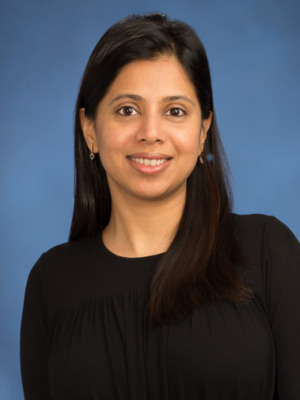
 “Leaders should hold complexity without the temptation to collapse it,” says Pooja Mishra Prahlad. “They should want to look at things from different perspectives and think deeply to earn the answer.”
As a partner at Goldman Sachs with more than two decades in the industry, Prahlad’s call to slow down, reflect, and resist the easy path is a throughline for how she moves through the world. She leads with curiosity, comfort in ambiguity, and a conviction that the best things, whether careers, relationships, or ideas, are built with time and intention. Now as Head of Americas Equity Structuring, she continues to be energized by innovation, by the people around her, and by a belief rooted in her own unlikely journey and her father’s before her: a single opportunity given to the right person at the right moment can change the trajectory of generations.
An Unexpected Arc
Prahlad grew up in a world far removed from Wall Street. As the daughter of a Naval officer, she spent her childhood moving across India, living in identical government-issued houses, and attending the same schools as her neighbors, in a community where, as she puts it, “nobody ever discussed money or invested in the stock market.”
That upbringing, Prahlad says, turned out to be more preparation than limitation.
“The life I led in India was a great foundation for being able to adapt to a new set-up and new people. The Indian Navy is very diverse. You have people from all over the country with regional differences and language differences, a diversity born of meritocracy working towards a greater good. There is so much celebration of that in the culture.” This has led her to fundamentally believe that a truly meritocratic organization breeds a diverse environment.
Like many academically strong students in India at the time, Prahlad studied computer science and worked briefly at a software firm. But she quickly realized something was missing. ” Even though I enjoyed the intellectual challenge of problem-solving, I wanted to have more of the advisory piece.”
Business school brought Prahlad to a Goldman Sachs internship in London, and it proved transformative. The energy of the equity trading floor, and the combination of analytical rigor with constant interaction, felt like a natural fit.
“It ticked all those boxes of a job that involves thinking, but also working with a lot of people,” explains Prahlad. She joined full-time in 2005 and has been at Goldman ever since.
Innovation at the Epicenter
Today, as a partner leading equity structuring, Prahlad builds bespoke solutions for clients navigating a rapidly shifting landscape.
“It sits at the epicenter of a lot of innovation,” she says. “In my job, I have a vantage point to a changing landscape — market structure changes, regulatory changes, macroeconomic changes. And you get to read the tea leaves of what it means for clients.”
The other thread running through her work is the one she didn’t anticipate loving as much as she does: the trusted advisor relationship. “It’s a real privilege to work with clients and have them not just rely on you for expertise, but to rely on you for counsel. That’s become more and more meaningful as I’ve grown in my career.”
Her North Star
When asked who has inspired her most, Prahlad speaks movingly about her father. His own life followed an improbable arc, from a small village with no local high school to higher education, a Navy career, and later aviation, all made possible by a relative who chose to support his education.
“What is amazing about his journey is I never saw him allow struggle to rest heavily on him. He was so bright, but also so funny. You would have never known what his journey had been.”
The lesson Prahlad took from her father’s example is one she returns to often: “What people remember is who you are with them and how you treat them.”
The second lesson shapes how she leads today: “It’s possible to change not just one person’s life, but generations after them, by giving someone an opportunity.”
That belief now shapes how she approaches her own role. Reflecting on her rise to partner, Prahlad challenges the idea of a replicable formula. She credits a willingness to embrace innovation, change and discomfort, and the mentors and sponsors who opened doors at pivotal moments.
Not All Doubt is Counterproductive
As a mentor, Prahlad notices one theme that surfaces repeatedly: self-doubt. Her take on it is more nuanced than one might expect.
“Not all self-doubt is bad. It’s healthy to doubt your opinion without doubting your ability. It can make you want to work harder. It can make you think more deeply about the consequences of your actions to others. Our culture sometimes demonizes a little bit of doubt, but it’s not necessarily bad.”
The problem, she says, is when it tips into paralysis. “Confidence comes with action. Take a step in the direction you want to go, then take another step, then take a third step. If you fail – fail fast, that’s the best way to overcome the doubt and lead to clarity.”
Earn the Answer
When Prahlad speaks about leadership and the future, her focus consistently returns to responsibility, both to ideas and to people. She believes the financial industry is in a generational moment of change, shaped by new technologies, evolving approaches to risk, and shifting models of capital allocation. Within that landscape, she offers three principles.
First: sit with complexity. “Resist the pull toward quick, serviceable answers. The distance to an answer is so short now, especially with AI. It’s easy to stop there, even when it’s not the best answer…Spend time to earn the answer.”
Second: stay curious. “As you grow in your career, you end up teaching more than learning. It’s really important to stay curious and create the time for that.”
Third: bring people with you. “If you want to go far, you can’t go alone. Having conviction in your view, articulating your vision clearly, building trust and earning people’s followership over a long period of time require investment of time and energy. They are not a quick solve.”
Opportunity Can Change Everything
Outside of Goldman, Prahlad’s life remains anchored by her family, now by her husband and thirteen year old son. “Whatever the demands of the day, my husband and my son are where I return – in every sense of the word. I learn from them constantly – they both move through the world with a hunger to understand it. They keep me honest about what growth looks like”.
The same spirit extends into her broader commitments. Prahlad sits on the board of the American India Foundation, focused on livelihood and education for women and children in India, and supports the Nudge Foundation, which works with communities living in ultra-poverty. Their missions mirror the chance once given to her own family.
“The world has more talent than it has opportunity,” she says. “Anything that I can do to bring opportunity to people who have the desire to transform their lives is very important to me.”
In a fast-moving, efficiency-driven world, Prahlad embraces depth: depth of thought, of relationships, and of responsibility. She is a leader guided by curiosity, sustained by people, and anchored in the conviction that opportunity, when offered thoughtfully to the deserving, can change everything.
“I genuinely believe in what I bring to the table,” she says. “But it is also important to recognize that through the arc of life, there were discrete moments where people came in and did their bit. It’s my turn to do that now, for people who come after me.”
By Jessica Robaire