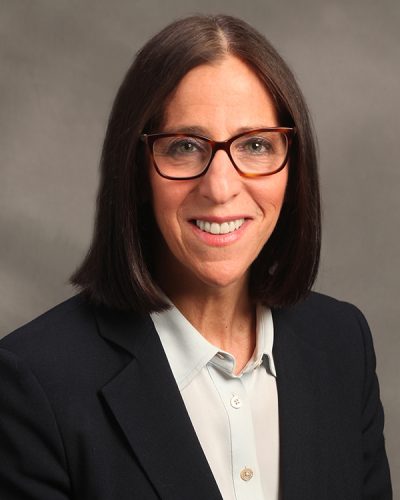
 “Say yes,” recommends Wells Fargo Advisors’ Diane Gabriel.
“There will be lots of risks and challenges, but embracing them brings opportunities and rewards.”
She finds that women tend to be more risk adverse and turn down opportunities because they don’t think they’re ready for them, but that can be counterproductive. “If you turn something down, you might not get the chance again.”
In fact, one of her favorite sayings is “Leap, and the net will appear.”
Words she lives by herself, based on her career trajectory.
Succeeding as a Woman in a Man’s World
Gabriel launched her career in 1982 – a time when only 10 percent of advisors were female – as a 21-year-old only female advisor at a branch full of men. Having grown up with older brothers and a supportive family, she was undaunted by the male-dominated, competitive environment, and in fact, thrived.
She became the company’s youngest officer at age 25 and then was asked to open a branch at 26. They sold the branch to a predecessor firm to her current organization, and she continued as a producing branch manager. Based on her success, she was tapped to help launch the firm’s independent broker-dealer. From there, she managed the online brokerage channel, and their phone-based advisor teams.
Seeing the Opportunities in the Next Generation
In 2017 Gabriel was asked to lead Wells Fargo Advisors’ Next Generation Talent Program, overseeing four financial advisor programs and one branch manager leadership program.
Being part of this groundbreaking effort is the professional achievement she is most proud of so far, parlaying her passion into having a hand in attracting almost 1,000 talented financial advisors to the brokerage industry.
“Leading our efforts across the Next Gen advisor and manager programs means ensuring that we are truly changing the face of the financial advisor workforce and ensuring its diversity,” she says. She is proud that today the program is about 40 percent “diverse,” not only in ethnicity and gender, but encompassing different ages, abilities and experiences.
The reason the program has been able to attract such a diverse group is because it takes an industry standard – a variable based compensation model — and modifies it to allow for a longer runway with salary and bonus-based compensation, while advisors learn about the industry. That, combined with the program philosophy of teaming and mentoring, has resulted in an overwhelming 82 percent retention rate.
“Because we eliminated the sink-or-swim mentality the industry embraced for so many years, our program is encouraging a wider swath of those who can bring a myriad of advice and viewpoints to clients,” Gabriel says. “It also allows us to address client needs too; for example, it will allow our team to nurture the next generation of clients, as surveys have found that an overwhelming number of children of existing clients prefer a financial advisor closer to their age.”
It also allows the transfer of clients from seasoned advisors whose book of business has grown too large to adequately service them to a newer advisor with more capacity for developing the relationships needed for ongoing success.
In addition, the firm continues to expand its use of technology. “It enhances how we interact with clients and specifically attracts that younger generation who wants to work with us in a different way.” And by bringing in younger advisors, the firm have the chance to reverse-mentor the more mature advisors and help them embrace this technology too, she notes.
Attracting younger advisors is a key goal of the program, and Gabriel says outreach to the next generation must start early. She has recently started the Community Champion program as a new means to create and maintain a pipeline of talented and diverse prospects for the Next Generation Talent roles. This program encourages financial advisors and leaders to engage with diverse organizations in their communities in an effort to educate diverse job seekers about Next Gen talent opportunities.
Although the industry has changed, it is still largely male-dominated, and women who are going to succeed have to be ready to stand shoulder to shoulder in an environment of men. However, Gabriel adds, “Studies show that the majority of women have said they would prefer to work with a female advisor so gender could be advantageous in this instance.”
Gabriel recommends finding mentors of both genders, identifying professionals you admire, creating your own “board of advisors” and then spending time with them to help build the qualities and standards you want to emulate.
Additional Programs Focused on Women’s Needs
In adding to the Next Generation Talent efforts, Gabriel has been active with Wells Fargo Advisor’s multiple programs designed to reach women. Eleven years ago, she started and has since served as co-chair of the National Women’s Summit, where between 300 and 500 top female financial advisors and managers from around the country are invited for personal and professional development. It’s a breath of fresh air for many of the women who are the only females in their office, yet male “allies” are also invited to the event.
She also helps to spearhead the firm’s Best Practice Forum where its leaders visit 10 -12 markets annually for all-day events for local advisors and managers, along with clients and prospects, that feature meaningful presentations and provides other networking opportunities.
Another program is the Women’s Business Exchange, which consists of monthly phone calls in which female team members share about a variety of topics and best practices.
And finally, Gabriel is also involved in the Women’s Team Member Network, which features speakers from across Wells Fargo’s enterprise and also includes mentoring and community service activities.
Outside of work, Gabriel continues to share her passion for the industry by acting as an executive sponsor of a program at Harris-Stowe State University, a historically black college in St. Louis with mostly first-generation students who may not have had exposure to job searching and interview skills. “I help students with everything from formatting a resume to cultivating a firm handshake,” she says. “If we want a more diverse and younger generation to join the industry, we have to help them be prepared.”
A passionate animal lover, she also spends time at shelters helping get pets ready for adoption.

Voice of Experience: Sarah McLean, Partner, Shearman & Sterling
Voices of Experience“I wish I had known when I was first starting out that most people don’t mind when you ask them questions about their work or request feedback on your work — and the more direct the question, the better,” she notes. “Specific questions lead to better discussion and ultimately lead to better information for you.”
An Early Pivot Leads to a Rewarding Career
With an undergraduate degree in biochemistry and molecular biology, Sarah assumed she would become a research scientist or go to medical school. But in her last year of college she took a business law class that intrigued her with how problems and solutions are presented so differently than in science. That, coupled with the three years of research she had been doing on the pea aphid genome, led her to decide to pursue law school rather than research.
Her first job out of law school was with a Texas-based firm where she initially practiced health law — at the time still considering medical school—but ultimately didn’t find it challenging and switched to oil and gas private equity. She practiced with the same firm for almost 20 years, in both Houston and Austin, along the way closing more mergers and acquisitions deals than any other lawyer in Texas in 2017, according to the records of The Texas Lawbook. She then started thinking about making a change, to find a new challenge that would energize and excite her. She moved to Shearman & Sterling in April 2018, where she currently practices private equity and oil and gas upstream and midstream mergers and acquisitions.
Building the Business One Relationship at a Time
While Sarah is currently working on a number of complicated, interesting deals and transactions, what she’s most excited about is her role in business development—going out to see clients and contacts and introducing them to Shearman & Sterling. “We’ve put together an impressive team of oil and gas deal lawyers in Austin and Houston, and it has been great to get out of the office and talk to people,” she says.
She’s built an impressive array of contacts over the years, primarily because she figured out soon after starting her career that every person you meet is a potential future business contact. “I realized that reaching out to people you’ve met through business deals is a great way to grow your network of contacts, and the newer associates working on your early deals will be decision makers in 10 years,” Sarah says. “Developing long-standing relationships helps tremendously when you are asking for referrals and work.”
She often tells young women that an important trait to help build fulfilling relationships is getting over any shyness. “I was always hesitant to reach out to contacts for lunch or coffee because I thought they would be too busy or they wouldn’t really want to get together with me or a hundred other excuses. But ultimately I’ve learned that most people do want to form relationships and do have time for a quick check-in meeting,” she says. And, furthermore, even if they don’t have time or want to meet, they won’t be rude about it. “They just don’t respond, and someone not responding is not tragic or embarrassing at all,” she points out.
Taking Charge of Your Own Career
Sarah advises her peers of the value of sticking together and supporting one other, along with taking the time to nurture as many younger women as possible. She urges those in a position of authority or power in an organization to use it to dispel stereotypes and promote diversity.
While she recommends young women find good mentors and sponsors, she makes clear that often you have to make your own opportunities, rather than relying on them coming to you. “This means getting out of your office, meeting people and looking for ways to make yourself more valuable to your firm or company,” she says.
Women especially need to spearhead their own careers, because in her experience big law firms, along with the specialties of private equity and oil and gas, are male-dominated industries, which can offer some barriers.
One barrier in big law firms is what she terms “compassionate discrimination,” which manifests itself like, “I know Sarah is busy so I’m not going to include her on this pitch for new work because she has kids, and I don’t want her to have too much on her plate.” She found that this happened on a number of occasions, including client pitches where the client specifically asked for her. “I felt that men were making decisions about my career, my availability and my workload without even asking me, and this would not have been the case if I were a man.”
Despite this devotion to her career, Sarah seeks a balance with her personal life. As a mother of four children, ages 5 to 15, she spends much of her time participating in their activities or just hanging out with them. One thing she is especially proud of is all the volunteer work they do together. Sarah and her family are active with Generation Serve, an Austin-based family volunteering organization whose goal is to develop kids into community-minded leaders. This past April, they received the Wally Pilcher Family Volunteering Award for their work with the organization. She and her daughters are part of the National Charity League, and they also work directly with Austin Pets Alive.
Important Conversations at Work: Improving Communication Across Differences
Career Advice, Guest ContributionGuest contributed by Katherine Giscombe
At this contentious time in the United States, the rights of all women are under fire.
In spite of movements against sexual harassment that are gaining in popularity and support, such as #MeToo and TimesUp, there are factions within the country including lawmakers who actively oppose equal, fair and just treatment for women. And there has been an uptick in violence and harassment directed against racial minority groups, which have been condoned, and even spurred, by those in high political offices.
Boundaries between our work and personal lives continue to blur given the increasingly 24-hour a day expectations of employers, greater levels of virtual work, and increased workloads across industries. It becomes more difficult, over time, to not bring concerns about our lives outside of work into the workplace. The context of our lives affects our well-being and experiences at work, as shown in Catalyst’s research on the Emotional Tax, which demonstrates that a majority of women and men across racial/ethnic minority groups report feeling vigilant or on guard in the workplace, constantly preparing for the potential to deal with bias, discrimination, or exclusion.
It is vital for employees and associates to be able to engage with each other in a healthy manner, and develop mutual understanding even when they do not share similar backgrounds or experiences. Further, in the workplace, as research on career progression has shown, it is essential to develop relationships with allies and potential sponsors who can help progress one’s career. But doing so can be difficult among those from different backgrounds.
Catalyst has developed methods for reaching across differences to form meaningful connections at a personal level. It starts with understanding how communication among employees and associates can improve, and providing tactics to do so. In summary, reluctance to engaging across differences can fall into three major themes:
Those who feel that there is not a problem may assume that race or gender differences don’t matter, because they believe they view women and men equally, and have no racial prejudice. A way to move beyond these beliefs is to ask one’s colleagues (of a diversity of genders and race/ethnicity groups) if they have ever experienced or witnessed biased behavior, and probe on what it looked like, what was verbally communicated. Further, they can ask whether colleagues of a different racial, ethnic, or cultural background feel that the workplace respects their identity and experiences.
Those who believe there is no benefit in talking may feel that race and ethnicity are not relevant in certain places, or that talking about our differences can only further divide us. Catalyst recommends asking colleagues a number of questions, including identifying times when discussing any type of difference has led to a positive outcome. Another suggestion is to identify “off-limits” issues— then discuss how not talking about these issues can derail inclusion.
Finally, the fear that there will be negative consequences to my actions is sometimes grounded in the fear of being labeled as overly sensitive, or the belief that it is not safe to speak up in the workplace. In these cases, Catalyst recommends that an employee ask a colleague for help in providing honest, constructive feedback, especially in cases where the employee uses words that are hurtful or offensive. Other advice includes asking a team member who has been silent during a meeting if he or she would like to contribute a different perspective.
In Catalyst’s workshops and consulting engagements, we sometimes use “ice breaker” exercises that build rapport across differences. One such example is a “pair share” in which each member of the pair names three identity groups he or she belongs to, including two visible elements of difference, and one invisible. Each person then takes turns sharing aspects of their identities. When sharing one’s identities, the speaker practices demonstrating vulnerability and self-disclosure. The listener, in turn, practices suspending judgment and inquiring across difference.
Going beyond building interpersonal connections at work, employees and associates can also co-create structures at work that encourage inclusion. This might entail forming an employee or associate resource group (ERG) for all women in the organization, that focuses on the many needs encompassed by women. In working with Catalyst’s supporter organizations, we sometimes see that women of color prefer to join an ERG that represents their racial/ethnic group, rather than the women’s groups. A good way to form alliances to get more done for all women would be for a women’s ERG to ensure that its officers represent a diversity of women within the company, and also represent the interests of a diversity of women.
Reaching across differences to form meaningful and robust working relationships can enhance our personal and professional lives, and provide a fortification of support during fraught times.
Dare to Dream! What Job Would You Do if You Won the Lottery?
Career Advice, Career Tip of the Week!Upon winning the lottery, some people might stop working.
Others would take the opportunity to work in their dream job. What is your dream job? If you do not know the answer, let us have some fun while summer is still here to dare to dream because you might just find some answers for real life by letting your mind run wild.
Let’s start with 3 questions to stimulate the process:
1. What makes you tick? ( there are many tests to take- for example, the Hogan personality instrument helps you understand you behaviors based on your personality and work environment, Myers Briggs, Firo-B etc). Do you need recognition? Is it about power for you? How high is your altruism markers? Are you hedonistic and want to have ping pong and happy hours? How social are you? Do you need to achieve at all costs?
2. How do you prefer to learn? if you are going to do a new thing, how would you like to approach it? Will you jump in and learn by doing? Or would you prefer to have time to studying?
3. What are your absolute bottom lines and how did you get to them? If you had teams of support people, would you choose to outsource child care or would you outsource work? How do you want to spend your time?
Have some fun here. Write it down, draw pictures, do a vision board, whatever works for you!
What comes out of this simple exercise for you?
If you want to work with an executive coach on this and and then the advanced exercises that will take you to the next level at work or even your next job, contact nicki@theglasshammer.com
Denise Wyllie, Partner, Goldman Sachs
Voices of Experience“When I initially joined the sector, there were very few women in leadership positions,” she says, but notes this did not hold her back from achieving her goals.
“As women strive to become more senior, they need to embrace their career and remember they would not be in their current role if they were not good at their job, and they also need to trust the process.” She adds that success in many ways is more an attitude than a skill. “You have to embrace your role with 100 percent energy, passion and commitment – take risks and if they don’t pan out then try something new.”
Wyllie also notes, “You also have to accept that you can’t have it all, all of the time, therefore at points in your career something may have to give – that’s ok but make sure it’s your decision.”
Advancing Her Career by Approaching Challenges Head On
As a “STEM student” before it became a common acronym, Wyllie studied biochemistry at university. While she initially considered a career in the sciences, she decided eventually to pursue a business career. Her first role was as a graduate trainee at the largest brewing company in the UK – the first female ever hired to train as a brewer and production engineer. In this role, she was able to leverage her biochemical degree and received fantastic managerial training, overseeing an all-male team on the brewing production line.
After nearly three years in this role, Wyllie decided she wanted to pursue a new challenge. She scoured the Sunday Times’ career section and was intrigued by an ad for Citibank in London, searching for people with engineering or manufacturing backgrounds to work in their Foreign Exchange & Treasury Division. Wyllie went on to work at Citi in a number of management and project roles across Europe for four years. She ultimately joined Goldman Sachs after she was recruited by a former coworker.
Wyllie spent the majority of the past 24 years in operational roles in commodities, derivatives, and as co-COO of the global Operations Division, with specific responsibility for Europe, India and Asia Pacific. In 2016, she transferred to Hong Kong, where she now serves as head of the Federation for Asia Pacific, operating as the COO for the region. In this role, she supports all of the firm’s business activities across the region, which she calls “massively exciting,” due to daily challenges and curveballs.
However, what she finds most thrilling is the opportunity for Goldman Sachs and the broader finance industry to potentially expand in China in the coming years. “Although it can be frustrating that markets aren’t opening up more quickly, we are on the cusp, and long after I’m retired I’ll look back and see the impact my team and I had to help move the firm forward,” she says.
In fact, building her team is one of the professional achievements Wyllie is most proud of – along with becoming one of Goldman Sachs’ female partners.
She notes that observing the number of people she’s hired and mentored, who have grown from analyst to Managing Director and even Partner, is extremely rewarding. “When I see my team flourish personally and professionally, it is very gratifying to think that I may have had a bit of an impact on them along the way.”
Balancing Outside Interests: 72 Countries & Counting
Wyllie is proud to be involved with Goldman Sachs’ affinity networks, including those serving women, military members and the LGBT community. She also is currently working with colleagues in London on “Music in Mind,” a charity that uses music to help promote wellbeing in people with Alzheimer’s as well as provide support for family members taking care of those with the disease. She has also worked closely with Opportunity International, which provides small loans predominantly to entrepreneurs in Africa, with the aim of pulling them out of poverty.
Wyllie is a firm believer in the importance of taking every vacation day you’re given to maintain both mental and physical health, as it will allow you to enjoy your job more as well as give you sustainability and longevity to your career. “As much as we love our careers, we all need a break!” She encourages others to “take advantage of down time to reflect on your career and your business. Often, it’s only when you have some time off that you really have ‘space’ to think.”
She also loves to travel, having visited an impressive 72 countries. Her favorite sojourns include going on safari – either Africa or India – to see wildlife. She also visits the UK frequently to see friends and family, and she stays active by going to the gym regularly and loves weight lifting as well as skiing, scuba diving and horse riding.
By Cathie Ericson
4 ways to know it’s time to ask for more from your job
Career Advice, Guest ContributionGuest Contributed by Deepa Ramaraj
According to a recent US census, only 19% of women executives reach the highest ranks of business.
The same census showed that the fastest growing demographic of business owners in the USA today are women-owned businesses.
Before you leave your corporate job, ask yourself questions about your aptitudes, aspirations and what really drives you to succeed? The below questions may help you to be better equipped to know if now is the time to ask for more from your job and may give you more clarity about what direction you could consider taking.
1. What will my life be like in 5 years if I keep this job?
If you were promoted, what is the level of responsibility and what are the daily tasks of this new position? Is this something that you are willing to take on? Is the level of salary increase over the next 5 years in this position something that you are excited about receiving or is it lacklustre? According to 2018 forecasts, most executive positions can only expect a 3% salary increase, barely keeping up with cost of living. Is working in this job creating difficulties in any other area of your life? Personally? Physically? Relationships? Health? Mental Health? Note down what impressions that you have about keeping this job in all of these factors.
2. What will my life be like in 5 years if I don’t keep this job?
What if you could decide for yourself what your life will be like if you don’t keep this current job? What are the other opportunities for employment? What marketplace demand is there for your skills and what salaries are being offered to seasoned entrants? What is your value proposition as a candidate, how will you shine? Could you choose to take time off right now or choose a different path?
3. What do I love about this job?
Challenge yourself to write 25 things that you actually love about the job that you are in. The 80/20 rule could be applied to your work. If 80% of your job is taken up with things that you enjoy and feel masterful about and only 20% of your job is not, then you are probably in a sustainable career for you. If it is the opposite, it may be time to consider a change. What else is possible for you to love about this job that isn’t obvious at the moment? Sometimes we get bogged down and don’t actually ask for the job to be enjoyable.
4. Is now the time to change?
Jumping back to fantasizing about winning a lottery or having an astonishing inheritance come in so you can retire from working altogether, which of course would be wonderful, realistically is now the time to actually ask for more from your job? What are you aware of politically from the company structure? Could you be promoted? Could you ask for more responsibility and get a pay raise or more benefits that would add to your life?
What if it’s possible to ignite a fire under your current job and develop it into something more profitable, something that you are excited to arrive at every morning? Asking and answering the above questions will start to point at possible changes that you can make to your job and your life, to increase the level of satisfaction and joy. Yes, it is possible to have both satisfaction and joy at work and settling for anything less is just that.
About the author
Deepa Ramaraj is a Computer Science Engineer turned Health and Wealth Educator, as well as a Right Riches for You facilitator, a specialty program from Access Consciousness. Deepa facilitates workshops for corporate companies to boost sales, to dissolve interpersonal or inter-departmental challenges and to transform the way business is done. These workshops are totally unconventional in approach. She also conducts workshops for individuals about how to receive more money, reduce stress, have better relationships, improve health and upskill as a parent.
Disclaimer: The opinions and advice of guest contributors are not necessarily those of theglasshammer.com
3 Easy Ways to Know What Job You Want to Do Next
Career Advice, Career Tip of the Week!Staying in the job, after the love has gone?
We have all done it, we have all stayed in a position at work that just did not excite us anymore on any level. The reasons that keep us there can vary but more often than not, it is a combination of wanting the security/ money and not believing that there is a better situation out there for us. Confidence, or lack of it for people who have never had a confidence issue before, can be very daunting.
It is normal to ask yourself, ‘But what would i do?’
The answer to that question is very personal and individual but in broad strokes my bet is that you could do a range of things inside or outside of your current firm and even industry.
Isn’t it time to do what you want to do? I mean, you probably have more skills than you give yourself credit for and probably most of them are entirely transferable.
Here are 3 steps to get closer to your ideal job.
1. Make a list of what you like doing
2. Then make a list of what you do not like doing
3. Make a list of the tasks you would be doing in a more ideal situation 12 months from now.
I am mentioning tasks, because often we talk about roles or responsibilities instead of tasks. Roles like, I want to manage people doesn’t actually define what is your task or the tasks they are doing that you will be responsible for, so go granular in this exercise.
What comes out of this simple exercise for you?
If you want to work with an executive coach on this and and then the advanced exercises that will take you to your next job, contact nicki@theglasshammer.com
Voice of Experience: Diane Gabriel, Wells Fargo Advisors
Voices of Experience“There will be lots of risks and challenges, but embracing them brings opportunities and rewards.”
She finds that women tend to be more risk adverse and turn down opportunities because they don’t think they’re ready for them, but that can be counterproductive. “If you turn something down, you might not get the chance again.”
In fact, one of her favorite sayings is “Leap, and the net will appear.”
Words she lives by herself, based on her career trajectory.
Succeeding as a Woman in a Man’s World
Gabriel launched her career in 1982 – a time when only 10 percent of advisors were female – as a 21-year-old only female advisor at a branch full of men. Having grown up with older brothers and a supportive family, she was undaunted by the male-dominated, competitive environment, and in fact, thrived.
She became the company’s youngest officer at age 25 and then was asked to open a branch at 26. They sold the branch to a predecessor firm to her current organization, and she continued as a producing branch manager. Based on her success, she was tapped to help launch the firm’s independent broker-dealer. From there, she managed the online brokerage channel, and their phone-based advisor teams.
Seeing the Opportunities in the Next Generation
In 2017 Gabriel was asked to lead Wells Fargo Advisors’ Next Generation Talent Program, overseeing four financial advisor programs and one branch manager leadership program.
Being part of this groundbreaking effort is the professional achievement she is most proud of so far, parlaying her passion into having a hand in attracting almost 1,000 talented financial advisors to the brokerage industry.
“Leading our efforts across the Next Gen advisor and manager programs means ensuring that we are truly changing the face of the financial advisor workforce and ensuring its diversity,” she says. She is proud that today the program is about 40 percent “diverse,” not only in ethnicity and gender, but encompassing different ages, abilities and experiences.
The reason the program has been able to attract such a diverse group is because it takes an industry standard – a variable based compensation model — and modifies it to allow for a longer runway with salary and bonus-based compensation, while advisors learn about the industry. That, combined with the program philosophy of teaming and mentoring, has resulted in an overwhelming 82 percent retention rate.
“Because we eliminated the sink-or-swim mentality the industry embraced for so many years, our program is encouraging a wider swath of those who can bring a myriad of advice and viewpoints to clients,” Gabriel says. “It also allows us to address client needs too; for example, it will allow our team to nurture the next generation of clients, as surveys have found that an overwhelming number of children of existing clients prefer a financial advisor closer to their age.”
It also allows the transfer of clients from seasoned advisors whose book of business has grown too large to adequately service them to a newer advisor with more capacity for developing the relationships needed for ongoing success.
In addition, the firm continues to expand its use of technology. “It enhances how we interact with clients and specifically attracts that younger generation who wants to work with us in a different way.” And by bringing in younger advisors, the firm have the chance to reverse-mentor the more mature advisors and help them embrace this technology too, she notes.
Attracting younger advisors is a key goal of the program, and Gabriel says outreach to the next generation must start early. She has recently started the Community Champion program as a new means to create and maintain a pipeline of talented and diverse prospects for the Next Generation Talent roles. This program encourages financial advisors and leaders to engage with diverse organizations in their communities in an effort to educate diverse job seekers about Next Gen talent opportunities.
Although the industry has changed, it is still largely male-dominated, and women who are going to succeed have to be ready to stand shoulder to shoulder in an environment of men. However, Gabriel adds, “Studies show that the majority of women have said they would prefer to work with a female advisor so gender could be advantageous in this instance.”
Gabriel recommends finding mentors of both genders, identifying professionals you admire, creating your own “board of advisors” and then spending time with them to help build the qualities and standards you want to emulate.
Additional Programs Focused on Women’s Needs
In adding to the Next Generation Talent efforts, Gabriel has been active with Wells Fargo Advisor’s multiple programs designed to reach women. Eleven years ago, she started and has since served as co-chair of the National Women’s Summit, where between 300 and 500 top female financial advisors and managers from around the country are invited for personal and professional development. It’s a breath of fresh air for many of the women who are the only females in their office, yet male “allies” are also invited to the event.
She also helps to spearhead the firm’s Best Practice Forum where its leaders visit 10 -12 markets annually for all-day events for local advisors and managers, along with clients and prospects, that feature meaningful presentations and provides other networking opportunities.
Another program is the Women’s Business Exchange, which consists of monthly phone calls in which female team members share about a variety of topics and best practices.
And finally, Gabriel is also involved in the Women’s Team Member Network, which features speakers from across Wells Fargo’s enterprise and also includes mentoring and community service activities.
Outside of work, Gabriel continues to share her passion for the industry by acting as an executive sponsor of a program at Harris-Stowe State University, a historically black college in St. Louis with mostly first-generation students who may not have had exposure to job searching and interview skills. “I help students with everything from formatting a resume to cultivating a firm handshake,” she says. “If we want a more diverse and younger generation to join the industry, we have to help them be prepared.”
A passionate animal lover, she also spends time at shelters helping get pets ready for adoption.
OpEd: Talking about Harassment in the Workplace
Career Advice, Op-EdGuest contributed by Stacey Engle
Women empowerment movements have been a prevalent force over the past year, from #metoo to #timesup.
The individual and collective impact of these movements has varied, as have the conversations we have had surrounding these topics – both at work, and at home.
At Fierce Conversations, we wanted to get a sense of how recent social movements have impacted the workplace, if at all. We asked more than 1,000 full and part-time employed individuals in the U.S. questions about current social movements, along with how their personal outlook has shifted over the past year.
Fifty-seven percent of those surveyed have discussed gender equality (including the #MeToo and #TimesUp movements), yet most of these conversations are occurring with friends and family, not within the workplace:
While we weren’t surprised to see that the topic came up more with those we feel closest to outside the office, these low numbers within the workplace signal a clear disconnect between issues that matter and affect our lives, and the amount of recognition these issues are receiving in our places of work.
And these numbers only increase when we look at gender and age. More women than men (58% vs 47%) have had conversations about gender equality; 49% of women have discussed the topic with their friends, while just 37% of men say the same.
Younger Americans are also talking about these issues at much higher rates. More than two-thirds of those 18-29 have had a conversation about these movements; just 53% of those 60+ say the same.
Given the reality that older men make up the majority of CEOs and company leaders today, these numbers are concerning. These social issues may not be top of mind for these leaders, but it’s imperative that they recognize their employees are discussing these matters outside of work, and respond accordingly by addressing them within their organizations. It is imperative for women in leadership roles, even those not at the very top, to ensure these are topics aren’t brushed under the rug.
The good news is that, despite these conversations not taking place in droves at work, these movements appear to be making an impact in how empowered individuals feel today than they did a year ago.
Almost half (48 percent) of those surveyed said they are more likely to stick up for themselves than they were a year ago, and another 40 percent are more likely to stand up for a colleague. Thirty percent are more likely to address a colleague directly for inappropriate behavior, such as a racist joke or unwelcome flirting, than they were a year ago.
This data varies by gender; 55 percent of women are more likely to stick up for themselves than they were a year ago; just 36 percent of men say the same. Forty-two percent of women are more likely to stand up for a colleague; just 34 percent of men say the same.
There is very cleary a more significant shift here with women in their comfort level in speaking up, and we believe with the right conversation skills, these numbers can be even greater.
Conversations around equality are necessary, and every employee should feel comfortable discussing these issues, especially if they have experienced or witnessed any type of discrimination. Not feeling comfortable enough to speak up is the reason we have seen systemic issues at many organizations over the past year.
A barrier that many struggle with, however, is how to come up with an organizational perspective on these issues, if they don’t truly understanding the specific issues their company is facing. Here are some tips we recommend to move in the right direction:
At the end of the day, conversations about gender equality are necessary and need to happen to ensure your organization is addressing any and all issues as they arise, and that your employees feel safe and encouraged to come forward if necessary.
Stacey Engle believes meeting the needs of clients start with truly understanding the challenges they face. As a result, she is always connected—to clients, the latest trends, and the newest opportunities.
Stacey is a passionate self-starter with over ten years’ experience helping to build businesses through smart go-to market and innovative people strategies. As executive vice president sales and marketing at Fierce Conversations, Stacey leads the marketing and sales strategies, along with branding efforts for the company. Over the past 7 years, Stacey has been key a driver in Fierce’s double digit growth, landing the company consistently on the Inc.5000 list as well as receiving consecutive Best Places to Work and design awards.
Stacey is very passionate about community work, serving on boards and offering pro-bono work with the University of Washington, various arts organizations, and community initiatives. She was recently awarded the Outstanding Alumni Mentor Award from the University of Washington with her work in founding a professional development board that connects students with transformational experiences from workshops to global opportunities.
Disclaimer: The opinions and views of guest contributors are not necessarily those of the glasshammer.com
The 3 Best Ways Busy Professionals Can Reduce Stress and Start Thriving
Career Advice, Guest ContributionGuest Contributed by Julie Morris
Ask busy professional women about what she most desires, and a lot will wish to reduce stress.
If you feel like you’re living on the proverbial hamster wheel, it’s time to make small changes to your day to reduce stress and save your sanity. Our tips will help you thrive instead of just get by.
1. Multitask in your personal life
Busy professionals are the rock stars of multitasking. But, multitasking for work is very different from multitasking for yourself. In fact, multitasking may be the wrong word to use. According to Entrepreneur, your brain time-shares rather than multitasks since it is only able to focus on a single task at a time. You must learn how to divvy up your time equally and effectively among tasks. How is this accomplished? Create a to-do list categorized into similar tasks so that your brain doesn’t have to totally change gears. Be sure to always keep your list visible so that you don’t feel that rush of accomplishment, only to realize you have more to do. If you start feeling overwhelmed, remember it’s okay to take a step back and get re-focused. In the future, saying “no” is an option too to avoid getting burnt out.
2. Use Your Lunch Hour to Reduce Stress and Refocus
Unfortunately, Americans take only a portion of their lunch break to eat, or they skip lunch altogether. According to the New York Post, one survey found that 50 percent of workers take 30 minutes or fewer on their lunch hour and that 29 percent work through lunch. Some of the best ways to reclaim your lunchtime include leaving the office to have lunch with a friend or exercising outside with a co-worker or friend. To maximize the benefits of getting out of the office, meet a friend outside to eat for 30 minutes and spend the other 30 minutes walking, meditating, or doing yoga. Physical activity gives you the true breaks you need from work to get refreshed and boost your brain function and mood to help you be more productive and have less stress.
3. Prioritize Tasks
Implementing time management practices is another excellent way to reduce stress on a daily basis. For example, create a checklist for work and home. Arming yourself with a checklist helps you focus and reduces the amount of time you waste on email and social media or chatting with co-workers. Be sure to organize your checklist from most to least pressing tasks and consider allotting yourself enough time for each one. By prioritizing, you will not only feel less stressed, but may find that you are better able to concentrate because you’ll know you’re giving your attention to the most important task on your to do list.
If you’re a visual person, put the checklist on your laptop or tablet or on your desk so you can mark off completed tasks, feel a sense of accomplishment, and know where you stand with your day. If you prefer to use technology, create a note or list on your smartphone; or download one of the many checklist apps.
Stress levels also climb when you feel like you have to do everything right now. One tip is to follow the two-minute and 10-minute rule, as described by Kyle Brost. If you have a task that will take fewer than two minutes, do it immediately so that you don’t face the stress of having too many incomplete tasks. However, if you have a task that requires more time, use the 10-minute rule. Commit to working on the task for 10 minutes. When the time is up, permit yourself to stop and move on to something else to keep chipping away at your to-do list.
High levels of stress prevent you from being productive and thriving. Do yourself a favor and multitask for yourself. Then, use your lunch hour to refocus and reduce stress. It’s also helpful to prioritize tasks and manage your time wisely.
Disclaimer: The opinions and views of Guest contributors are not necessarily those of theglasshammer.com
5 Things You Can Do as a Leader to Help Increase Engagement In Company Initiatives
Career Advice, Career Tip of the Week!This week we invited a guest to contribute to the career tip column.
Fierce Conversations wrote a recent blog post on how leaders engage with it comes to organizational initiatives.