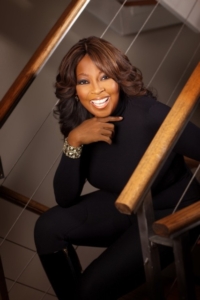
 Though she’s widely known as a high-profile lawyer and former host of ABC’s The View, Star Jones doesn’t consider those her most important roles. Rather, she is proudest of the changes she is helping affect by serving as president of the Professional Diversity Network, Inc., which merged with the National Association of Professional Women in September 2014.
“As I have forged my career path, it was always with an eye toward a profound sense of service – knowing it would be about helping people,” says Jones.
As a young woman, Jones always wanted to be a big-city prosecutor and got what she considers her dream job straight out of law school. She rose to the level of senior prosecutor in the Kings County District Attorney’s Office in Brooklyn, New York, when she was invited to start her career in media at NBC News. At the age of 30, she became the youngest person to be named the network’s Legal Correspondent. “It was such a compliment from the then-president of NBC News, who said I had the ability to make the law user-friendly,” she recalls.
She became an admired legal talk show host and then national talk show host on ABC’s The View, where she relished her ability to give voice to women and speak about issues that matter to her gender and community at large. Joining PDN/NAPW was the perfect next step allowing her to advocate on behalf of women, minorities, veterans and the disabled to put them to work. “We are changing lives one job at a time.”
Jones says that though her career has taken multiple twists and unexpected turns, she has stayed on the path intended for her by making the most of each opportunity. “Luck doesn’t just happen,” she says. “It’s the result of preparation meeting opportunity, and I have been prepared each step of the way.”
“Doesn’t Get the Attention it Deserves”
Jones’ overall top mission is to bring attention to diversity, inclusion and gender inequality. “It doesn’t get the amount of attention it deserves,” she says, citing the statistic that, on average, a women working full-time earns .78 to the dollar compared to a man in an equivalent job. Wage disparities are even greater among Black and Hispanic women.
“This is the biggest challenge to women, and the No. 1 problem I’m trying to address is equal pay for equal work.”
The business case is there, of course – research shows that when women executives run a company, they lead the business to increased revenue, making it not just right thing to do, but the smart thing to do.
Rising Tides Lift All Boats
Her passion stems from her upbringing in the projects of Trenton, New Jersey. Her close-knit family always encouraged her to be anything that she wanted. However, they didn’t focus on the fact that she was the most beautiful or most talented, but rather that she had everything she needed to do what she wanted.
Applying for every grant and scholarship that was available, she started college. When she realized that the work/study program only paid $3.55 an hour, she applied at the Brookings Institute as a second-semester freshman. A 90 word-per-minute typist, she earned a data input position at $10 an hour, which she held throughout college.
“I had acquired a skill, and that’s one of my mantras to young people: I feel strongly that I want to empower young people to achieve their dreams, but they have to have the skills necessary to do so,” Jones says. “I always had a voice telling me I could succeed, and I want to give that voice to other women.”
PDN was founded on two premises: empowering people and networking, which Jones says are the foundation of her successful career. “Women do need to help other women. Rising tides lift all boats, and when women help each other professionally — especially women at the top — everyone benefits,” she says, advocating that women who can, should focus on recommending other women for positions and act as mentors.
When NAPW and PDN merged, Jones was tasked with nominating new board members. She proudly boasts that with four women on the nine-member board, it is now one of the most diverse among publicly traded companies in the United States, second only to Macy’s. “Achieving women leadership at the board level allows it to trickle down to all levels,” she says.
Success Doesn’t Come Easy
Jones is the first to admit that fulfilling your dreams is hard work; even once you earn your success, you have to work even harder to maintain it.
“I’ve heard ‘no,’ but I’ve been patient and persistent and never gave up,” she says. In fact, she is proud that the song played for her at the recent “Go Red for Women Red Dress Fashion Show” was I’m a Survivor by Destiny’s Child.
“I’ve heard ‘no,’ but I’ve been patient and persistent and never gave up,”
Says Jones, “You can’t step on people to get ahead but you can get around them if they’re in your way. Each time you hear a ‘no’ or encounter a stumbling block, you have to figure out what you need to do to be ready for the next opportunity.”
Role Modeling Begins at Home
Often called a role model herself, Jones recommends that people seek role models in their own communities, where they can be touched every day. Her grandma and her mom are her role models – her grandma who is 96 years old, still “dresses” every day. And she says her mom filled her with just the right amount of attitude to make sure that no one takes advantage of her.
Jones remembers a guidance counselor who advised her not to rock the boat. “My mom told me that if you’re in the boat, you better turn it over,” says Jones. “My grandma’s ladylike qualities and my mom’s ‘vinegar’ have made me who I am today.”
Jones also cites as role models Donna Brazile, Vice Chairwoman of the Democratic National Committee, one of PDN’s board members and a friend since she was 17; and Barbara Jordan, American politician and a leader of the Civil Rights movement.
She adds that she has the deepest respect and admiration for Hillary Clinton, who she says has the uncanny ability to find common ground, a skill she tries to mirror on a daily basis.
Feeding Her Passion
As a community advocate, Jones says her passion and purpose is with the American Heart Association. “My pastor told me that you often don’t know your purpose until you’re walking in it, and now I am.”
Five years ago, Jones had open heart surgery and due to this second chance at life, she has a new mission to educate the world about this disease that is the No. 1 killer of African Americans and women, but is 80 percent preventable with simple lifestyle changes.
“As a survivor I have an obligation to raise awareness,” she says, which is what inspired her to start the NAPW Foundation, the charitable arm of NAPW which now has more than 200 chapters. She knows that women love to network over causes they believe in, so she selected four philanthropic organizations that touch all aspects of women’s lives: the American Heart Association, The Breast Cancer Research Foundation, Girls Inc. and Dress For Success.
And what does she do for fun? “Everything I am doing is fun,” she says. “My version of ‘play’ is feeding my passion.”
By Cathie Ericson

Men Who Get It: John Cannon, Partner, Executive Compensation & Employee Benefits Group, Shearman & Sterling LLP
Men Who "Get It", People“Define what success means for you, and then go for it. When you first start your career, make a point of asking yourself every day where you are going and why, and look to peers and more senior colleagues to find careers and best practices to emulate.”
So says John Cannon, a partner in Shearman & Sterling’s Executive Compensation & Employee Benefits group in New York, who has long been a champion of helping women progress in their careers, both informally and as co-chair of the firm’s Diversity Committee. He volunteered to join the committee almost immediately after becoming a partner 20 years ago and was asked to chair the committee shortly after.
Early Influences Sparked Interest In Diversity
Being a diversity champion has been important to Cannon from an early age when, as a “history nut,” he was deeply affected by what he perceived were the many injustices committed in the country over the years against minorities, women and those who didn’t belong to the dominant groups of their times.
Cannon carried that ethos into his career, and when he began practicing at Shearman & Sterling in 1985, he decided to look for ways to help fellow lawyers who did not as obviously “fit in” as well as he did — a self-described private school and Ivy League- educated heterosexual white male.
“While I felt confident in my own ability,” he recalls, “I was certain that others of equal or greater innate talent but different backgrounds than mine would have a much more difficult path to professional success ahead of them, and I wanted to do something.”
He was also influenced by the fact that many of his closest friends, mentors and colleagues at the firm have been women and people of color, including his practice group, which for many years has been a majority female.
Championing Diversity throughout the Firm
In his various firm administrative and management capacities over the years, Cannon has focused on advocating for women at the firm and for the issues that have been important to them.
During his time as co-chair of the firm’s Diversity Committee, he helped establish a number of successful associate-led affinity groups, such as WISER (Women’s Initiative for Success, Excellence and Retention), which has galvanized women associates in the firm for networking, business development and leadership skill enhancement. He has also been a supporter of subsequent women-focused programs, such as a Women Partners Initiative, regular Lean In circles, a social media presence that includes @ShearmanWomen on Twitter and a Shearman Women showcase page on LinkedIn, as well as active participation in Ellevate, the professional women’s network founded by Sallie Krawcheck.
But more meaningful to him has been the mentorship, encouragement and assistance he has provided to female colleagues, from professional guidance and career sponsorship to a role as a sounding board and informal advisor.
Addressing Blind Spots
Cannon knows that it’s crucial to avoid subconscious bias or stereotyping by maintaining constant self-scrutiny — questioning one’s initial reactions to a person or work product, and then examining even more closely the subsequent judgments that might appear to be well-considered and open-minded.
“Although I have undoubtedly failed on many occasions to objectively assess each person with whom I have worked based on his or her own individual merits, I have not ceased cross-examining myself,” he says.
The firm’s Diversity Committee has dedicated time and effort to combating the effects of stereotyping and unintentional bias, principally by keeping itself informed of the performance reviews and career development of diverse associates and intervening where appropriate. “We have tried to impress upon our partners across the firm that despite our best intentions, we are prone to making assessments of other people based on mental shortcuts, including both conscious and unconscious assumptions about the backgrounds, talents and character traits of the members of various groups,” he says.
Leading by Example
“On diversity, as with other matters, the members of an organization take their cue and model their behavior on those who are admired and acknowledged as the most powerful and successful within the organization,” says Cannon, who has consistently advised firm leaders to confidently express their commitment to diversity while also taking concrete steps to help advance the careers and leadership opportunities available to women and other diverse individuals within the organization.
For example, he encourages leaders to actively seek out and personally encourage women and other individual members of non-dominant groups. He has seen that play out at Shearman & Sterling, which he believes has many leaders who have accepted this responsibility and are fully committed to increasing inclusiveness.
Although he notes significant progress in the profession since he joined it 30 years ago, he says that it still strikes him how relatively modest the gains have been in the representation of women and minorities among the most senior leadership ranks. He cites as an example his graduating class at NYU Law School and his summer associate class at Shearman & Sterling, which were roughly 50 percent female.
“Had you asked me then to predict what percentage of the partnerships at the elite law firms would be women by 2015, I would probably have answered 40 percent or so when in fact the actual number is about half that,” he says, adding that similar observations can be made about minorities.
“The bottom line is that much work still needs to be done to promote diversity in our profession,” he says, adding that as law becomes an increasingly competitive business in a challenging economic environment, the market may hold sway in law firm diversity efforts. “Clients regularly insist that diverse teams staff their matters, and I expect that they will continue to reward the law firms that perform best in this regard.”
By Cathie Ericson
Voice of Experience: Tina Youngblood, CEO of Spencer RE & Vice Chair of Spencer Holdings Company
People, Voices of Experience“This was definitely a watershed moment in my career”, says Youngblood. She spent two and half years working with Schiro in Switzerland before returning to the United States as Zurich’s Chief Administrative Officer in North America. Again, she was the first woman ever to hold this position, managing human resources, governance and “all functions of the company that were not directly related to insurance.” From there, she moved from one promotion to the next. She became the first woman to run Construction Services, and then head of Direct Markets for Zurich North America Commercial where she was responsible for overseeing the company’s insurance offerings to businesses that service cars, trucks, motorcycles and auto recyclers. In total, Youngblood held 5 different positions in her 10-year run with Zurich, addressing new challenges without pause or consideration of what it might mean to be the “first woman” over and over again.
With a diverse set of management experiences, Youngblood moved on from Zurich to become US CEO of Cunningham Lindsay. She has served as Vice Chair of Spencer Capital Holdings since 2013 and has recently been named CEO of their subsidiary, Spencer Re in December of 2014.
Youngblood took her time when looking back over the years to find her proudest moment, “This is a tough one for me because I have had an incredible career with lots of opportunity.” But once she has decided, she is clear. While head of the Direct Markets group at Zurich, Tina was responsible for putting together a team of people who would turn around the company’s bottom line in only a couple of years. “Putting together that team and building a culture of transparency and turning the company around from the employee engagement perspective, making it a place that people were proud to work, and leading them through the process was a very proud and gratifying experience. It was a tough decision—to save 600 jobs we had to get rid of some—but because we were honest, we transformed the business from a financial and cultural perspective as well.”
Listen before you leap
If Tina could pass a bit of advice to her younger self, she would counsel her on the art of communication, “It is 90% listening and 10% talking.” Luckily, she learned this lesson early in her career when she was a professor. “I had a student ask me a question, and I answered her. She stared back at me blankly and I knew I hadn’t gotten it right. When she asked me for the third time, I repeated her question back to her, and when I did that, it was wrong. We got though it and it was a great lesson for me then as it still is today. Every single day of my career and my life, I see how active listening is the most essential part of communication. I can’t tell you how many times I’ve been in a board room, listening to a discussion between two people who are talking about two completely different things. I say, ‘Hey, do you guys even realize you are talking about two different things?’”
Breaking from tradition
Not surprisingly, Tina sees a lot to be excited about in her new position, “we have a tremendous opportunity that will allow us to make a real difference in the company and the industry.” For customers, she is excited about the unique options that Spencer Re will be able to offer as a result of the ongoing consolidation in the insurance industry. “We are in a unique place right now that will allow us to have new conversations with stakeholders who haven’t previously been at the same table. There are a lot of new options outside of the traditional offerings when we think of the reinsurance industry.”
It is with this same good business sense that Youngblood approaches the many challenges facing women in the workforce today. “As a woman who has been in a male dominated industry for my entire career, I think it is always possible to overcome the barriers. A lot of times the barriers are because of expectations—there are expectations of women with a particular role that they will succeed in, there are lots of them. Some of them are self-imposed and some are imposed by the industry. There are jobs traditionally held by women and those that people expect to be held by men. I’ve never felt like there was anything I couldn’t do if I set my mind to it. It’s never really occurred to me that I’m the only woman or the first woman. It’s more about how I can contribute, this is how I can add value. I just look at other people as people.”
Value integrity
Obviously, this perspective has served Tina well. She advises her mentees and other young women in her industry to remain true and just be who they are, right down to their haircuts. “I used to have longer hair, I was given advice to cut my hair, and wear my glasses. I thought, ‘Why would I do that, and what does that have to do with anything? At the forefront of everything is your integrity – when you put your head on the pillow at night, you sleep on your integrity, and that’s all you have. If there is something that you don’t think is right and it goes against your belief system, then you shouldn’t do it. Don’t forget your core, your purpose, as they say.”
Youngblood feels that Spencer has a culture that supports her own sense of integrity. “One of the reasons I took this job is because of the culture that we are building is all about retention, advancement, education and values.”
Tina served as the head of women in leadership group at Zurich and says that mentoring is still her favorite part of the job. Finding young people to mentor is an essential part of her plan as she works to build and grow Spencer Re.
Share your blessings
As the surviving sister of a younger brother with special needs, Mallie has found great satisfaction in working with the St. Michael Special School in New Orleans. The relationship began while she was with Zurich. The school serves children of all ages; giving them the education and support they need to be their best selves. “There are opportunities to serve everywhere. If you are blessed, I believe you should share.”
In her free time, Tina “sincerely enjoys” the game of golf. Still a resident of Kansas City, she spends a lot of time traveling for work, but still loves to travel for fun as well.
By Rebecca S. Caum
The “Other” Social Network – Events Build Business for Lawyers
NetworkingRead more
Conquering What You Are Not So Crazy About At Work!
Career Advice, Career Tip of the Week!By Nicki Gilmour, Executive Coach and Organizational Psychologist
Contact nicki@glasshammer2.wpengine.com if you would like to hire an executive coach to help you navigate the path to optimal personal success at work
Is Authentic Leadership Stuck on Gender Norms?
Career Advice, LeadershipYou can aspire to act authentically as a leader based on what it means to you, but authentic leadership ultimately gets attributed to you -not by you.
We’ve seen how defining authenticity too narrowly can become a self-defining box that holds you back from growing as a leader, keeping you from daring to evolve into unfamiliar territories which could catalyse growth to expand.
Authenticity – What does that mean for women?
According to Dr. Helena Liu and her co-authors Cutcher and Grant in their study “Doing Authenticity: The Gendered Construction of Authentic Leadership”, authenticity is not a trait that we “have” or “are”, but a performance we “do”. So too, they argue, citing many studies, is gender. The researchers argue that looking at authenticity as a genderless true-to-self concept is a fallacy.
Authentic/inauthentic, when we’re talking subjectively about people, is a binary and limiting social construct. Just like gender. The two are interwoven in the representation of authentic leadership.
The research found that when it comes to how high profile leaders are perceived, authenticity is socially co-constructed by the media and gender expectations play a big role. The study found “doing authenticity requires leaders to conform to gender norms.”
Liu and colleagues analyzed verbal and visual media representations (across 266 articles) of two CEOS, one male and one female (first and only to date), of Australia’s largest banks before and after the Global Financial Crisis (GFC).
They wanted to explore how Mike Smith of ANZ and Gail Kelly at Westpac “performed authenticity” for the media as well as how the media drew on gendered stereotypes and norms in constructing the leaders as either authentic or inauthentic as industry conditions changed.
Their research illustrates how a woman whose leadership publically benefited from the outsider-inferred status of gender norms also found her authenticity conditionally latched to them.
Capitalizing on Gendered Leadership
Before the crisis arrived, the researchers found that both CEOS seemed to “perform” and were depicted with highly gendered leadership styles. Each leader seemed to play on their gender capital and the media verbally and visually accentuated gender norms.
Mike Smith used sporting metaphors to talk about himself and the company, positioning himself as a tough trainer who would get the weak athlete (ANZ) strong again. Media and imagery reflected him as bringing a “hyper-masculine”, “James Bond” “change agent” style approach to the leadership. He tended to be depicted on his own, with salient positioning, as the essence of the message.
Recruited to WestPac from her position as St George CEO, Gail Kelly’s idealogical focus on “customer satisfaction” and her “people-orientation” were emphasized as core to her success record.
Her leadership was depicted as “family-friendly” and her firm as “family.” Media and imagery focused on relationships with customers and staff, depicting her as a heralded industry outsider with “her personal demeanour” and emphasis on promoting work/life balance. Imagery emphasized her “feminized warm and relational image,” and she was usually depicted visually with others to convey relationship-building.
According to Liu’s piece for a volume about “Gender, Media and Organization”, “the media by and large heralded Kelly’s gender as a welcome change from the traditional image of a banker” with her leadership identity resting “on assumptions of femininity as inherently caring and nurturing.”
Both leaders were cast in a narrow box of gendered leadership and each were constructed in the media as doing authenticity, or “doing gender in line with stereotypes.”
When Gendered Leadership Backfires on Authenticity
When the global financial crisis hit Australia Mr. Smith’s language in the press included “carnage”, “an Armageddon situation,” and a “financial services bloodbath” and the media reflected back with talk of “plenty of financial firepower,” the “largest war chest,” and a “no nonsense officer.” ANZ’s rapid acquisitions were “applauded by the media and framed as reflecting the bank’s newfound strength and aggressive strategy of international expansion.”
But according to the study, in the context of Ms.Kelly’s leadership the media depicted the financial crisis as “an uncertain and fragile situation that invited careful and considered response.” When she took pro-active and decisive action to raise interest rates first and acquire St George, Kelly’s leadership was seen as out of step with the both the situation at hand as well as her caring and nurturing leadership identity. Her authenticity was thrown into question across the media, and actions were depicted as “predatory,” including a reference to the merger as “akin to a mother eating her children.” Her attempts to revive positive “family” metaphors fell flat.
Both CEOs took action, but because the situation and their leadership was constructed through gendered norms, the actions they took were rendered authentic or inauthentic. Aggressive action suited Smith’s gendered leadership persona in the aggressive situation he was framed in but betrayed Kelly’s gendered leadership persona in the fragile and uncertain situation she was framed in, in which she was expected to care and nurture.
How Can You Avoid Being Boxed In?
The research highlights how gendered norms can become defining to leadership identity and make authenticity highly conditional upon performing them. How can women avoid being boxed in?
“Ithink that gender norms, like what we saw in the media during the crisis permeate Western organisations and societies, but the corporate world is especially prone to the reproduction of gender stereotypes,” Liu shared. “Stereotypical assumptions often manifest in mundane and seemingly innocent practices, such as sexualised banter and informal networks and bonding, which can work to further marginalise women from leadership.” She continued, “I would stress that structural inequality should not be ignored and can ultimately be challenged through more reflexive and progressive practices from those who are often relegated to the margins of leadership.”
Liu advises women to be aware of the box, and defy representing your leadership only within it.
“I would suggest women who aspire to leadership need to remain aware of the wider gender norms that constrain their exercise of leadership and their pursuit of authenticity,” Liu told theglashammer.com.
“As Gail Kelly demonstrated, women can communicate compelling leadership personas that speak to gender norms around being attentive, responsible and people-oriented in order to assert their right to lead. At the same time, there is immense promise for women (and men) who may choose to reject and subvert gender norms through their leadership work. They can pay attention to how they frame themselves when they communicate with their employees and peers and potentially engage more proactively with the media to project more nuanced images of themselves as embodying both feminine and masculine qualities.”
“With increased representation and visibility of female leaders, including those who may not occupy formal positions of leadership but nevertheless engage in ‘leading’,” she shared, “I’m optimistic that we will see that women leaders are diverse, well-rounded and irreducible to gender stereotypes.”
Theglasshammer.com hopes she is right.
By Aimee Hansen
Voice Of Experience: Paula Smith, Senior Vice President, Head of DC and College Savings Investments at Voya Investment Management
Movers and Shakers, PeopleSmith’s first position was in human resources after a three-summer internship at Bank Julius Baer. While it wasn’t her intended starting point, it was one that proved serendipitous. She says now that her involvement with employee benefits, specifically the 401(k) program, allowed her to see first-hand how these plans worked, and the struggles for plan sponsors in getting people to join in the plan and invest the right way. Smith developed an instant liking to the details of retirement plans, specifically the importance of the investment options, how they were marketed and what they could do if used the right way.
That experience offered her insight into the importance of focusing on building skills. “It’s not about the individual job or role as much as the skills you can take away that can help you in your broader career.”This later included an MBA at Fordham University to help round out her business skills.
Soon after her stint at Julius Baer, Smith decided to move into the business side within financial services, and found a role developing and managing defined contribution/401(k) investment products and services at Sanford C. Bernstein, where she discovered her background with employee benefits was the ideal stepping stone.
From there, Smith has spent the last 20 plus years largely within product management for retirement and college savings plans at firms like J. & W. Seligman and Columbia Management – building businesses, teams and strategies, and trying to meet challenges as the financial services industry morphs over time.
“Though I didn’t have a very specific idea of where I wanted to be, I was lucky to identify a particular aspect of my first job that I loved and create a career out of it,” she said. “I still enjoy the ins and outs of retirement plans – investing, the changing rules and landscape and how, at the end of the day, helping people plan and save provides peace of mind and a positive future. This keeps things fresh and new.”
She says that she has tended toward roles where there is a building aspect, and that has provided a common thread of achievement over the course of her career. “I’m very proud of the growth of the various product lines I’ve worked on over the years. We move so quickly in our day-to-day lives, that it’s often hard to see what we’re trying to accomplish.” She says that an interesting emerging area is work they are doing with plan sponsors to help shape how they approach their DC plans.“Retirement is probably the single most important financial goal on anyone’s mind, and the work being done in our industry to help people prepare for that is so exciting.”
Lessons Learned Early
Smith had always assumed that if she worked hard, building a career would be easy, similar to how delivering on assignments in school earns you a high grade.
“But the truth is, while hard work is a very large part of it, very often it’s making sure people higher up know that you want to take on additional responsibilities,” she said, adding that it’s crucial for young women starting out to make sure that people know what they’re doing within the organization.
Early in her career she found that too often people make the mistake of silently getting the work done but rarely talking about it. “It was an important lesson, and I am cognizant of it to this day.”
Even so, she believes there is no substitute for putting in the time and effort and rolling up your sleeves to get things done, making sure that you have considered priorities to avoid devoting time and effort to activities that simply don’t matter that much in the end. “Always focus on what will help move the business forward or meet key goals.”
And, speaking of sleeves, those can have an impact on your career too. Smith advocates dressing for the job you want and not the one you have.While a bit cliché, someone offered that advice early on and it stuck.“As the culture becomes more casual, dressing well puts you in the right frame of mind and demonstrates your professionalism to others.”
Taking Smart Risks
In many cases, Smith has found that women tend to believe they have to be experts or have all the answers before they’re ready to take on a new challenge. But being thrown right into something where she didn’t necessarily have the background or expertise helped her throughout her career.
For example, when given the opportunity to launch what was a brand new product in the industry at the time – a 529 college savings program — there was no blueprint. Therefore it came with challenges, such as state involvement and unique product and regulatory requirements, which created some trepidation at first. “Sometimes it’s frightening, but in some ways, not having all the answers provides that continued learning that so many of us desperately crave,” Smith said.
Smith has found that these larger roles that involved new skills, such as leading a sales team, or being responsible for a very big budget, have provided some of the best learning moments of her career, as she found out that she enjoyed it and was successful at it.
Now, she says she would never wait for the expertise or having a large knowledge base before delving into new projects. “If you are open to learning and ask the right questions, and bring people to the table with their own knowledge, then taking on new challenge should be exciting rather than a cause for anxiety.”
In addition, success comes from being deliberate about letting people who are expert at a particular part of a project be that expert and lead the way. “When managing large business initiatives, you have to let other people play their critical role.”
Sponsors and Role Models Can Guide the Way
Smith says she has been fortunate to have had great sponsors throughout her career, both men and women. Interestingly, sometimes that sponsorship came from people who were otherwise viewed as difficult within the organization but nonetheless were helpful in shaping her path.
While she doesn’t have one specific professional role model, she has identified several who have offered ongoing career lessons – those who have a career trajectory she’d like to emulate, those who present with effectiveness, those who have a positive way of effecting change, and others who have been a touchstone in balancing her personal and professional life.
She advocates looking around deliberately to decide who has the traits and skills you would most like to have rather than choosing one person as a role model.
Family Travel
Right now, Smith says her time is divided between career and family. With a husband who is a stay-at-home dad to their two daughters, ages six and three, Smith knows it’s important for her to spend her time at home really focusing on them to recharge.
The family enjoys traveling together. “Having various trips planned throughout the year, even if it’s just for a weekend, or even not too far away, gives me something to focus on and to have my children focus on as time we’ll spend together. This goes a long way for all of us.”
By Cathie Ericson
Intrepid Woman: Star Jones, President, Professional Diversity Network
Intrepid Women Series, People“As I have forged my career path, it was always with an eye toward a profound sense of service – knowing it would be about helping people,” says Jones.
As a young woman, Jones always wanted to be a big-city prosecutor and got what she considers her dream job straight out of law school. She rose to the level of senior prosecutor in the Kings County District Attorney’s Office in Brooklyn, New York, when she was invited to start her career in media at NBC News. At the age of 30, she became the youngest person to be named the network’s Legal Correspondent. “It was such a compliment from the then-president of NBC News, who said I had the ability to make the law user-friendly,” she recalls.
She became an admired legal talk show host and then national talk show host on ABC’s The View, where she relished her ability to give voice to women and speak about issues that matter to her gender and community at large. Joining PDN/NAPW was the perfect next step allowing her to advocate on behalf of women, minorities, veterans and the disabled to put them to work. “We are changing lives one job at a time.”
Jones says that though her career has taken multiple twists and unexpected turns, she has stayed on the path intended for her by making the most of each opportunity. “Luck doesn’t just happen,” she says. “It’s the result of preparation meeting opportunity, and I have been prepared each step of the way.”
Jones’ overall top mission is to bring attention to diversity, inclusion and gender inequality. “It doesn’t get the amount of attention it deserves,” she says, citing the statistic that, on average, a women working full-time earns .78 to the dollar compared to a man in an equivalent job. Wage disparities are even greater among Black and Hispanic women.
“This is the biggest challenge to women, and the No. 1 problem I’m trying to address is equal pay for equal work.”
The business case is there, of course – research shows that when women executives run a company, they lead the business to increased revenue, making it not just right thing to do, but the smart thing to do.
Rising Tides Lift All Boats
Her passion stems from her upbringing in the projects of Trenton, New Jersey. Her close-knit family always encouraged her to be anything that she wanted. However, they didn’t focus on the fact that she was the most beautiful or most talented, but rather that she had everything she needed to do what she wanted.
Applying for every grant and scholarship that was available, she started college. When she realized that the work/study program only paid $3.55 an hour, she applied at the Brookings Institute as a second-semester freshman. A 90 word-per-minute typist, she earned a data input position at $10 an hour, which she held throughout college.
“I had acquired a skill, and that’s one of my mantras to young people: I feel strongly that I want to empower young people to achieve their dreams, but they have to have the skills necessary to do so,” Jones says. “I always had a voice telling me I could succeed, and I want to give that voice to other women.”
PDN was founded on two premises: empowering people and networking, which Jones says are the foundation of her successful career. “Women do need to help other women. Rising tides lift all boats, and when women help each other professionally — especially women at the top — everyone benefits,” she says, advocating that women who can, should focus on recommending other women for positions and act as mentors.
When NAPW and PDN merged, Jones was tasked with nominating new board members. She proudly boasts that with four women on the nine-member board, it is now one of the most diverse among publicly traded companies in the United States, second only to Macy’s. “Achieving women leadership at the board level allows it to trickle down to all levels,” she says.
Success Doesn’t Come Easy
Jones is the first to admit that fulfilling your dreams is hard work; even once you earn your success, you have to work even harder to maintain it.
“I’ve heard ‘no,’ but I’ve been patient and persistent and never gave up,” she says. In fact, she is proud that the song played for her at the recent “Go Red for Women Red Dress Fashion Show” was I’m a Survivor by Destiny’s Child.
Says Jones, “You can’t step on people to get ahead but you can get around them if they’re in your way. Each time you hear a ‘no’ or encounter a stumbling block, you have to figure out what you need to do to be ready for the next opportunity.”
Role Modeling Begins at Home
Often called a role model herself, Jones recommends that people seek role models in their own communities, where they can be touched every day. Her grandma and her mom are her role models – her grandma who is 96 years old, still “dresses” every day. And she says her mom filled her with just the right amount of attitude to make sure that no one takes advantage of her.
Jones remembers a guidance counselor who advised her not to rock the boat. “My mom told me that if you’re in the boat, you better turn it over,” says Jones. “My grandma’s ladylike qualities and my mom’s ‘vinegar’ have made me who I am today.”
Jones also cites as role models Donna Brazile, Vice Chairwoman of the Democratic National Committee, one of PDN’s board members and a friend since she was 17; and Barbara Jordan, American politician and a leader of the Civil Rights movement.
She adds that she has the deepest respect and admiration for Hillary Clinton, who she says has the uncanny ability to find common ground, a skill she tries to mirror on a daily basis.
Feeding Her Passion
As a community advocate, Jones says her passion and purpose is with the American Heart Association. “My pastor told me that you often don’t know your purpose until you’re walking in it, and now I am.”
Five years ago, Jones had open heart surgery and due to this second chance at life, she has a new mission to educate the world about this disease that is the No. 1 killer of African Americans and women, but is 80 percent preventable with simple lifestyle changes.
“As a survivor I have an obligation to raise awareness,” she says, which is what inspired her to start the NAPW Foundation, the charitable arm of NAPW which now has more than 200 chapters. She knows that women love to network over causes they believe in, so she selected four philanthropic organizations that touch all aspects of women’s lives: the American Heart Association, The Breast Cancer Research Foundation, Girls Inc. and Dress For Success.
And what does she do for fun? “Everything I am doing is fun,” she says. “My version of ‘play’ is feeding my passion.”
By Cathie Ericson
Professional Women in Russia and the Landscape for Working Women
PipelineHow easy is it for Russian woman to climb the corporate ladder in modern day Russia? Russian women typically haven’t made their way into Russia’s management positions. However according to a recent survey by PricewaterhouseCoopers and the Russian Association of Managers, women represent 93 % of chief accountants, 70 % of personnel directors and 47 % of finance directors in 2010. But Russia still faces many hurdles when it comes to workplace equality in the corporate world. A culture of leadership discrimination, male dominance in certain sectors and a marked lack of confidence in Russian women’s ability to hold high profile positions puts todays Russia behind many of its Asian (China) and European neighbours. Tatyana Dolyakova, general director of Penny Lane Personnel recently said these statistics are promising for Russia’s women, “But in general no revolution is in sight in the market for top managers”
The present reality and the future progress
One of the biggest barriers to Russia’s career driven professional women is Russia’s culture of discrimination. For many Russians in the corporate world, there is a belief that women simply do not make competent leaders. Elvira Maymina, CEO of Russia’s Gasinvest Bank says,“One thing that I understood very early on in my career is that whatever job you do you have to learn, you have to ”soak up“ professionalism and always be a head taller than everyone following you, otherwise you stop being a leader.” The qualities demanded by this distinctly macho leadership style are often seen in Russia as unobtainable by women.
But corporate discrimination in Russia isn’t as blatant as in many of Russia’s neighbors to the east. Tatyana Dolyakova, the general director of Penny Lane Personnel says, “It is quite a rare occasion that the gender of a future employee is indicated in an employer’s request sent to a recruitment agency.” This discrimination seems to be more concentrated in the traditionally male dominated industries like aviation, technology and oil and gas rather than media and retail. Dolyakova then goes on to say “Of course, on the one hand, the world of business was created by men and therefore a handicap of this kind is not surprising, but, on the other hand, a lot depends upon the particular industry.”
Recently a lot of attention has been paid to women who seem to have beaten the odds and attained leadership in industries not traditionally held by women. Again, Dolyakova states, “There are examples of a traditionally ‘male’ business being run by a woman, like general director of Ledovo (a sea-food producer), Nadezhda Kopytina, or president of Inteko (a construction group), Yelena Baturina.” However these women are often divided carefully between a minority who are self-made and the majority who are married to Russian business magnates. Russia’s most popularized business women, Daria Zhukova and Polina Deripaska, known for their art galleries and media house respectively were both “heavily associated” with two of Russia’s richest men when they launched their ventures. And the groundbreaking President of the Inteko Construction Group, Yelena Baturina was once married to Moscow’s former mayor and third richest man Yury Luzhkov. The perceived notoriety of such relationships is seen by many as an example of how Russian women really climb social ladders and acts as a barrier to young women looking to succeed in business on their own.
Today in Moscow, women are on average better educated than men. But despite this, they hold only 15% of management positions within the city. This is typical of Russia’s problem of limited regional success in the involvement of women in top tier positions. In the city of Belgorod for instance, women command a 65% share of all top management offices. Statistics like these are sometimes used to show Russia’s progress and avert attention from more encompassing statistics.
PricewaterhouseCoopers and the Russian Association of Managers reported that a whopping 91% of chief accountant positions were held by women but conversely women only occupied 6% of company president seats. The study blamed a large portion of this figure on Russian women themselves not reaching for the top. Panfilova, of Transparency International says candidly that “Sometimes women just prefer to keep a lower profile. We shouldn’t forget that most women are also mothers and simply don’t have the time to promote themselves. The time that men have to spend on self-promotion and PR, women spend cooking dinner.” What this reflects is not only the predominance of traditional gender roles in Russia but also the widespread acceptance of these roles as an excuse for the lack of women in business leadership positions.
But the Russian leadership disparity between genders is improving. In the first months of 2010 there were more women chosen for top level positions than left them. This could represent a shift in the philosophy of Russian’s big-wigs. And the PricewaterhouseCoopers and the Russian Association of Managers survey also reported that most people felt that pay and conditions were the same for men and women, with only 18 per cent saying their company paid women less than men in similar positions.
By Ben Rozon
Voice of Experience: Teresa Weintraub, President and CEO, Fiduciary Trust International of the South
People, Voices of ExperienceBy Cathie Ericson
“To whom much is given, much is expected.” Those are the words Teresa Weintraub lives by, especially when it comes to mentoring other young women, and she urges her peers to also lead by example.
Weintraub’s career has spanned the worlds of international tax, fundraising and now the wealth management world as the president and CEO of Fiduciary Trust International of the South in Florida, which she joined in 1998.
“Though my path seems circuitous, when you step back, you can see how it’s all connected,” she says. She left her career as a tax attorney when she realized it didn’t offer the flexibility she needed for her young family and her desire to spend as much time as possible with them in addition to activities such as president of the PTA and other roles. As a tax attorney, she gained the technical and analytical skills while her 11 years in fundraising at the University of Miami offered her the community knowledge and people skills necessary to succeed in her current role.
One of her key focuses right now is developing her firm’s Latin American strategy, which she has been working on for the past two and a half years in order to help families from that region, or who either have moved to the United States or have beneficiaries who are residents or citizens of the U.S. The fact is, there are many U.S. nationals who are living abroad who may not realize that there are certain reporting requirements. Her firm has identified a significant market to work with and the goal is to ensure those families will be able to successfully transfer their assets to future generations in the most tax advantageous manner possible.
She is extremely proud of having grown Fiduciary Trust International of the South to be the fifth largest trust company in Florida, with the help and support of her team and her colleagues at Franklin Templeton, the parent company of Fiduciary Trust.
Weintraub knows how vital it is to have a team that you believe in, because as she mentions, as you rise in management and the business grows, it becomes harder to work directly with clients. “You need people in place that you trust to do a great job. If you’ve done your hiring, training and mentoring well, you have those people,” she says, adding that one of her favorite aspects of her position is mentoring and working with young people in the firm and seeing them rise through the ranks.
Advice for Those Starting Out
Though her career path makes sense in retrospect, Weintraub is the first to admit that she never spent too much time assessing career goals or making long-term plans. “I have never felt regret over something I didn’t do because at that time, I didn’t realize it was something I should have been doing.”
She advises women who are starting their careers to speak up and make their voices and opinions heard. “Sometimes a woman who speaks up is considered aggressive, and a man who speaks up is considered smart. That’s an issue that’s still with us, but we are making strides and shouldn’t let that deter women.”
Weintraub says it’s important to work hard, with focus and integrity, and become that go-to person who can be relied on to get the job done. “People will recognize and be grateful for your support and hard work, and that’s when the promotions come.”
She hopes that women in leadership positions take the time to mentor, coach and develop other women. Of course, she says it’s important to mentor all young people, male and female, to really coach and pull people aside after meetings to spend time and give feedback – what did they do well? What could they do better?
“When I started, women tended to be harder on other women,” she recalls, appreciating how much that has changed. “We as women didn’t have role models helping us because they were just trying to survive. But since that’s no longer the situation, we need to be good role models — supportive and encouraging.”
Although the industry has matured – she recalls being told to wear dark suits when she first entered the workforce – there are still advances to be made. One area in particular relates to the issue of women and children. She says that although in this generation, you may see just as many men stepping down, only women deal with the prevailing mindset of ‘are they going to be coming back? “How can that be after so many years of women going back to work after having kids, especially when many men have equal childcare roles?” she asks rhetorically.
In past generations, men were expected to work full time, while women did the carpools, but that is no longer the case. Since this generation is more 50/50, with a lot more hands-on fathers than before, leaders have to be aware that men need similar flexibility options. “I believe strongly that we can’t forget the men in this generation.”
Sharing Success with other Women
Weintraub currently acts as global treasurer for the 60 chapters of International Women’s Forum, a global network of preeminent women, whose careers span fields from chefs to writers to educators. She’s also involved in C200, another invitation-only group of entrepreneurial women, and the Women’s Fund, along with other organizations dedicated to helping women and girls. Mostly notably she was on the founding board of the Miami Commonwealth Institute that mentors and trains women in middle management.
“I believe strongly in being a valued member of the community – that could be your work community, the broader community or your family community.”
Weintraub knows she’s been blessed with a large circle of friends and a close family which includes her husband and three kids, a son and two daughters. She and her husband are committed to traveling as much as they can, having enjoyed recent trips to Cairo and Istanbul. “I have met wonderful women from around the world, and it is great to see their countries and learn their cultures,” Weintraub said. “Women around the world have much in common and much to learn from each other. That’s why I believe that mentoring and helping bring up the future generation of leaders is very important.”
By Cathie Ericson
Taking Steps Towards Doing What You Love
Career Advice, Career Tip of the Week!Step two. Make a list of tasks that you would like to do.
How do those lists compare?
By Nicki Gilmour, Executive Coach and Organizational Psychologist
Contact nicki@theglasshammer.com if you would like to hire an executive coach to help you navigate the path to optimal personal success at work