
Tag Archive for: define your own success

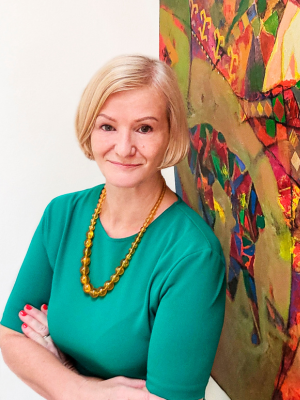
Sally J ClarkeIt took me a long time to realise that I am a verb, not a noun,” says Sally Clarke. “That’s why I now have a portfolio career.”

From leading communications at some of the world’s largest fintech companies to writing novels, building a business, and advising boards, Clarke has consistently evolved while staying true to her values of creativity, integrity, and impact.

Clarke shared with The Glass Hammer her experiences in shaping a career defined by movement, meaning, and a refusal to be boxed in.

On embracing a portfolio career:

“At the world’s largest financial technology companies, I led global marketing and communications over an eleven-year period. I’ve built and sold an online arts business, won multiple awards in the technology industry, published my fiction novel  Ringside Gamble, established the advisory practice of Asia’s leading think tank, visited Iran and Kazakhstan on writing assignments, sat on several boards across both the arts and technology sectors, and am now writing two new books. One non-fiction and the other fiction.

“It took me a long time to realise that I am a verb, not a noun. That’s why I now have a portfolio career. From my home in Singapore, I divide my time between advising technology companies solving complex problems, writing, and participating on boards.  My career continues to be an evolutionary process, not a ladder, but a landscape.”

On the personal qualities that shaped her path:

“I’m an optimistic team player — resilient and reflective. I was born into a working-class family and had my first job at the age of 14, delivering newspapers in rain, sunshine, sleet, and snow on my not-so-trusty, rusty bicycle. To this day, I can still remember the click-clacking sound the pedals made! I supported myself and earned scholarships through university and two postgraduate Master’s degrees — one in International Finance and the other in Asian Art History. I work hard to stand in the other person’s shoes.”

On living her values in high-stakes moments:

“Thanks to my parents, I have an internal compass forged in tungsten, a North Star I’ve trusted throughout my life.  I take time to reflect and rely on qualitative as well as quantitative data when forming decisions.

“In Singapore, I faced significant pressure to tell a potential customer at one firm that we had paid pilots — when the company did not. The same founder misinformed about the readiness of the software, employed bullying tactics and took credit for other people’s achievements. As a consequence I found opportunities aligning to my integrity and transitioned from the firm.

“The second challenge was leading the development and rollout of a content management system (CMS) and the front-end client interface. I pitched and secured USD two million in funding to lead a team of developers, designers, and project managers to rapidly build a web platform for data distribution. When it came time to go-live, self-doubt crept in. Many people told me the CMS would be rolled back — I had countless sleepless nights. But I trusted the process, and the so-called Greek chorus of naysayers was wrong.”

On mentorship and the power of stories:

“I’ve had the honour of working on the teams of some incredible people, such as Michael Rushmore who was pivotal in contributing to the growth of IHS Markit, a company I joined as head of marketing and communications in 2007.  Data giant S&P Global agreed to buy IHS Markit in a deal worth $44 billion in November 2020.  Michael had phenomenal insights, which I still share to others.  For example, “don’t make them have to work it out.” This golden nugget refers to the importance of communicating in such a way that your ideas land.

“Cristobal Conde former President, Chief Executive Officer and FIS and Chief Executive Officer at SunGard is a leader I admire.  He was incredibly supportive of the sustainability framework I helped build during my time at the latter firm.  At SunGard I won the President’s 100 per cent award.

“I read. A lot. Both fiction and non-fiction. Some of my favourite start up books, Shoe Dog by Nike co-founder Phil Knight,  Start Up CEO, by Matt Blumberg,   Play Nice but Win, by Michael Dell, and  Venture Deals: Be Smarter than your Lawyer and Venture Capitalist by Brad Feld and Jason Mendelson are examples.  I am inspired by stories. Indra Nooyi , former Chairman and CEO of PepsiCo, is another business leader I follow, and can thoroughly recommend My Life in Full.”

On how she leads with positivity and empathy:

“One piece of advice that shaped me early on was: “Don’t wait for permission.” It gave me the confidence to lead with conviction, long before I had a formal title. That mindset has served me well: whether I am building global brands, launching a start-up, or navigating difficult company mergers.

“But perhaps more influential than any single piece of guidance has been the example set by the leaders I’ve most admired. They led with clarity, composure, and care, especially in high-pressure situations. They didn’t command attention with noise; they earned respect with consistency. And they made people feel seen.

“Something I’ve carried with me through every chapter of my career is this: always role model the positive. Culture is shaped by what we tolerate, and by what we choose to amplify. So even when things are tough, I make a conscious choice to lead with optimism, empathy, and purpose. It’s not about pretending everything’s perfect; it’s about showing up in a way that helps others believe in what’s possible.

“And finally, I’ve learnt that how you leave matters as much as how you lead. It’s easy to focus on beginnings, but endings reveal who we really are. Whether moving on from a role, a company, or a chapter, I try to exit with the same integrity and thoughtfulness I brought to work itself.”

On redefining success:

“I often tell those I mentor that you can define success on your own terms, but only if you’re brave enough to step outside the conventional path. Early in my career, I tried to fit into other people’s expectations. It wasn’t until I started backing myself that I truly began to build things of value.

“I’ve learnt that leadership isn’t about knowing everything; it’s about being willing to go first, to take risks, and to bring others with you. I’ve built global brands, scaled start-ups, and now manage a portfolio career, and through it all, what’s mattered most is clarity of purpose, emotional resilience and having smart colleagues who challenge you.

“I would also say this: creativity is not a luxury; it’s a leadership superpower. Whether you’re building a business or writing a novel, the ability to imagine something that doesn’t exist yet and make it real is what sets great leaders apart. That, and the ability to walk away from what no longer serves you.

“Your career is not a ladder, it’s a landscape. Don’t be afraid to move sideways, take a leap, or build something of your own and test a hypothesis. Solving a big problem is where the real growth lies. If you opt to build a hobby business that’s fine too.  Just define what success means to you.”

On blending purpose with creative pursuits:

“I aim to continue supporting the efforts of sustainable companies using technology to make the world a better place. One particularly impressive firm I have worked with is Yokahu, a leading innovator in parametric insurance.

“That same sense of purpose carries into the passion projects that are a part of my portfolio career. In 2023, Ringside Gamble, a universal story about a young boy with a big dream, was published. Christopher Hatton (Star Trek: The Next Generation, Raven’s Hollow) is attached as producer for the feature film adaptation. I donate a percentage of the royalties to support the purchase of books and school equipment for children in Khao Lak, Thailand.

“With Deborah Overdeput, Chief Operating Officer of Innovative Systems, I’m currently working on a non-fiction book. It features a series of interviews with C-suite women, many of whom have founded their own successful companies or hold senior roles at the world’s leading banks and technology firms. More than a series of personal narratives, it is a testament to resilience, ambition and the power of choice. Each story shares hard-won insights, lessons in leadership and practical guidance for those looking to shape their own future. We’re currently seeking a publisher, with submissions expected to begin in September 2025.


Natalie Runyon“My definition of success has shifted,” says Natalie Runyon. “Fifteen years ago, I wanted to be in the C-suite. Now, my biggest legacy is raising well-adjusted children and having a good partnership to do that.”

First profiled in 2013 while Director of Global Security at Thomson Reuters, Runyon reflects on how her mindset of continual evolution has shaped her approach to achievement, purpose, and impact. She speaks to how she has embraced change with intention, guided by adaptability, self-awareness, and a commitment to aligning her professional growth with her personal values.

Evolving Through Curiosity and Change

Early in her career, Runyon made a name for herself in security operations, first at Goldman Sachs and later at Thomson Reuters, where she managed critical operations around the clock. At the same time, Runyon was already thinking about the future, getting involved with the company’s women’s network, earning a coaching certification, and launching a workshop called Be the CEO of Your Career, which eventually reached more than 1,300 employees globally.

Be the CEO of Your Career was translated into Spanish and Portuguese, and I trained facilitators to lead it. It helped get my name out there, build my credibility and expand my network.”

That visibility opened the door to a lateral move into sales operations, a role that allowed her to transition out of security and take on new challenges, but with more regular hours. “It was a big relief,” she says. “By then, I had two young kids, and I needed a shift.”

After a few years in sales, Runyon made her next career leap to a position at the Thomson Reuters Institute, where she has spent the last seven years curating thought leadership on topics ranging from talent and inclusion to ESG, human rights, and AI in the courts. While the content areas have shifted over time, one thing has remained constant: her ability to dive into unfamiliar territory with confidence.

“One consistent thread throughout my career, and why I have been able to make such big moves, is that I’m very comfortable operating in ambiguity and understanding how to ask the right questions to leverage the collective expertise of the people around me.”

In addition to being comfortable with uncertainty, Runyon highlights her natural curiosity as a strength. When she was asked to lead the Institute’s coverage of ESG, she got two ESG certifications to build her credibility and experience, “it opened up a new area for me to sink my teeth into and learn something new.”

That same curiosity is now guiding her latest area of focus: AI governance in court systems. “It’s not something I ever thought I’d be working on,” she says, “but I love that my role continues to evolve. Even though my title hasn’t changed, the content keeps shifting, and that keeps it interesting.”

Reframing Success and Failure

Runyon’s career evolution has also been shaped by her willingness to take risks outside the corporate world. She reflects on how her experiences as an entrepreneur, first in launching a coaching business, and later in acquiring a small company, shaped her definition of success and failure.

“Even though I originally designed the Be the CEO of Your Career workshop for my own coaching business, I probably had more impact rolling it out at Thomson Reuters than I ever would have had as a solo coach,” she says. “That was a success, just not the one I originally pictured.”

Years later, she challenged herself again by buying a business, after investing significant time in learning how to value and grow companies. However, when a family matter demanded her focus, she made the decision to sell. “I sold it at a loss, and financially it was rough,” she says, “but I don’t regret that decision at all.”

Through it all, Runyon has reframed what success looks like. “I don’t really look at things as failures, I look at them as learning opportunities,” she explains. “Life is fluid. None of my plans have ever worked out exactly the way I thought they would, but life has worked out.”

For Runyon, evolution is not about a perfect outcome. It’s about continuing to ask herself the hard questions, adapt, and stay open to wherever growth leads next.

The Dual Impact of Leadership Coaching

With a background in leadership coaching, it is no surprise that Runyon is a firm believer in its transformative impact. She often draws on what she learned during her training, skills that continue to influence how she leads, communicates, and navigates challenges at work.

“From the ability to ask good questions when I’m interviewing somebody for an article to having a level of comfort in asking the hard questions and not being afraid of the answers, my training as a coach has impacted me in foundational ways.”

She continues, “that includes not letting fear drive decision making, because in coaching you learn how to look at the worst-case scenario and explore questions like, ‘how bad can it really be? What if that happens? What can you do about it?’ That mindset has impacted my ability to adapt and flex and pivot.” Additionally, Runyon points to emotional intelligence, self-awareness, and the ability to see things from multiple perspectives as aspects of coaching that she continues to apply in her day-to-day life.

Runyon is also quick to acknowledge the impact coaching has had on her personally, having experienced its benefits not just as a practitioner, but as a client.

“In 2019, I was completely burnt out between juggling work, young kids, and being on two nonprofit boards. I met with Nicki for coffee, and she saw right away that I was miserable. She coached me for six months and helped me see how my mindset wasn’t serving me. She helped me recognize and assert that ‘no’ is a complete sentence and to give myself space to figure out what I needed next. It was a pivotal moment where coaching was critical.”

Grounded by Growth

As Runyon looks to the future, she acknowledges that her path is still unfolding. “I’m still trying to find my way,” she notes. “I’m challenging myself in new ways to give me clarity.”

Today, her focus is less on chasing traditional career milestones and more on creating lasting impact, especially through her family. “My biggest goal is to raise good human beings,” she emphasizes. “If I can give my kids the learnings I’ve had — to take risks, to not be afraid of failure, to stay true to themselves, then that’s success.”

Outside of work, Runyon continues to pursue growth on her own terms. What started as a personal challenge to swim a mile, a skill she once disliked, has grown into training for a sprint triathlon. “I’m trying to stretch myself, to do hard things, and to keep learning,” she says. She also set a goal two years ago to visit all 50 states by the time she turned 50, a milestone she will complete this summer.

Setting ambitious goals, inside and outside of work, is part of how Runyon continues to evolve. As she puts it, “It’s about progress, not perfection…You’re in charge of your own journey. You’re in charge of your own path. Just live your life.”

By Jessica Robaire

focus on what matters“You are the sky. Everything else – it’s just the weather.”
― Pema Chödrön

It can be tough to follow arbitrary advice to be less stressed, do more self-care, and spend more time ‘sparking joy’ while writing emails and trying to eat a salad. Our advice this Women’s History Month is much like Nike’s clever advertising campaign of “You can’t win, so win”. If you want to go all the way, then go all the way in your career in Corporate America, do not let anyone tell you that you cannot succeed. We would go further and say win on your own terms, define your own success however that is to you. Know what you want and what you are ready to do and if it resonates with you to avoid stress, overwork and overwhelm in these strange times then that, too, is a message to listen to.

In a world overflowing with distractions, tapping into your own voice and ignoring nonsense is a powerful act of self-care and productivity. We take in over five times more data daily than we did in 2011 and being stricter about the scroll in our lives allows us to preserve our energy, focus on what truly matters, and build lives that are more fulfilling and less cluttered with irrelevant noise.  According to experts, fear based topics like wars, erratic leaders, fear of layoffs, financial loss and reduction of rights—which seems to be our daily fare so far in 2025—creates more overwhelm and attentional bias than cat videos. Ignore the noise.

Start with You

You learn from others that inspire you and then spend time figuring out how to live your values. This year instead of the hashtags for International Women’s Day, I invite you to spend thirty minutes going deeper with yourself to figure out how to embrace what aligns with your values to create space for growth, happiness, and success.

Is the course you’re following leading you to the destination you want to reach? Are you living “outside in,” following a path where others have set the milestones and dictated how you should take each step? If this works for you, great, but if you find yourself asking “Is this it?” then consider what Bonnie Wan writes in her book “The Life Brief- A Playbook for No Regrets Living!”. She recommends “inside out” living, meaning getting real about what you want, however unconventional. And, if that means being the CEO or a dog spa owner, do everything you need to do to make it happen.

Know your Values

If you listed your values on paper, what would you write down? How would you say you lived those values? Give yourself some examples to test for accuracy as you may find you want to change words. Make your values verbs as it is in the doing of them that matters. What percentage of the time do you spend living those values?

If this feels daunting, then consider a few exercises to ensure you are spending as little as an hour per year on ensuring you know your values and are living them. Imagine you are celebrating your 100th birthday – where are you and with whom? What are you saying about what your life has looked like? What are the people around you saying in their speeches? What do you have to do now to make that a reality?

Increase your Mental Clarity

When we stop allowing ourselves to be distracted by trivial matters or irrelevant opinions, we free up mental space for things that truly require our attention. Focusing on what’s important helps us sharpen our thoughts, increase clarity, and make better decisions. Ignoring nonsense isn’t just about avoiding distractions; it’s about consciously choosing where to direct our energy. It is about being mindful and intentional about what we are doing but moreover, why we are doing it. Ignoring unproductive conversations or toxic comments allows us to maintain control over our reactions, helping us stay calm, composed, and more emotionally resilient in difficult situations. We can spend the time building trust with our colleagues so that we can get to a place of saying and hearing hard things and having radical candor.

Time is our most valuable resource. Every minute spent on trivial or irrelevant matters is a minute taken away from what truly matters. By ignoring nonsense, we reclaim that time and can devote it to more meaningful and productive activities—whether it’s pursuing personal goals, focusing on work, or spending quality time with loved ones. By being selective with your attention, you can cultivate relationships that matter and spend time on people and experiences that energize you. Not everything deserves your time and energy. Recognize what’s important and focus on it. Whether it’s in your personal life, at work, or online, ask yourself: Is this worth my attention? If the answer is no, let it go.

Instead spend time reminding yourself of your personal and professional priorities. This helps you keep perspective and make decisions about where to focus your time and energy. When nonsense arises, you can quickly assess if it aligns with your goals or if it’s something you can afford to ignore. Social media is a breeding ground for nonsense. Whether it’s heated debates, inflammatory opinions, or people airing personal grievances, it’s easy to get sucked into the drama. Consider taking regular breaks from social media or curating your feeds to include only meaningful content.

Strengthen Your Confidence by Being True to Yourself

Letting go of the urge to please everyone or respond to every negative comment builds self-assurance. By ignoring what doesn’t align with our values or doesn’t contribute to our growth, we assert our boundaries and reinforce our self-worth. Over time, this enhances our confidence and makes it easier to focus on our goals without being derailed by irrelevant opinions.

Of course, there are times when engagement is necessary—whether it’s addressing genuine concerns, advocating for yourself, or standing up for others. The key is knowing when something is worth your time and when it’s just noise. When in doubt, pause and evaluate the potential impact of engaging.

At the end of the day, success—however you define it—begins with clarity, confidence, and the courage to ignore the noise. By tuning out distractions and aligning your actions with your values, you create a path that is both fulfilling and sustainable. So, as you move forward, ask yourself: What truly deserves your time? What will you let go of to make space for what matters?

Define your own version of winning—and go all in.

Work with us as you navigate your career. Coaching starts at $300 per session and we offer a fifteen-minute exploratory needs call for assessing how we can help you and for a chemistry fit. Book HERE

By Nicki Gilmour, founder and CEO of theglasshammer.com and Evolved People Coaching