
Tag Archive for: author

Deborah Overdeput“I can look back and point to the promotions, the double-digit growth, all the successes along the way, but I never truly believed in my success until I stepped out on my own and built a business,” says Deborah Overdeput.

That moment of independence was not just a career milestone, but a shift in how she saw herself as a leader: someone who thrives on curiosity, creates clarity where there is none, and knows when it is time to pivot.

From Rocket Science to Market Growth

Overdeput began her career as a rocket scientist, trained in space station computing and fault-tolerant systems. Yet, when she relocated to Belgium for an engineering role at Swift, she felt restless. “I realized I really liked talking about what we were doing rather than actually building it. Once I got bit by that bug, I knew I had to transition into marketing.”

With no formal background in marketing, Overdeput made a bold decision: she would become a Chief Marketing Officer in technology. That goal guided every step she took, from mastering the fast-changing dynamics of marketing to taking lateral moves and pushing herself into stretch roles that expanded her skills and influence. At SunGard, her determination paid off as she advanced from marketing a single product line to overseeing more than 40. Later, at Sapient, she led the repositioning of a 250-million-dollar business unit and helped drive it to more than 500 million dollars in under five years.

What she took away from those years was simple: strategy only works if it is rooted in reality. “If you do not understand how products work, how teams operate, and what customers actually need, it is hard to make the right choices. I have always believed strong leadership starts with really knowing what is happening on the ground.”

Creating Clarity in Uncertain Times

Overdeput believes leadership matters most when circumstances are ambiguous. “You do not need leadership when everything is well defined. You need leadership when the path is unclear and the pressure is high. My role has always been to take that uncertainty, translate it into strategy, and help others see the way forward.”

That principle carries into her role today as COO at Innovative Systems, where she leads global product management, marketing, operations, and human resources. “My focus is on enabling human potential by aligning talent, strategy, and resources so that even in shifting markets, our people can do their best work and deliver meaningful impact for our clients.”

Innovative Systems is also known for building long-term relationships with clients, some spanning decades. Overdeput emphasizes that trust is both a differentiator and a responsibility. “Our clients count on us not just for technology, but for partnership. Delivering on that promise, year after year, is what keeps us relevant and resilient in a shifting compliance landscape.”

Lessons in Confidence and Voice

Before her COO role at Innovative Systems, Overdeput built a successful consultancy as a fractional Chief Marketing Officer. Working with a range of technology and financial services clients, she discovered a new level of confidence in her own capabilities. The experience affirmed her expertise and sharpened her ability to deliver high-impact results across different businesses and industries.

She also discovered her voice had changed. “Earlier in my career, as a woman inside large companies, I often found my ideas ignored until repeated by a man. Over time, I learned to strengthen my voice, to claim my authority. Today, people stop and listen not just because of my title, but because they know I speak with conviction and experience.”

That conviction shapes her leadership style today. “I try to listen more and advocate for voices within the company. Leadership is not about being the loudest person in the room. It is about making sure the right voices are heard.”

The Power of Networks and Mentorship

For Overdeput, networks and mentorship are essential leadership tools. She has mentored University of New Hampshire students since 2009, often those with math or computer science backgrounds like her own. “I tell them, start early. Build your network, get on LinkedIn, connect with your peers. Those relationships are career changing.”

Mentorship, she says, has shaped her as much as her mentees. “Working with students helps me see how the next generation thinks, what motivates them, and how they want to grow. That perspective is essential for any leader who wants to build teams that are not only high-performing today but also ready for tomorrow.”

It is also what inspired her latest project: Walk Away, a book she is co-authoring with Sally Clarke. “The book brings together stories of women who reached pivotal moments and chose to leave situations that no longer aligned with their values or ambitions. Hearing these stories has been like sitting with different mentors. Each one has helped me rethink the situations I face in my own career and the challenges my mentees bring to me. One of the women said, ‘Walking away was the boldest form of leadership I have ever practiced.’ That stayed with me, because leadership is often about knowing when to stay the course, and when the braver choice is to step into something new.”

Building Teams Through Talent

For Overdeput, the heart of leadership lies in building strong teams. “High-performing teams are not built by accident; they come from spotting potential others might overlook and giving people the chance to prove themselves. One of my best hires did not meet the checklist on paper, but I knew she had what it would take. She went on to become a star. As Steve Jobs once said, it does not make sense to hire smart people and then tell them what to do. My role is to create the conditions for their talent to shine.”

Her approach is less about rigid processes and more about creating conditions for people to thrive. Weekly check-ins, open conversations, and celebrating wins keep teams connected and aligned to a bigger purpose. “One of the most rewarding experiences is when a team pulls together to deliver something bigger than any one individual could achieve. I make it a point to celebrate those moments, because they remind me that leadership is not about one person’s actions, but about creating the environment where everyone’s contributions matter.”

Leading With Intuition and Humanity

Her leadership philosophy is also shaped by yoga and meditation, which she has practiced for more than 30 years. “Yoga taught me how to breathe through stress and build core strength, not only physically but also in the way I show up as a leader. Meditation taught me to quiet the noise, to see the world beyond my own ego, and to stay present for others. Together, they remind me it is not about me, it is about enabling others. Maya Angelou captured it best: people will forget what you said and what you did, but they will never forget how you made them feel. That truth stays with me, because I have seen it reflected back in the people I have supported, watching their success become part of my own impact.”

And from her mother, she learned the value of having a cheerleader in your corner. “She showed me that sometimes what you need most is someone who believes in you, no matter the obstacles. That is the kind of leader I try to be for others.”

Looking Ahead

Asked what drives her today, Overdeput points to impact. “I want to look back and know I left a stamp, that I built teams, grew businesses, and created opportunities for others to succeed. For me, leadership is about enabling human potential in ways that last, so the people and organizations I have touched continue to thrive long after I have moved on.”
That philosophy ties her trajectory from rocket science to COO together. As she puts it: “Great leadership means building great products, growing great people, and creating clarity in a complex world.”
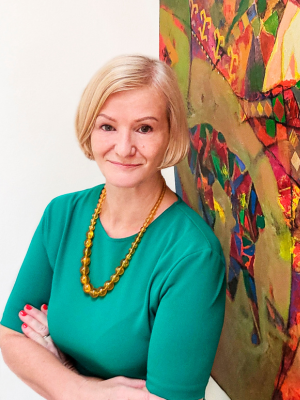
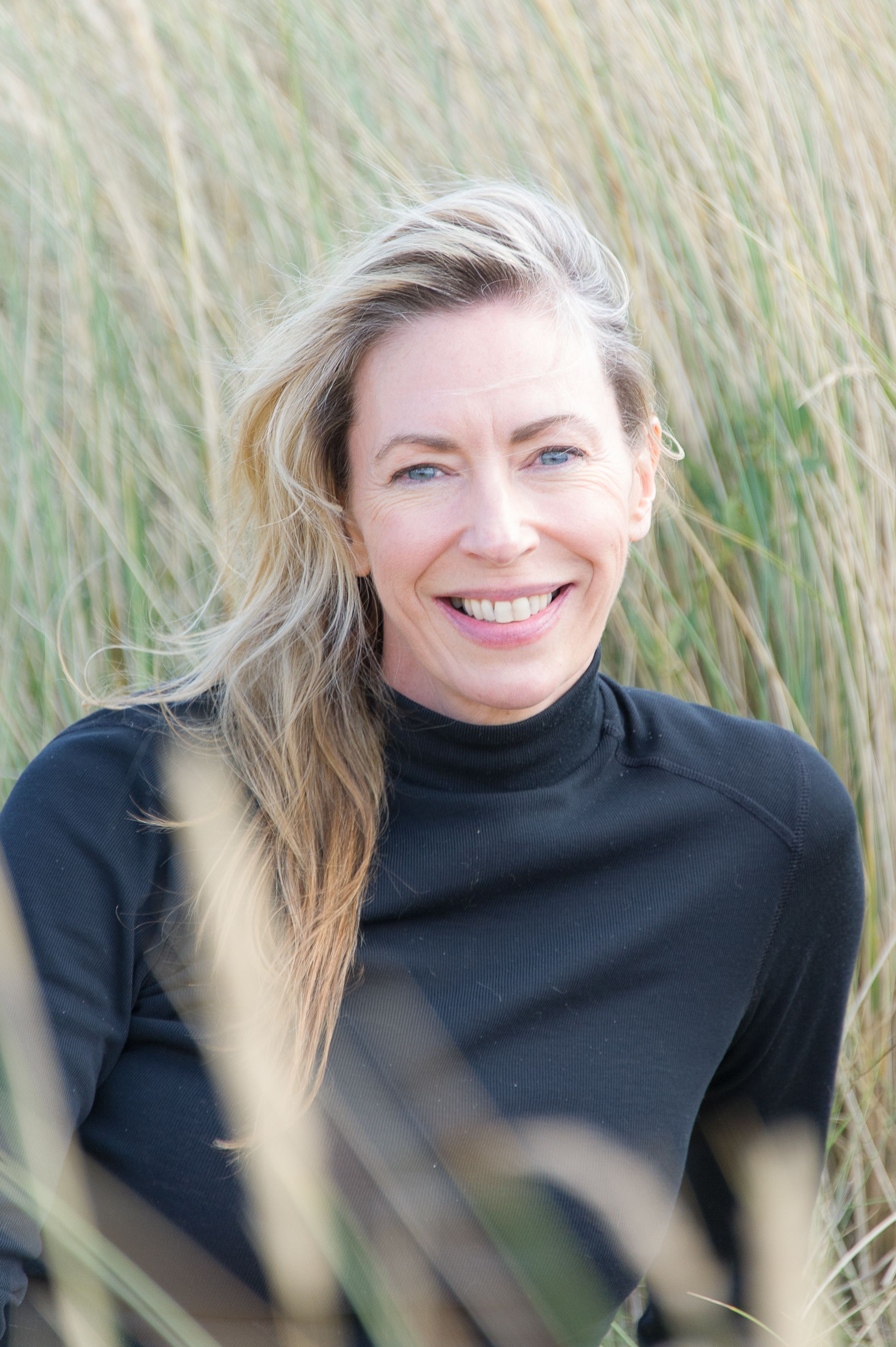
Sally J ClarkeIt took me a long time to realise that I am a verb, not a noun,” says Sally Clarke. “That’s why I now have a portfolio career.”

From leading communications at some of the world’s largest fintech companies to writing novels, building a business, and advising boards, Clarke has consistently evolved while staying true to her values of creativity, integrity, and impact.

Clarke shared with The Glass Hammer her experiences in shaping a career defined by movement, meaning, and a refusal to be boxed in.

On embracing a portfolio career:

“At the world’s largest financial technology companies, I led global marketing and communications over an eleven-year period. I’ve built and sold an online arts business, won multiple awards in the technology industry, published my fiction novel  Ringside Gamble, established the advisory practice of Asia’s leading think tank, visited Iran and Kazakhstan on writing assignments, sat on several boards across both the arts and technology sectors, and am now writing two new books. One non-fiction and the other fiction.

“It took me a long time to realise that I am a verb, not a noun. That’s why I now have a portfolio career. From my home in Singapore, I divide my time between advising technology companies solving complex problems, writing, and participating on boards.  My career continues to be an evolutionary process, not a ladder, but a landscape.”

On the personal qualities that shaped her path:

“I’m an optimistic team player — resilient and reflective. I was born into a working-class family and had my first job at the age of 14, delivering newspapers in rain, sunshine, sleet, and snow on my not-so-trusty, rusty bicycle. To this day, I can still remember the click-clacking sound the pedals made! I supported myself and earned scholarships through university and two postgraduate Master’s degrees — one in International Finance and the other in Asian Art History. I work hard to stand in the other person’s shoes.”

On living her values in high-stakes moments:

“Thanks to my parents, I have an internal compass forged in tungsten, a North Star I’ve trusted throughout my life.  I take time to reflect and rely on qualitative as well as quantitative data when forming decisions.

“In Singapore, I faced significant pressure to tell a potential customer at one firm that we had paid pilots — when the company did not. The same founder misinformed about the readiness of the software, employed bullying tactics and took credit for other people’s achievements. As a consequence I found opportunities aligning to my integrity and transitioned from the firm.

“The second challenge was leading the development and rollout of a content management system (CMS) and the front-end client interface. I pitched and secured USD two million in funding to lead a team of developers, designers, and project managers to rapidly build a web platform for data distribution. When it came time to go-live, self-doubt crept in. Many people told me the CMS would be rolled back — I had countless sleepless nights. But I trusted the process, and the so-called Greek chorus of naysayers was wrong.”

On mentorship and the power of stories:

“I’ve had the honour of working on the teams of some incredible people, such as Michael Rushmore who was pivotal in contributing to the growth of IHS Markit, a company I joined as head of marketing and communications in 2007.  Data giant S&P Global agreed to buy IHS Markit in a deal worth $44 billion in November 2020.  Michael had phenomenal insights, which I still share to others.  For example, “don’t make them have to work it out.” This golden nugget refers to the importance of communicating in such a way that your ideas land.

“Cristobal Conde former President, Chief Executive Officer and FIS and Chief Executive Officer at SunGard is a leader I admire.  He was incredibly supportive of the sustainability framework I helped build during my time at the latter firm.  At SunGard I won the President’s 100 per cent award.

“I read. A lot. Both fiction and non-fiction. Some of my favourite start up books, Shoe Dog by Nike co-founder Phil Knight,  Start Up CEO, by Matt Blumberg,   Play Nice but Win, by Michael Dell, and  Venture Deals: Be Smarter than your Lawyer and Venture Capitalist by Brad Feld and Jason Mendelson are examples.  I am inspired by stories. Indra Nooyi , former Chairman and CEO of PepsiCo, is another business leader I follow, and can thoroughly recommend My Life in Full.”

On how she leads with positivity and empathy:

“One piece of advice that shaped me early on was: “Don’t wait for permission.” It gave me the confidence to lead with conviction, long before I had a formal title. That mindset has served me well: whether I am building global brands, launching a start-up, or navigating difficult company mergers.

“But perhaps more influential than any single piece of guidance has been the example set by the leaders I’ve most admired. They led with clarity, composure, and care, especially in high-pressure situations. They didn’t command attention with noise; they earned respect with consistency. And they made people feel seen.

“Something I’ve carried with me through every chapter of my career is this: always role model the positive. Culture is shaped by what we tolerate, and by what we choose to amplify. So even when things are tough, I make a conscious choice to lead with optimism, empathy, and purpose. It’s not about pretending everything’s perfect; it’s about showing up in a way that helps others believe in what’s possible.

“And finally, I’ve learnt that how you leave matters as much as how you lead. It’s easy to focus on beginnings, but endings reveal who we really are. Whether moving on from a role, a company, or a chapter, I try to exit with the same integrity and thoughtfulness I brought to work itself.”

On redefining success:

“I often tell those I mentor that you can define success on your own terms, but only if you’re brave enough to step outside the conventional path. Early in my career, I tried to fit into other people’s expectations. It wasn’t until I started backing myself that I truly began to build things of value.

“I’ve learnt that leadership isn’t about knowing everything; it’s about being willing to go first, to take risks, and to bring others with you. I’ve built global brands, scaled start-ups, and now manage a portfolio career, and through it all, what’s mattered most is clarity of purpose, emotional resilience and having smart colleagues who challenge you.

“I would also say this: creativity is not a luxury; it’s a leadership superpower. Whether you’re building a business or writing a novel, the ability to imagine something that doesn’t exist yet and make it real is what sets great leaders apart. That, and the ability to walk away from what no longer serves you.

“Your career is not a ladder, it’s a landscape. Don’t be afraid to move sideways, take a leap, or build something of your own and test a hypothesis. Solving a big problem is where the real growth lies. If you opt to build a hobby business that’s fine too.  Just define what success means to you.”

On blending purpose with creative pursuits:

“I aim to continue supporting the efforts of sustainable companies using technology to make the world a better place. One particularly impressive firm I have worked with is Yokahu, a leading innovator in parametric insurance.

“That same sense of purpose carries into the passion projects that are a part of my portfolio career. In 2023, Ringside Gamble, a universal story about a young boy with a big dream, was published. Christopher Hatton (Star Trek: The Next Generation, Raven’s Hollow) is attached as producer for the feature film adaptation. I donate a percentage of the royalties to support the purchase of books and school equipment for children in Khao Lak, Thailand.

“With Deborah Overdeput, Chief Operating Officer of Innovative Systems, I’m currently working on a non-fiction book. It features a series of interviews with C-suite women, many of whom have founded their own successful companies or hold senior roles at the world’s leading banks and technology firms. More than a series of personal narratives, it is a testament to resilience, ambition and the power of choice. Each story shares hard-won insights, lessons in leadership and practical guidance for those looking to shape their own future. We’re currently seeking a publisher, with submissions expected to begin in September 2025.

Linda DavisNew York Times and Sunday Times bestselling author Linda Davies wrote this guest article for theglasshammer.com about how she succeeded as an investment banker and then made the leap from corporate life into full-time self employment as a novelist. This is surely a dream that many people share, but is it really that easy?

The GH: Linda, tell us about your career in finance in the city of London?

Linda: When I first stepped into the hallowed streets of the City of London as a callow twenty one year old graduate fresh out of Oxford, I only ever intended to stay for a few years.From when I was a little girl, I had always wanted to be a writer.Corporate life was a means to that end.

In the City, I had two objectives: one was to make as much money as I could legally in as short space of time as possible, and the second was to prove a point to myself and whoever I fancied might be watching.

The City lured you in with the promise of money but it had another USP that appealed to my young and foolish ego: it prided itself on its hair-cloth-shirt toughness, insinuating that you had to be something of a superhero to survive let alone thrive.

There weren’t any super heroines back then in the American investment bank I went to work for.I was the first woman they employed in European corporate finance.Back then, the glass ceiling was at entry-level and I was thrilled to have smashed it.
The work was an intellectual challenge, but the environment was not a fit for me..

Dealing in astronomical sums of money and being lavishly rewarded can be very corrupting, can lead you to think that you deserve the money, that you are entitled to the money, and that you need that amount of money to live a satisfactory life.

I had a plan and I stuck to it. I deviated occasionally and allowed myself indulgences, but the greatest indulgence of all is time and money buys time in my opinion. After seven years as a leveraged buyout and high-risk specialist, it was time to leave.

I had for several years been searching for a plot, and then, one day, I was sitting at my desk, feeling particularly annoyed with my boss, and wondering idly how much trouble I could cause financially, when the bare bones of a story leapt into my head.

It was a totally illegal plan, it would have made a lot of money, but I like to sleep easy at night, and so instead of doing it, I wrote about it. After six months, I knew that this plot could turn into a book.

I was young, free, and single. After seven years I had saved up enough money. It was time to take a risk, to turn my back on my large six-figure salary and bonus, and the status and security that went with it.
I remember the day I handed in my notice. I felt as if I had jumped out of an airplane without a parachute. It seemed like I was in freefall for weeks afterwards. It was a gloriously heady feeling.

The GH: Ok, so that is definitely a moment that some people would consider scary, possibly even risky! How did you go from quitting your day job to realizing your dream?

I wrote for 18 months, refining the plot until it was time to test the reality of my dream. Through a friend of a friend I was introduced to a literary agent. I went to see him, handed over my manuscript. It was a Thursday.

Then in some strange feat of serendipity, a kind of fortune favors the brave moment, a bizarre thing happened over the weekend.

About four months earlier, I had written a speculative letter to the Sunday Times, where I suggested writing an article about my experiences in the City. I was contacted a few weeks later by the editor of the Sunday Times Magazine who said absolutely, yes please, do write an article for us about what it is like to be a woman in that extremely testosterone-fuelled environment.

I had no idea when the article would appear, but, as luck would have it, it came out, covering six pages, on the Sunday immediately following my Thursday meeting with the literary agent.

This produced two rather wonderful and wholly anticipated results: one, an auction ensued amongst a number of publishing houses to buy my novel and two, I was contacted by about six different highly prestigious and successful financial boutiques and offered jobs (I have to say at this point, nothing in my article suggested that I wished to return to finance.)

This was 20 years ago.The book was Nest of Vipers – an adrenaline fuelled insight into the life of an investment banker, Sarah Jensen, who was recruited by the Governor of the Bank of England to go undercover in her investment bank to investigate an insider-trading ring that stretched from a central bank to the Mafia. Unbeknownst to her, she was also working for MI6.The novel went on to be published in over thirty territories and to be optioned three times for movies.

I am now on book number 13. Jumping out of my investment banking career had been a risk worth taking on every level.

The GH: What advice would you give our readers today?

I suspect that a number of you reading this are contemplating or have contemplated leaving the corporate system and so my advice to you would go along the following lines:

* While you are inside the system, be wary of buying into it and into the lifestyle to match it if you are intending to leave it, particularly in highly paid professions such as investment banking. Investment banking is a great way to amass money, but only if you do not spend like an investment banker.

* Many women in corporate life can still in some ways feel like outsiders. As the first woman employed by Bankers Trust’s European corporate finance department, I was patently and obviously an outsider and always felt like one. That was a real advantage. Relish and use that feeling. It gives you perspective, the ability to stand aside and look at your position and your broader options in the outside world and gives you greater flexibility in terms of the choices you might go on to make. There is no wonderfully set career path stretching out ahead of you. You have far greater freedom to make it up as you go along.

It’s been shown in personality tests/behavioral profiles that entrepreneurs are overwhelmingly outsiders. Being too wedded to corporate life can blunt your desire and ability to take risks with your career. Being an able quantifier of risk for your organization often does not extend to being able to quantify risk as regards your own life.

I’m a contrarian by nature and it’s led to some odd but potentially beneficial opportunities: the first was my Sunday Times article which I had thought was a very public exercise in boat-burning, in deliberately removing any fallback position, any hint of a Plan B should Plan A fail.I believed that the very absence of a Plan B would make me work harder to ensure Plan A worked!

How contrary was it then that my article and my attitude produced all these offers. I’m sure had I gone knocking on their doors the week before those same doors would have remained closed to me.

Being an author these days really means that you are an entrepreneur so a lot of my experiences and the lessons I have drawn from them can be applied across the spectrum to different areas of entrepreneurship besides writing.I hope some of these above might be of help.For those of you who are budding writers here are a few tips that have helped me.

* Write a whole draft before you begin editing.Writing and editing at the same time is a dispiriting and inhibiting process.Just get the first draft down and then you can play around with it.

* Make use of the most current technology to help you.I don’t type really well or very quickly but I have always typed out my novels on my desktop computer.However, just over a year ago, an old friend of mine who is an investigative journalist told me I was mad not to write about the story of my kidnap and detention in Iran.I started to think about it, suggested it to my agent who leapt at the idea.He said, look if you can write it in the next two months, we can publish it at the same time as your latest thriller, Ark Storm, which was due to be published nine months later.

Two months is a tight deadline, especially for someone who cannot type very well.So I did something I had been contemplating for a while.I installed Dragon Dictate voice recognition software on my computer.And I dictated the book, the memoir, which would go on to be called Hostage, Kidnapped on high seas, the true story my captivity in Iran.And I discovered a very welcome side benefit.I had wanted this memoir to sound much more intimate than my novels. I wanted it to read as if it were a tale being told at a dinner party perhaps to someone I had just met, one of those rare and special human beings who manage to elicit the most candid of confessionals.

And it worked. The act of dictating bypassed the overthinking intellectual part of my brain and turned out to be some of the best writing I have ever done. Instead of having to do my customary ten drafts I did only three.

If you are writing Instead of dictating, still read your work aloud. You will pick up many infelicities and awkwardnesses in the writing that silent reading and editing just will not detect.

We all know the maxim, write what you know, but also research and use what you know. Dictate great snatches of fabulous dialogue that you have heard in the workplace into your phone and then email them to yourself to save them and use them.This hones your ear for dialogue and also keeps fresh the characterizing lexicon of whatever workplace you happen to be in and will render your book much more immediate and real to readers.

Remember, everything is material. As I found during my seven years in the City, there’s always a silver lining.

Linda Davies’ latest book, Longbowgirl, a novel for children and Young Adults, is published on September 3rd by Chicken House Books.

To find out more about Linda and her novels and her memoir, Hostage, please see: www.lindadavies.com
www.longbowgirl.com

You can also find her on Twitter @LindaDaviesAuth