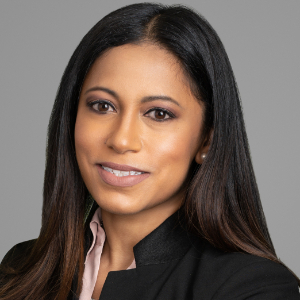
 “I will say I’m incredibly lucky that I’ve had the support of many women in my industry,” says Trisha Sircar, Partner at Katten.
The terrain of data privacy and cybersecurity is evolving as quickly as our relationships to technology, so there’s rarely been a more challenging or rewarding time to be an authority in this field.
Organic networking from one of the world’s largest insurance companies to Katten
After beginning her legal career in litigation at a law firm, Sircar moved to in-house at a global insurance company. In 2014, two years into her eight-year tenure there, she segued from employment law to data privacy and cybersecurity, exploring from both legal and business vantages, usually for Fortune 500 clients.
“We’d take a deep dive into how organizations measured their data privacy and cybersecurity from a macro and micro perspective,” Sircar says. “It was very interesting to see how different clients — healthcare, pharmaceutical, hospitals, universities, media, tech, professional services firms, retail, and others — use, collect and retain data, and manage their privacy and cybersecurity risk.”
Within her last remit as counsel and compliance officer, Sircar helped implement the company’s global privacy compliance and records and information management program, as well as manage internal policies and procedures pertaining to privacy, data and cyber security across more than 50 global locations.
Through her work, Sircar developed a longstanding client relationship with Floyd Mandell and Karen Artz Ash, Katten Partners and Co-Chairs of the Intellectual Property practice.
“I had very close ties with Katten throughout my career,” she says. “I saw Floyd and others on his team as mentors and friends that I could always turn to.”
Sircar was focused on establishing her career in-house and did not plan to return to private practice, but soon found herself accepting the invitation to join Katten in January 2020.
“I knew their business model, their reputation, and I knew that I could trust them as a partner based on the multiple matters that we handled together,” she says. “I always tell my mentees and associates on my team that you should keep an open mind and be open to opportunities. So I kept an open mind, and I’ve been very happy with the decision.”
New World, New Questions, New Challenges
In her role at Katten, Sircar is largely confronting the issues that have arisen and solutions to be forged under the context of a public health crisis.
“I’ve recently worked on updating business continuity plans for clients that envisaged a terrorist attack in advance of 9/11 or natural disasters before Hurricane Sandy struck, but many of our clients never thought to foresee a pandemic,” says Sircar. “So we are creating a new playbook. It’s something that is dynamic and going to change day to day, every day.”
A salient focus right now is education privacy, both in creating safe and secure practices for sustaining education in a remote environment and navigating, where feasible, re-entry into the classroom.
As both an attorney and aunt, Sircar appreciates the complex considerations at play in the transition to remote learning, including the importance for schools to perform critical due diligence on software, applications and technology platforms with regards to how they protect students’ privacy, and to pay close attention to how these platforms collect data on students.
Schools need to address whether they provide sufficient disclosures to students, parents and guardians, and teachers, and employ adequate information and cybersecurity protocols so parents and guardians are clearly aware of what is going on in virtual classrooms and what support is available, according to Sircar.
“Whatever we can do to promote safe and secure practices for schools during this environment, whether they are participating remotely or in a hybrid model, is really important,” Sircar said.
Sircar clarifies there is no easy, one-size-fits-all solution. Not only are schools under state-level laws, but guidance at the district and school levels differ and fluctuate too.
Many business clients are also navigating creative changes in their client or consumer relationship and interface in the present pandemic world.
The way of overseeing businesses’ privacy policies and processes, and compliance with global privacy law, is also impacted — from managing increases in cybercrime to what to do when you can no longer run to the IT guy down the hallway.
Real Diversity is Visible
Despite the tech-related nature of her legal realm, Sircar attests that neither her gender nor Indian ethnic background have been personal barriers.
“My last manager was a female. Her manager was a female and the hierarchy above her were all females,” she says. “I have been fortunate to have had incredible mentors. And Katten is truly supportive and amazing in terms of their work/life balance and maternity leave policy.”
“I have interviewed with companies and law firms that I know have strong diversity and inclusion programs, and it’s not just window dressing. I see their impact at a substantive level,” says Sircar.
She recommends to do the research before interviewing, ask the hard questions and pay attention. At a senior level, she suggests reaching out to networking peers to share thoughts on the leadership culture of a firm.
“When I hired Katten at my predecessor company’s lawyers, I saw the hierarchy, and there were females and minorities in those high positions that I’d be working with or reporting to,” says Sircar. “But I think law firms generally have more work to do to achieve parity.”
On that note, Sircar finds her pro bono work with entrepreneurs in socioeconomically disadvantaged communities, which helps to foster more diversity in law, to be essential.
“I think it’s really important that as lawyers and leaders, we don’t always look to what we deserve or what we should get,” states Sircar. “It should be more of a culture that embraces giving back.”
Mentorship and Support
“Katten really supports mentorship, not only at an internal level between partners and associates,” notes Sircar, “but also externally with students — from high school to college to law school.”
While she’s often gone the path on her own — from Australia to New York to law school to partnership — she emphasizes to her mentees to be willing to ask for support.
“Reaching out for help or advice does not subvert you from your task of getting to what you want to do,” says Sircar, “and it could have gotten me there faster. Be open to others’ opinions. Don’t be afraid to ask uncomfortable questions, but also be prepared for the tough answers.”
“It’s really important to get different perspectives from different people, from different backgrounds and different facets of the legal profession.”
Guardian of our Times
In addition to being perceived as a role model to other women and making her family proud, Sircar is proud to stand as an authority in a field of law that has an impact on everyone in this interconnected, global digital economy.
“I assist my clients in understanding and managing the evolving privacy and cybersecurity risks that they face when they create their services and products or market them, while protecting and securing personal data and confidential information,” she says. “Working in an industry that really affects everybody and holding all parties accountable to that, that’s another thing I’m proud of. I get to do a job every day that helps society by promoting and ensuring an ethical approach to the usage of data, individual privacy and sound cybersecurity hygiene.”
By Aimee Hansen

Intrepid Women: Beverly Robinson, Client Service Consultant Abbot Downing
Intrepid Women Series, People“I’ve learned to “code-switch” conversationally, in order to convey diverse philosophies and concepts. This tactic allows me to circumvent being profiled and misinterpreted as “angry or aggressive”, and in that way, my voice for diversity and inclusion, and ideas for advocacy are heard more clearly. As an African American woman in Corporate America, I’ve learned that I cannot afford to be thin-skinned when my ideas are usurped, re-mixed or claimed by others. There’s an art to being a woman of diversity, inclusion and advocacy.
My banking career is a means to my economic well-being. However, support of the disenfranchised and marginalized is where I have the greatest impact, and receive heartfelt, profound fulfillment.
As a survivor of childhood molestation, it’s imperative that I fight for those whose voices are often stifled by domestic violence, fear, stigma and even death. I spend priceless time at our local Family Services and Rape Crisis Centers, talking with mothers, hearing their stories of survival, and offering my time and resources. Organizing programs for the national “Domestic Abuse Awareness Month”, to assist the families in moving to the next level, empowers these families and creates hope for a brighter future. In addition, I spend time on college campuses, speaking for the National “Take Back the Night” campaign, and have met and formed friendships with students who have opened up and come forward with their own stories of abuse. Many of these students have graduated to become powerful advocates. Pushing my corporation to provide professional opportunities for students of color who attend Historically Black Colleges and Universities (HBCU’s) is an ongoing passion, resulting in graduates achieving internships and careers and even becoming entrepreneurs. Several of my colleagues have volunteered to become guest lecturers at those HBCU’s, forming an alliance with the faculty and students, helping to power an enduring and ever growing partnership, focused on providing opportunities for a rising generation of talent and leaders.
Because of the confluence of all the above, I became an author, sharing my story and life experiences, presenting workshops and seminars, and traveling nationally doing book tours. My audience is diverse, broad and varied.
Growing up, my upbringing was a bit eclectic. My childhood was not unusual, but not necessarily normal. I began school in Ft. Riley, Kansas where my step-dad was stationed in the Army, in an integrated environment including students who were children of soldiers. Our neighborhood was fully integrated, and by all accounts, civility and unity ruled the day. Being a leader in class both scholastically and athletically, I made friends easily. I clearly remember my first bold act of advocacy on behalf of my classmate, my little blonde, blue-eyed friend named Donna, who, when called on by our teacher to give answers to pop quizzes, was paralyzed with fear, unable to raise her hand to answer the questions asked in rapid fire succession.
As all of our hands were upstretched in excitement, wanting to be picked to answer the questions, our teacher continued to purposely call on her, making my classmate cry uncontrollably, in embarrassment.
The discomfort I felt for her compelled me to yell out the answer each time our teacher berated her, which angered and frustrated the teacher. I spoke up and answered the questions out of turn, knowing I would get in trouble. Donna’s feelings mattered to me. I didn’t appreciate the mistreatment and bullying of my friend. Conversely, my teacher didn’t appreciate my interjections, with my yelling out the answers, so she hastily took me out of the classroom, and in the presence of another teacher as the “witness”, I received corporal punishment. The other teacher seemed irritated that the punishment did not fit the crime, but did not interfere, nor raise opposition. I remained defiant. After this episode, the teacher tapered her verbal assaults directed at my classmate, all but ignoring her. I remained prepared to yell out answers on her behalf. I learned about getting into “good trouble” early on.
My step-dad’s military career was cut short due to his poor physical health. The normality of my childhood was disrupted because he was also unhealthy mentally. He was an incestuous pedophile. We left Ft. Riley, and moved back to my hometown, where I began a new school. A segregated school. The anomaly of transferring from an integrated school to a segregated school and neighborhood wasn’t earth shattering in my young eyes, as I felt comfortable in both settings. My new school was all-Black. All of the teachers, faculty and staff were Black, and the students were treated like family. The women wore dresses, pearls and heals, and all the men wore suits and ties every single day. The pride they carried washed over us as students. They believed strongly in instilling in us a solid education. They believed in excellence and wouldn’t allow any of us to settle for less. Integration and busing came to our school four years later. Our fifth grade teacher, Mrs. Tanner, who was beautiful and brilliant, prepared us for the integration process that was to happen the following year. She gave us “the talk”, and drilled in us that although the books, equipment and educational materials that we used for study were old and dated, compared to the ones of our white peers whose schools were on the more prominent side of town, we were just as smart and capable. I believed Mrs. Tanner, and her words regarding capability settled in my consciousness to this day. I graduated from college and obtained my MBA.
From corporate boardrooms to college campuses, and from church pulpits to women’s empowerment conferences, my sphere of influence has allowed me the esteemed opportunity to listen with compassion, create viable diversity programming, to serve as mentor and trusted advisor to executive management, share life experiences, and to empower and affirm those seeking answers to life’s challenges. I learn and grow with each interaction. Advocacy isn’t the path of least resistance, and often, fighting for others while girding oneself mentally and emotionally is typically the road less
traveled. At times, my resolve and tenacity has been shaken when I’ve seen clear paths and pipelines to inclusion, but met with non-cooperation, deflection, indifference and lack of enthusiasm. It’s always a challenge understanding those who are not willing to work hard on behalf of others, unless they receive accolades – self-aggrandizement. But I’ve learned that to push forward to accomplish goals, ideologies and dreams, sometimes obstacles have to be sidestepped, and rerouting and recalibrating is necessary in order to accomplish the objectives of unity and inclusion.
I’m enjoying my journey, paying keen and sincere attention to the needs of those requiring a voice. I relish being able to push, pull and convince others to work on behalf of those in need. All of our lives improve markedly when we serve l.o[0others. I shall continue to advocate for those within our company structure, and for those outside of our corporation. And, as I say often, “courage takes courage”.
Abbot Downing, a Wells Fargo business, and Wells Fargo Private Bank offer products and services through Wells Fargo Bank, N.A. and its various affiliates and subsidiaries. Wells Fargo Bank, N.A. is a bank affiliate of Wells Fargo & Company
By Aimee Hansen
Op-Ed: Leading Toward Disruption – A Call to Action for Women In STEM
NewsThere has never been a time in my career when I have been more optimistic about the future for women in leadership and women in STEM.
I have been inspired through all of the chaos of the last year to work toward a new kind of change leadership where uncertainty is the norm and reinvention becomes the goal.
The intense turmoil of 2020 – the pandemic, social unrest, economic instability and devastating natural disasters – has exposed the fragility and insecurity of old paradigms of leadership.
Leadership that is rooted in preservation ignites fear. The fear of change that persists in organizations is the same fear that perpetuates gender bias because it means that we have to do things differently.
As women, STEM professionals and change leaders, we are uniquely positioned to shift the equilibrium from fear toward sustained progress.
We are a triple threat.
Now is the time for us to seize the momentum as champions for equity, catalysts for purpose driven innovation and architects of permanent changes for good.
We must expose the invisible barriers that have weakened companies and communities and leave the rules of the past behind.
While there are more women in STEM than ever before, recruiting more women into STEM careers is not enough. Developing and galvanizing a pipeline of women that can lead into disruption is our greatest opportunity.
In a 2019 research study developed and conducted by RTI International commissioned by L’Oréal USA and the Heising-Simons Foundation, 90% of respondents agree that in the past decade, women’s opportunities for career advancement in science have improved along with gender composition and 66% agree that women’s representation in leadership positions in scientific fields has improved.
While there is a sense of progress emerging, the gender gap in STEM continues to grow especially in leadership roles.
My journey upon reflection
Reflecting on my own leadership journey, I was not always optimistic about the future – especially my own. I experienced set backs, rejection and a lot of disappointment.
For many years, I emphasized competence and performance as a way to advance. I took on more stretch assignments to increase my visibility. I ignored the signs that my dissenting voice was unwelcome and my naïveté got the better of me. I was exhausted, frustrated and ready to throw in the towel. I falsely assumed that change in organizations is rational. And, I battled whether or not I needed to change myself or my expectations to be successful.
Overtime, I began to realize that competence is a trap, certainty is a fallacy and being a critic is really hard.
I started to educate myself and concluded that I wasn’t alone and that the discrimination I experienced was not personal but systemic and far reaching.
According to a study conducted by the American Association of University Women (AAUW) commissioned by the National Science Foundation, women believe they need to be exceptional to advance in STEM.
As STEM is considered “masculine”, women are seen as either competent or likable but not both. When a woman displays competence, she pays the price in pay equity, rewards and advancement. And this double bind has a significant impact on retention among the most talented and highest potential women in particular. An Oxford Academic Journal studying retention concluded that women with advanced degrees are 165% more likely to leave STEM.
I too was on my way to becoming another statistic but I reversed the trend and actually I’m proud to say that I am a statistic – but the good kind. In 2018, Harvard Business Review published a study from the Center for Talent Innovation which found that one in five women in STEM achieve success regardless of how supportive or hostile their working environment is.
One of the key differentiators highlighted in the research is speaking up. However, 82% of women in STEM say when they do speak up, their contributions are ignored.
It is no wonder, many of us eventually retreat. According to the Oxford study, after about 12 years, 50% of women who originally worked in STEM leave, compared to only 20% of professional women.
There have been many times that I have been afraid to speak up to avoid discomfort, retaliation and embarrassment.
I became aware that I could take a stand, get overlooked, keep going and be afraid all at the same time.
I convinced myself that I could breakthrough by taking the biggest risk of all – being myself.
This journey of leadership is how I got to today – ready to embrace the unknown, finding the way forward between old and new and reimagining what comes next.
Standing up for change is a courageous decision – especially when it requires change from within.
I envision a future where courage is rewarded and change resistance is no longer tolerable.
Women leaders in STEM are the trifecta of audacity, empathy and diversity needed to unleash a new reality that is grounded in equality.
We are the change.
Danielle Maurici-Arnone is the Chief Information Officer at Reckitt Benkiser (RB), a global Consumer Products company, where she leads the technology function for the North America Health and Nutrition businesses and sits on the Global Council for Diversity and Inclusion.
Danielle has served in global technology leadership roles for more than 20 years. She has founded and led SaaS based start ups in digital marketing and retail.
She has a rare combination of skills and experience delivering enterprise digital technology transformations as well as designing and scaling emerging technology solutions.
Danielle graduated Magna Cum Laude with a BA from Rutgers University. She received her Masters in Public Policy and was a graduate fellow at the Eagleton Institute of Politics at Rutgers. She holds a Masters in Information Systems from the Stevens Institute of Technology.
She serves on the Governing Body of Gartner’s CIOs Forum, is a board member of the Foundation Committee for the NJ Society of Information Management, is board member and Scholarship Committee chair for the Academy of Finance.
Danielle passionate about the advancement of women in STEM careers, technology and business leadership
Niamh Bushnell: Chief Communications Officer (CCO), Soapbox Labs
Voices of ExperienceBushnell shares her passion for Ireland’s technology prowess, the importance of equitable AI and the challenges for women in technology.
Tech Was The Ticket, Ireland Was the Passion
Coming out of university in the mid-90’s, Bushnell was keen to travel, use her foreign languages (Spanish, French and Italian), and work with smart, exciting people.
“So it wasn’t a love of technology itself that attracted me to the tech industry.” she admits. “I’ve always had those two sides, working with savvy tech entrepreneurs and representing tech companies, but not being a ‘tech person’ myself. What I did love, and was drawn to, was their smarts, and the universality and the dynamism of the industry.”
During 16 years based in the NYC area, she worked on supporting Irish, European and other international start-ups in entering the U.S. market. While adventure may have drawn her to tech, what compelled her to remain has been the opportunity to secure Ireland’s place in the “pantheon of technology champions.”
“For someone who loves to travel and has a global mindset, I’m also very committed to supporting local – be where you are, get involved in where you, shop where you are,” says Bushnell. “I was 16 years in NYC when I saw an ad for a leadership role in Dublin – to be the face of the indigenous tech industry there, to tell the story of Dublin as a city of technology and innovation. It read like a job tailor made for me, with a mission I could be really excited about.”
In 2014, as Dublin Commissioner for Startups, she returned home with family, where she launched popular initiatives like the First Friday Brekkie, the publication Dublin Globe (to tell the stories of Irish tech companies), the data tracking platform TechIreland, and female founder focused activities like the €100M campaign, and the video series Female Founder Fridays.
“People think that multinational companies are the only Irish tech stories,” states Bushnell. “But there are over 2000 Irish startups and scale-ups expanding globally with technology homegrown in Ireland. I was just really fired up to tell that story.”
The Power of Tech Networking
As Commissioner, Bushnell’s strategy was to focus on promoting “the best of the best” Irish companies to achieve international traction.
“My philosophy was always that to win, our approach can’t be to love all of our companies equally. If we want Dublin’s reputation to grow, we have to focus our limited resources on promoting the very best companies, the most talented and gifted teams, the businesses with the greatest global potential,” she remembers, “Promote them first and foremost, and all Irish companies will benefit from that.”
It was at one of the monthly First Friday Brekkies Bushnell hosted in the Commissioner’s office that she met Patricia Scanlon, CEO and Founder of SoapBox Labs, a deep tech AI company specializing in speech recognition for children. They happened to both have a ring made by the same Soho designer from their stints living in New York.
“You can tell when you meet founders how deep their ambition is, how great their vision is, and how solid their ground rules are,” states Bushnell. Scanlon’s 20+ years of specialization in speech recognition, her vision, and her approach to fundraising impressed Niamh hugely.
“Speech recognition for kids hadn’t really been touched,” explained Bushnell. “So SoapBox was going to be the specialist who would become a world leader in that space. The ambition to deliver on that was already tangible.”
Real integrity in AI
In her current role at SoapBox Labs, Bushnell testifies to the value of foresight and patience in developing the best technology to positively impact all user’s lives.
“Is your AI developed in a way that is equitable – that doesn’t have inherent gender bias or racial bias?” asks Bushnell. “If voice tech doesn’t recognize a kid’s dialect and gives them a lower score on a reading assessment because they don’t pronounce words in the way the AI has been built to understand them, they’re going to lose out at school.”
“The way technology is built these days hugely impacts people’s quality of life – including their physical and mental health – and it can impact them socioeconomically too.” says Bushnell. “Equity is a big piece. Our voice technology has been proven to show no bias when it comes to accents and dialects. That’s massive. We built it with the ambition to deliver a level playing field for all kids, so we’re super excited that independent validators and customers are confirming that.”
As technology becomes more deeply integrated into our lives and education, especially at a young age, it’s more important than ever that it offers a positive and accurate experience for all users. With voice technology, this means developing solutions from the ground-up that actually work for all kinds of children.
“So that’s the compelling vision I’m now happy to be communicating,” smiles Bushnell.
Challenge for Women in Tech
Having held several roles promoting the tech industry, Bushnell has talked to many women about their experiences.
“What is one-hundred percent true, but kind of unbelievable still, is that women founders who are technical by background are often not taken seriously for their big vision and big ambition,” says Bushnell, especially if they’re proposing game changing, first-of-its-kind innovation.
“Women founders who are scientists, who are engineers, who are PhDs, who have spent their whole careers building innovation and have the patents to prove it, these women say that when they go into a room and position a big vision of something that is going to change the world, they are often not believed by the men or the women (if there are any) sitting on the other side of the table.”
These women need extra grit and resilience as they move step by step through the process of knocking down the hurdles placed before them. Bushnell agrees that women have a huge responsibility to support other women in breaking down the barriers we collectively face. She also says it’s about time that women get over the need to be liked by everyone.
“I think you’ve gotta really be comfortable with being a leader and being respected” she says, “but it’s also okay to be unpopular for decisions you make. It’s also okay to be wrong about decisions you make and put up your hand and say so. I think women care a lot more about their reputations at every stage of their journey than maybe they should.”
Despite the observation that society has a harder time accepting and encouraging women through failures, she encourages women to learn to embrace racking up some failures along the way.
“We just have such a hard time faking it until we make it,” says Bushnell. “and business is nothing but that. You never really have any of the answers! You do good research, pay attention to the trends, listen to your instincts, but in the end, you have to take risks.”
One of her greatest experiences was in the TechIreland role when her team had little resource but a big vision. She loved taking risks, dusting herself off, and developing the tenacity to get up again and learn by doing.
“You can have loads of failure but if you have tenacity, the chances are you’re going to figure it out as you try and fail, as you go along.” she muses.
“There’s a lot of freedom when you’re comfortable with risk, and with freedom comes creativity. Don’t worry if every single step isn’t going to come out as you want it to. Often times you don’t even know what the ideal outcome is, until you start.”
Women in Tech: Seven Hurdles to Overcoming the Gender Gap
NewsSo why is tech still so male-dominated? Research shows gender diversity training programs are not altering the leadership composition in tech.
Perhaps it’s because the gender gap is truly a series of interconnected hurdles that run along the tech trajectory.
Attraction Deficit
Women have been disinvited from tech over the decades, often even steered away by their teachers. Both tech stereotypes and a lack of visible role models are discouraging.
Back in the 1980s, women made up 37% of computer science (CS) graduates. Nationally, women earning CS degrees decreased from only 27% percent in 1997 to 19% in 2016.
Meanwhile, Accenture found there are more jobs in the field than graduates to fill them.
Yet focusing only on attracting female students – who are inclined to be more proficient in engineering and tech tasks at the eighth grade level – is highly oversimplifying.
Fewer Women In Tech Roles
As of 2015, women made up only 25% of computing roles nationally. In the UK, only 17% of the digital workforce is women for a decade now.
“A diverse mix of voices leads to better discussions, decisions, and outcomes for everyone,” says Google CEO Sundar Pichai. But the tech profile does not reflect gender diversity.
As of 2020, women comprise only 20% of Microsoft tech jobs, and 23% of tech jobs at Facebook, Google and Apple.
“Bro Culture”
A stereotype-ridden “bro culture” that is laden with microaggressions creates a sense of women not belonging in tech.
“Diversity in the workplace has a lot to do with psychological safety and a comfortable welcoming environment in the workplace,” writes Kamilika Some in Analytics Insight. “As long as workplaces don’t become women-friendly, they would not feel comfortable enough to speak up and contribute to the team constructively.”
Pew research in 2017 showed that 74% of women in computer jobs felt gender discrimination. In a male-dominated workplace, 79% of women felt they had to prove themselves all the time.
An Ivanti study showed that more than 60% of women in the tech sector felt that long-standing stereotypes still favored men in leadership roles in tech and that women are judged by different criteria. 53% of women felt they weren’t taken seriously in the workplace.
Forbes council member Tendu Yogurtcu writes that increasing women in leadership requires meaningful cultural changes and “happened (at her company) because we focused on creating a fair, inclusive environment where everyone feels empowered to share ideas.”
Less Pay
Pew Research reports that women in computing on average earn 87% of what a man earns, with greater gaps for Black women.
A 2019 IDC report showed that, contrary to stereotype, women (52%) in tech were more concerned about compensation and pay than men (33%). Further, only 42% of women felt their employer paid equitably, while a whopping 75% of men felt they did.
The Ivanti research revealed that 64% of women would see equality in pay and benefits as a main factor in attracting them to a new role.
Low Retention
National Science Foundation data shows that only 38% of women who majored in computer science are actually working in the field (compared to 53% of men).
Previous research showed that US women working in tech, science, or engineering were 45% more likely than male colleagues to quit their job in the first year.
With lower pay, unwelcoming culture and less likelihood of leadership, it’s not surprising.
Missing in Leadership
The Ivanti women survey found that women perceiving a glass ceiling in tech (31%) rose in 2019 (from 24% in 2018).
An IDC report indicated that women in tech senior leadership increased from 21% in 2018 to 24% in 2019. 54% of men felt they were likely to be employed to executive management in their company, whereas only 25% of women felt the same – noting lack of support, self-confidence and sponsorship.
Deloitte found that women who have sponsorship within STEM are 22% more likely to be satisfied with their rate of promotion, 37% more likely to ask for a raise, 70% more likely to have their ideas endorsed, 119% more likely to have their ideas developed and 200% more likely to have their ideas developed.
According to Silicon Valley Bank (SVB), only 41% of new US tech startups have a woman in the C-Suite and 37% have one on the board of directors. Only 4.8% of S&P 500 CEOs are women.
Women make up only 25% of Microsoft leadership, 26% at Google, 27% at Amazon, 29% at Apple and 33% at Facebook.
IDC research shows that at companies where at least half of the senior leadership positions are held by women, the chances of equal pay for women, higher retention and job satisfaction are better.
Yet only a third of start-ups have programs focused on increasing women in leadership and 17% have goals to increase C-Suite representation, according to SVB.
Few Women Founders
The gender of the founder or founding team of startups has a huge impact on gender diversity in leadership, according to SVB.
Only 14% of total startups have a women CEO. But among startups with a woman on the founding team, 46% have a woman CEO. Among startups with only male founders, only 2% have a female CEO.
Yet less than 4% of total startup funding goes to women founders, and Pitchbook reports 77% of US Venture Capital funding in 2019 went to all male founding teams.
When it comes to venture firms who channel the capital, 65% have no female partners. Only 7% of partners at global top 100 venture firms are women.
All in all, tech is currently better at keeping women out than encouraging them in. If the industry wants to catch up, it’s not only one gap that must be addressed, but all of the hurdles at which women drop out.
by Aimee Hansen
Trisha Sircar; Partner, Privacy, Data and Cybersecurity, Katten
People, Voices of ExperienceThe terrain of data privacy and cybersecurity is evolving as quickly as our relationships to technology, so there’s rarely been a more challenging or rewarding time to be an authority in this field.
Organic networking from one of the world’s largest insurance companies to Katten
After beginning her legal career in litigation at a law firm, Sircar moved to in-house at a global insurance company. In 2014, two years into her eight-year tenure there, she segued from employment law to data privacy and cybersecurity, exploring from both legal and business vantages, usually for Fortune 500 clients.
“We’d take a deep dive into how organizations measured their data privacy and cybersecurity from a macro and micro perspective,” Sircar says. “It was very interesting to see how different clients — healthcare, pharmaceutical, hospitals, universities, media, tech, professional services firms, retail, and others — use, collect and retain data, and manage their privacy and cybersecurity risk.”
Within her last remit as counsel and compliance officer, Sircar helped implement the company’s global privacy compliance and records and information management program, as well as manage internal policies and procedures pertaining to privacy, data and cyber security across more than 50 global locations.
Through her work, Sircar developed a longstanding client relationship with Floyd Mandell and Karen Artz Ash, Katten Partners and Co-Chairs of the Intellectual Property practice.
“I had very close ties with Katten throughout my career,” she says. “I saw Floyd and others on his team as mentors and friends that I could always turn to.”
Sircar was focused on establishing her career in-house and did not plan to return to private practice, but soon found herself accepting the invitation to join Katten in January 2020.
“I knew their business model, their reputation, and I knew that I could trust them as a partner based on the multiple matters that we handled together,” she says. “I always tell my mentees and associates on my team that you should keep an open mind and be open to opportunities. So I kept an open mind, and I’ve been very happy with the decision.”
New World, New Questions, New Challenges
In her role at Katten, Sircar is largely confronting the issues that have arisen and solutions to be forged under the context of a public health crisis.
“I’ve recently worked on updating business continuity plans for clients that envisaged a terrorist attack in advance of 9/11 or natural disasters before Hurricane Sandy struck, but many of our clients never thought to foresee a pandemic,” says Sircar. “So we are creating a new playbook. It’s something that is dynamic and going to change day to day, every day.”
A salient focus right now is education privacy, both in creating safe and secure practices for sustaining education in a remote environment and navigating, where feasible, re-entry into the classroom.
As both an attorney and aunt, Sircar appreciates the complex considerations at play in the transition to remote learning, including the importance for schools to perform critical due diligence on software, applications and technology platforms with regards to how they protect students’ privacy, and to pay close attention to how these platforms collect data on students.
Schools need to address whether they provide sufficient disclosures to students, parents and guardians, and teachers, and employ adequate information and cybersecurity protocols so parents and guardians are clearly aware of what is going on in virtual classrooms and what support is available, according to Sircar.
“Whatever we can do to promote safe and secure practices for schools during this environment, whether they are participating remotely or in a hybrid model, is really important,” Sircar said.
Sircar clarifies there is no easy, one-size-fits-all solution. Not only are schools under state-level laws, but guidance at the district and school levels differ and fluctuate too.
Many business clients are also navigating creative changes in their client or consumer relationship and interface in the present pandemic world.
The way of overseeing businesses’ privacy policies and processes, and compliance with global privacy law, is also impacted — from managing increases in cybercrime to what to do when you can no longer run to the IT guy down the hallway.
Real Diversity is Visible
Despite the tech-related nature of her legal realm, Sircar attests that neither her gender nor Indian ethnic background have been personal barriers.
“My last manager was a female. Her manager was a female and the hierarchy above her were all females,” she says. “I have been fortunate to have had incredible mentors. And Katten is truly supportive and amazing in terms of their work/life balance and maternity leave policy.”
“I have interviewed with companies and law firms that I know have strong diversity and inclusion programs, and it’s not just window dressing. I see their impact at a substantive level,” says Sircar.
She recommends to do the research before interviewing, ask the hard questions and pay attention. At a senior level, she suggests reaching out to networking peers to share thoughts on the leadership culture of a firm.
“When I hired Katten at my predecessor company’s lawyers, I saw the hierarchy, and there were females and minorities in those high positions that I’d be working with or reporting to,” says Sircar. “But I think law firms generally have more work to do to achieve parity.”
On that note, Sircar finds her pro bono work with entrepreneurs in socioeconomically disadvantaged communities, which helps to foster more diversity in law, to be essential.
“I think it’s really important that as lawyers and leaders, we don’t always look to what we deserve or what we should get,” states Sircar. “It should be more of a culture that embraces giving back.”
Mentorship and Support
“Katten really supports mentorship, not only at an internal level between partners and associates,” notes Sircar, “but also externally with students — from high school to college to law school.”
While she’s often gone the path on her own — from Australia to New York to law school to partnership — she emphasizes to her mentees to be willing to ask for support.
“Reaching out for help or advice does not subvert you from your task of getting to what you want to do,” says Sircar, “and it could have gotten me there faster. Be open to others’ opinions. Don’t be afraid to ask uncomfortable questions, but also be prepared for the tough answers.”
“It’s really important to get different perspectives from different people, from different backgrounds and different facets of the legal profession.”
Guardian of our Times
In addition to being perceived as a role model to other women and making her family proud, Sircar is proud to stand as an authority in a field of law that has an impact on everyone in this interconnected, global digital economy.
“I assist my clients in understanding and managing the evolving privacy and cybersecurity risks that they face when they create their services and products or market them, while protecting and securing personal data and confidential information,” she says. “Working in an industry that really affects everybody and holding all parties accountable to that, that’s another thing I’m proud of. I get to do a job every day that helps society by promoting and ensuring an ethical approach to the usage of data, individual privacy and sound cybersecurity hygiene.”
By Aimee Hansen
Afua Richardson-Parry, Senior Medical Manager, Pfizer Ltd.
Movers and ShakersShe didn’t set out to be a “Jill of all trades,” but rather to be adaptable and flexible. However, this drive shaped a sense of focus that sharpened when she came across a quote that really spoke to her; “Know your strength, staff your weakness.”
“That has changed my perspectives on teamwork and delegation in both ‘work’ and ‘play’ contexts,” she says. “Knowing what you’re best at and what others can and should do instead of doing it all yourself allows you to be your best.”
Keeping a Focus on Patient Needs
Richardson-Parry pursued pharmaceutical sciences because she was interested in research and exploration into how the body works and possible interventions to combat diseases. “I can say that now with almost 18 years in the industry, my desire to make an impact in healthcare has and continues to be positively fulfilled,” she says.
After earning a post-graduate research degree, Richardson-Parry began her career at the UK Department of Health – specifically the executive branch dealing with medicines regulation and licensing (MHRA). She then moved into the pharmaceutical industry, working within regulatory affairs and rising quickly into senior executive roles with increasing responsibilities.
Now a senior manager within medical affairs, compliance, governance and strategy at Pfizer, she appreciates her role as one that brings her close to healthcare professionals—and more importantly patients—through various educational initiatives. She views this as a great professional achievement – seeing the fruits of her passion for making a meaningful difference in the lives of patients through collaborative partnerships that help to optimize their health.
“I have had the privilege of working with and supporting leading experts, academics, healthcare professionals and clinicians, such as doctors, pharmacists nurses and specialists through a series of online and digital educational resources to enhance clinical practice and patient care,” Richardson-Parry said.
Working With Others to Learn More, Achieve More
Over the years, Richardson-Parry has had the opportunity to mentor and be mentored in personal and professional life settings. She has found being able to coach or encourage someone in the right direction is rewarding. Equally, being championed by fellow colleagues has tremendously bolstered her understanding of the business and corporate world. “In addition, I believe my career has progressed because of having a sense of purpose and focus. I live to better understand why I am here and what I am supposed to bring to this world. Also, having a strong conviction in my values and beliefs is just as important to me as being confident, hard-working, positive and resilient. Above all I have a personal desire for growth in every season of life.”
In addition, she cites former UN Secretary General Kofi Annan, Dr. Martin Luther King and Michelle Obama as some of her goal role models – both for their outlook on life and their sense of optimism even in the face of adversity and challenges.
Closer to home, she has found value in company networks that are designed to create a more diverse and inclusive work environment, which she finds essential for business as well as personal growth. “When women connect on professional and relational aspects, it can help ensure that they are well-represented in leadership, while having the freedom to balance family life and other social initiatives”, Richardson-Parry says.
She recently has been able to co-lead colleagues in the UK in continuous dialogue about race and ethnicity at work. She confirms that diversity and inclusion is a key focus of all levels of senior leadership at Pfizer. Through her local networks and workstreams in the UK, she joins a group of dedicated colleagues who are passionate about raising awareness about race and ethnicity at all levels of leadership.
“With a group of passionate allies, we are leading the conversation to effect lasting change so people feel confident to talk about racism and injustice, as well as create opportunities where all colleagues can thrive and progress in their careers, whilst bringing their best selves to work.”
Richardson-Parry, in collaboration with colleagues at Pfizer, continues to build lasting partnerships within academia and among clinicians through digital educational resources that may help them to manage patients with chronic disease and within the context of the current pandemic.
While she initially held the view that the corporate pharma world might tend toward being business- and transaction-driven, with little opportunity for the patient’s voice to enter key decision making, she soon learned that was far from the case. “Throughout my career in the industry and especially in my current role, I can share plenty of examples that attests to a strategy that puts patients right at the heart of everything that we do.”
by Cathie Ericson
Pamela Yoon, Vice President & Portfolio Manager, RBC Wealth Management/RBC Dominion Securities Inc.
Voices of Experience“I encourage newer professionals that the first few years will always be tough so you have to adjust for playing the long game,” she says. “It’s like training for a marathon and while it can be hard to stick with, it pays off.”
Building a Successful Business From Scratch
That long game has worked for Yoon. She joined the banking world right out of university without knowing much about it. In her 23-year-old mind, she saw starting as a teller as the traditional route to success. But a friend recommended that she try something different; he had an opening for a junior assistant position and even though she didn’t know exactly what it was, she knew she would catch on quickly. Yoon didn’t grow up in a household where they discussed financial markets, but she found the field fascinating and never looked back.
Yoon studied how the most successful people in the office made their way and realized that at the time, all the assistants were women, and all the brokers were white males. However, she loved the client interaction and asked the office manager if she could be considered as an investment executive. He rebuffed her, and her friend recommended that she join him at BMO Nesbitt Burns, which at the time had the best rookie training on the street. “I was persistent and aggressive to get hired even though there were no job openings,” she says.
After starting from scratch in 1996, today Yoon has built a $200 million business. It wasn’t easy, she says. Born in Malaysia, she came to Canada for university and is proud she could build a successful business despite no family connections or friends with money, which is a challenge in a business built on relationships. Her solid client foundation has helped her realize success as the field has pivoted from one that used to be primarily transaction-based to a fee-based holistic wealth management approach that covers full financial planning.
Now she is able to concentrate on growing her business from current clients and referrals. “I wish I had done something else first to build a network, as my start was a little slower than many, but with my current experience, I can now grow much faster.”
Helping Women Assert Their Role in the Business
Despite that early experience, the challenges and obstacles she sees are largely in women’s minds, Yoon says. “They might tell you that a certain role is not for you, as happened to me early on, but you have to push back.” She especially finds that in a business like hers where you are judged by performance, you don’t have to deal with glass ceilings or bosses denying raises because everyone is on par. “If I produce more than a man, I have that option.”
It’s one of the reasons she finds it puzzling that there aren’t more women in the business. In addition, she feels that women’s skillsets are well suited to success. “They have more of the emotional intelligence that is important in this business to help people plan, and they ask good questions to help families make hard decisions around their money, Yoon says.
Giving Back to Aspiring Students
Yoon is still very active at her university, where she graduated with a degree in economics. For the past six years has hosted a forum in her board room (which will be virtual this year) where students are invited to tour the firm and ask questions. There, too, she sees the disparity as it is almost always a ratio of 20% female and 80% male.
She also serves as a guest lecturer in behavioral finance and last year announced the inaugural “Pamela Yoon Award for Economics,” which is open to anyone pursuing a CFA (Chartered Financial Analyst) or CMT (Chartered Market Technician). “I truly feel that I want to give back and create a legacy.”
Despite her many professional obligations, Yoon stays busy and balanced. A weightlifter and road cyclist, she is also a self-taught chef and enjoys spending time with her two teenage sons.
She finds her work very rewarding. “I want to empower more women to take control of their finances,” she says, adding that Vancouver, Canada, where she lives, is a region that’s very real estate focused, so she is trying to educate people about the possibilities in the stock market. “I see many get lost, and so it’s important to explain the market in plain language and give them confidence to approach their financial life with full confidence.”
by Cathie Ericson
Venture Capital, Wake Up: It’s Time To Back Women Founders
NewsVenture Capital is still funding all male teams at an alarming rate.
In 2019, according to final statistics from PitchBook, all-female founding teams garnered only 2.6% of total venture capital (VC) invested in the U.S. Male-female combined founder teams took home 12.9%.
And the rest, $87 of every $100 VC dollars, went to all-male founding teams.
The U.S. is, at best, on par with the world in backing female founders and mostly backs those with a top university degree.
According to Kauffman Fellows Research Center (KFRC), the investment which only all-male founding teams collected in 2018 alone “exceeds the amount of VC dollars put into Female Founding Teams (at least one female) for the last 19 years combined.”
2020 Hits Female Founders
In 2020, the pandemic measures have caused a huge setback to gender equality, including a big drop in funding for women founders.
As of Sept 30th, only 1.8% of 2020 U.S. VC has gone to women teams, and Q3 has delivered the lowest quarter total of capital for female founders in three years.
Suspected factors include: VC’s are sticking to their existing network circle amidst uncertainty. Women are dealing with disproportional responsibilities in the at-home workplace. Women are pushed towards steady jobs when venture capital is evidenced to be harder for female entrepreneurs to earn.
It is beyond dysfunctional for business and humanity that 98.2% of investment capital is put behind men’s ideas only.
VC Persists as a Boy’s Club
At the end of February, All Raise put female decision makers (people with checkbooks) for both VC firms and angel investors at 13%. Underrepresented people of color make up less than 1%.
All Raise reported that 54 women (corrected from 52 in the initial publication) became female partners for the first time in 2019, a 42% increase from 2018, though only two were Latinx or Black.
65% of VC firms still had no female partner, down from 85% in 2018. 14% of VC firms had two or more female partners.
According to All Raise, among the new female VC partners in 2019, 62% were in the San Francisco area, where teams with women founders currently garner a smaller percentage of VC than New York.
50% of new female partners joined from operational or executive roles. 15% changed firms to get promoted, 17% were promoted within a VC firm and 17% started their own VC firms.
Women VC’s Back Women Founders More
Women VCs are more likely to back women. KFRC found that from the earliest stage of company development, women VCs are twice as likely to invest in female founding teams (at least one woman).
“We believe the reasons for this increased investment may include women having personal experiences that male investors would not,” writes the KFRC team, “which in turn helps them identify overlooked problems and understand their market size.”
All Raise found that “out of all of the U.S. VC firms that scored a top-quartile fund between 2009 and 2018, 69.2% of them had women in decision-making roles.”
When it comes to sectors, women VCs back female tech founders 63% more often and female consumer founders 108% more often than their male peers.
The researchers write, “one small step for VC partner diversity equals one giant leap for female entrepreneurs and the entire startup ecosystem.”
Founding Teams With Women = More Success in Business
KFRC also found that founder teams that include women raise millions more in capital than all-male founder teams in a head-to-head comparison, and create more innovation. They are also more likely to exit one year faster than companies with male-only founding teams.
In a review of their first ten year’s, First Round Capital found that women-founded companies in their portfolio outperformed companies founded by men by 63%.
As shared in Fast Company, companies with female founders generate 10% more cumulative revenue over a 5-year period, and generate 78 cents per dollar invested as opposed to only 31 cents per dollar invested for only male founding teams.
When it comes to increasing gender diversity, start-ups with at least one woman founder go onto hire 2.5 times more women than all-male start-ups to create more gender diverse companies. Going further, a female founded firm with at least one female chief hires six times more women than an all-male founder and chief firm.
Simply put, investing VC dollars into women founders or women inclusive founding teams is good for creating both diversity and the resulting increased business success.
VC Funding Needs a Paradigm Shift
Disrupting the homogeneous VC world, dangerously blinded by its comfort zone bias, has become an economic and human imperative. We’re overdue for a new paradigm of gender equity in investment.
Women, especially women of color, are inclined to entrepreneurship. Despite lack of VC support, the number of women-owned businesses increased by 21% over the past five years, sprouting up at a rate twice as fast as all firms. Businesses owned by women of color increased by double that rate (43%), even faster for Black women (50%). But while women own 42% of businesses, those businesses only earn 4.3% of revenue.
Morgan Stanley has reported that VC firms’ failure to invest in women and diverse founders is risking as much as $4.4 trillion in investment returns.
Solution Space
“The launch of Women’s Venture Capital Fund was the hardest thing I have done. We were a lone voice in the wilderness in the beginning,” says Co-Founder and Managing Director Edith Dorsen. “We were questioned and met skepticism every step of the way. At the time, there was no other venture capital firm focused on Series A capital for women. While there’s been great progress, there are still too few women around the investing table and almost no senior women partners.”
Today, WomensVCFund ll, among other VC firms and angel networks are helping to change the paradigm in venture capital by investing in high potential entrepreneurial companies led by women and diverse leadership.
For example, Venture Summit Virtual Connect, from November 17-19, will connect diverse innovators with investors.
Much more still needs to be done to effect real capital access. As reported recently in Harvard Business Review, the preponderance of capital invested in venture capital funds comes from institutional investors – foundations, family offices, endowments, pension funds and insurance companies. Large institutional investors can and should leverage their outsized resources and unique position to hold venture capital funds accountable for addressing gender and race gaps in their investment portfolios, assert Ilene Lang and Reggie Van Lee, investors in WomensVCFund ll
In Fast Company, Kathryn Ross, Accenture Ventures, Open Innovation, and Katica Roy, CEO and founder of Pipeline Equity, propose that strategically-driven Corporate Venture Capital (CVC) could catalyze the closing of the gender gap.
One way or another, it’s time for much of the VC world to wake up from being blinded to the value of firms that are founded and run by women.
By Aimee Hansen
Shani Hatcher, Financial Advisor, Wells Fargo Advisors
Rising Stars“I want my clients to make informed investment decisions and to let them know it’s okay to feel helpless or angry. This is a time to be compassionate regarding the expectations we have for ourselves.”
Hatcher loves her job and sharing her knowledge to educate others. She began her career in financial services immediately after she graduated from Duke University in 2001 and took the Series 7 exam, also known as the General Securities Representative Exam shortly afterwards. In 2005, she joined Wells Fargo Advisors as a client associate to a team of financial advisors. Shani reveals that her path to where she is today consisted of choices that gave her good work-life balance in order to raise her children as a single mother.
“Spending time with my kids was as important as financial success,” she added. “I loved my assistant job because I was well compensated and it was relatively stress-free. I had the ability to be active in my children’s lives.”
Her approach to wellbeing and family time, particularly during the current pandemic has become extremely useful.
“I think that we need to try to treat ourselves and others with compassion,” Hatcher said. “I believe, despite the pandemic, we should expect the same level of motivation and productivity to occur. That said, it’s advisable to adjust our expectations and to be open about our feelings, particularly with our kids.”
Relationships, both personal and professional dominate thematically for her, as she truly enjoys getting to know people.
“The old paradigm that a financial advisor is merely a stock picker is far from what we do. We utilize a more collaborative approach. It is about knowing your clients—really listening to them articulate their goals and fears in order to propose the right investment plan,” she added.
Hatcher also sees the value in mentorship. She believes mentoring relationships can be practical and cites her mentor as helping her to get a pay raise while inspiring her to make the leap from client associate to financial advisor. Interacting with other female financial advisors who are successful gave her the confidence she needed to leave her salaried role for a commission-based position.
Timing is Everything
Born in the San Francisco Bay area, Hatcher was selected to attend a private boarding school in Pebble Beach for high school. She then attended Duke University and started interning at Merrill Lynch during her junior year. During her first post- graduate job, she obtained the licenses needed to become a financial advisor. Due to the dot-com bubble and September 11th terrorist attack and resulting market decline, she pivoted to become an administrative assistant to a team of investment managers at RBC. That role led to another administrative role at Citibank and in 2005, she launched her career at Wells Fargo Advisors.
Hatcher knew when the time was right to take her career up a notch.
“I always looked at my career development from the perspective of whether I was content or being complacent. I trusted that it would become clear when the time was right to become a financial advisor. I knew that there was a demand for more representation of not only women but also African Americans in the industry,” she said.
When her children were a little older and she found herself not feeling challenged in her role, she knew it was the right time. This coincided with the Women’s’ March in Washington in 2016, which made her feel empowered and confident in the timing.
She added that she is a member of a multi-generational household, like many of her clients. She knew the importance of planning towards the future and understood the dueling financial goals of the Sandwich Generation, as was managing her mother’s retirement plan while still funding her own retirement and saving for children’s college education.
Changing Role of the Corporation
Hatcher believes that Wells Fargo Advisors tries to mindfully ‘walk the walk’ on diversity and that she is proud to work there.
“I’ve been lucky to have both female and African American managers,” she said. She believes that the firm is working hard to have more diversity at every level of management.
She added, “People tend to discount how corporations can impact change, yet in the past few years, we have seen how companies can stand up for important issues and support their communities through donations and partnerships with great non-profit organizations.”
On Black Lives Matter, Shani comments:
“It is an emotional issue for me as a mother of a black son. For me, it is very real–it’s not a concept or a theory. I had to have ‘the talk’ about how to interact with the police when my son started walking home across town when he was only 11-years-old.
“For me, there is a real sense of helplessness that I can’t protect my son 24/7,” she said. However, Hatcher is hopeful that change is happening and will continue to gain momentum as attention to racial inequity and social justice increase. She noted that Wells Fargo has worked to provide resources to address the issues and providing safe spaces for people to talk about their experiences and feelings about race.
She added, “I am thankful that the difficult conversations are being had. I believe that the only way progress can be made is by raising awareness and all of us uniting together in the fight against injustice.”
Want to Work Virtually? Now is the Time to Make it a Reality
Career AdviceIf you were someone who used to commute to an office every day, the first few weeks of the pandemic might have felt particularly unsettling as your routine was upended: No corridor chit chat where you found out what was really going on behind the scenes with a particular deal; no lunches with colleagues to get caught up on projects.
And then, you might have realized that you were able to plausibly replicate those experiences, making them work virtually, whether through video calls, Slack channels or a combination. In fact, you might have decided that working remotely would be an ideal option—not just for you but for your company as well.
If so, you’re not alone. In fact, a June Yahoo Finance – Harris poll found that 54% of respondents are currently working from home due to changes from COVID-19, and half of those believe it’s better than going to the workplace.
Many organizations are still encouraging their employees to work remotely, at least for the time being. But others are slowly starting to urge them back in the office, mistakenly believing it’s a necessity for productivity.
If you’re one who has seen the benefits of remote work over the past few months—or has always hoped to try a new flexible schedule—now is the time to seize on the opportunity. Here is your six-point plan to talk to your manager about formalizing a remote work plan.
1. Get the facts.
While companies pivoted to remote work because they had to, the truth is that a large number of jobs lend themselves to being done virtually—in fact, one analysis by the University of Chicago says that’s the case for 34% of U.S. jobs. Add to that the fact that a Gartner survey found that 82% of company leaders say they plan to allow at least some remote work going forward, and you can make a solid case that remote work is the wave of the future.
2. Prove your productivity.
No doubt you’ve been showing your worth to your company day in and day out during the pandemic, but now is the time to quantify those achievements. Start a document that highlights some of your biggest wins over the past few months, whether it was securing a new client (or keeping one from jumping ship), implementing new processes or even overseeing a remote intern.
While you want to make sure that your eventual contract specifies output in work product and goals, rather than hours, some managers still equate productivity with time worked. Track your hours for the next few weeks so that you can show your supervisor that you don’t see remote work as a chance to slack off. Again, you don’t want hours to be the ultimate metric, but it can help assuage concerns from a boss who still values face time as a measure of production.
3. Outline how your responsibilities can be managed remotely.
If you routinely collaborate with others, your supervisor might be concerned that a lack of face time can hamper your projects. Talk to key colleagues about how they feel about replacing in-person meetings with video calls or commit to coming into the office one day a week for an all-hands-on-deck meeting.
Find out how your supervisor wants to hear from you—whether it’s a quick check in at the beginning and end of the workday, or a detailed weekly progress report.
Prove you’ve done your homework and your plan is solid.
4. Document your work environment.
Women can be at a disadvantage when they request remote work because a supervisor might assume you will be shouldering the burden of extra domestic duties while at home. Couple that with the fact that many kids won’t be returning to a full-time classroom, and you need to make clear that your time working virtually will be spent doing exactly that, not overseeing school work.
Show your supervisor that you’ll have a private office where you can take professional video calls and agree on the hours you’ll be working. The onus is on you to check in frequently to allay any concerns your colleagues may have.
5. Offer a trial period.
Sometimes its’ easier for a boss to say “yes” if they know it’s only temporary. While you’ve already essentially been doing this for the past few months, they might have been looking forward to assembling the whole team. Offer to give it a try until the end of 2020, for example, and then the two of you can re-evaluate how it’s working on both sides. Remember that it’s a two-way street; you want to make sure you are getting the support you need and that you don’t feel your opportunities for advancement or to work on prime projects are being restricted by not being in the office.
6. End on a high note.
Ultimately you want to show your manager that your remote work is mutually beneficial. You don’t want to end the conversation from the positon of being a supplicant, or sacrificing salary or title for this new arrangement. If COVID-19 has shown anything, it’s that remote work can and does work. Use this new realization to approach your boss with a solid plan that documents your continued value—even in the virtual world.
by Cathie Ericson