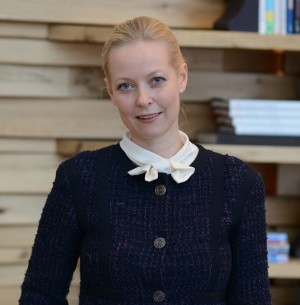
 “If you’re surrounded by inspiring people, junior or senior, you’ll be able to work through complex problems,” says Marie Louise Kirk. “They become your source of energy and creativity.” She recommends that professionals develop friendships with the colleagues around them and notes that the relationships she has cultivated throughout her career at Goldman Sachs have helped her succeed. “We all have tough days once in a while, but you have to move on and not let those frustrations inhibit your success. My office friends always help me do that,” Kirk advises.
As Kirk puts it, she is “Goldman Sachs born and bred,” initially joining the firm as an intern. She is now head of FICC Client-facing Engineers for the Americas, responsible for client strategies and solutions. Kirk also serves on the Firmwide Technology Risk Committee and the Securities Division Client and Business Standards Committee.
Originally from Denmark, she was the first in her family to attend university abroad, after being accepted to Harvard. “I come from many generations of Vikings so it was a huge deal when I got a scholarship to attend Harvard from the Crown Prince of Denmark.” She also ended up meeting her now-husband as a classmate at Harvard University.
She describes her experience at Harvard as “eye opening and life changing,” and now serves as a trustee on the board of the Crown Prince Frederik of Denmark Fund for Harvard University.
Although many companies came on campus to recruit, Kirk says that she was won over at her first Goldman event hosted on campus, because of a connection she made with a senior female professional at the firm. “She was so relatable and passionate about her work,” Kirk said. After interviews in Boston and London, Kirk was offered an internship in London on the trading floor. She began working full time as an interest rate derivative trader following graduation. “Trading was at the heart of where things were happening,” she says, describing it as very dynamic, though with a steep learning curve, where she received lots of opportunities to learn.
Data Shows the Way
After several years on the trading desk, Kirk realized that she wanted to become a financial engineer because she enjoyed the quant work, but also wanted to work with clients. Reflecting on this role Kirk says, “This is what I’m passionate about.”
In 2006, Kirk transitioned to the engineering team, and in 2008 she was asked to move to New York to lend her expertise. She arrived in New York two weeks before Lehman Brothers went under and at the time there was a need for her derivative skill set: “Quant skills come in especially handy in tough times,” she says.
In her current job, she appreciates that the role allows her to find solutions for clients – she says she does her best to help clients make money and manage risk and their businesses better.
The advancements in data science and machine learning for how the firm services its clients better are exciting aspects of her work. “We are really figuring out how we can be more relevant to our clients at the right time with the right content.” Kirk notes that her team lets “data be a leading indicator to help guide us and give clients the best and most relevant service possible.”
Although the firm’s risk-management activities have always been driven by data, Goldman Sachs is now starting to apply data to a much larger extent in other areas. Data can create huge efficiency improvements, Kirk says, as well as smarter, more scientific decision-making in areas that were previously driven by more subjective analysis, anecdotes and gut-feeling.
“The change that has taken place in the last couple of years and what’s predicted for the near-term is mind blowing,” she says. “Through data and technology there will increasingly be ways that machines can perform the more manual functions that humans have had to do. It will allow all of us to focus more on the high-value activities in our business.”
Proudest Achievement is Facilitating Success for Next Generation
Kirk says she was proud to be named a managing director in 2009 and partner in 2012, but that she’s most proud of her role in building next generation. “Recruiting talented people, coaching them with the right mix of support and push and ultimately seeing them flourish is wonderful,” Kirk says. “Helping create the next generation of successful leaders is a true legacy. And now seeing them naturally turn around and start supporting and pulling up the generation behind them makes me even prouder and, frankly, quite emotional.”
As Kirk says, “It’s gratifying to know there is a virtuous cycle that will benefit generations that will last way past any one person’s time at Goldman Sachs.”
Savvy Advice on Perfectionism
When asked what advice she wishes she’d known earlier in her career, Kirk notes that no great advice can replace the personal growth that comes from a journey of ups and downs. “No life is perfect. No career is perfect. The sooner you find peace with that truth, the sooner you will find your path to success.” She cites Winston Churchill’s quote: “Success is not final; failure is not fatal; it’s the courage to continue that counts.”
She sees that many people in the workforce, especially those of us with Type A tendencies, become obsessed with perfection and the perception of perfection, but she advises peers and junior employees to be comfortable with not always trying to be perfect.
“To be really creative and innovative, you have to push boundaries and give it your all,” she says. “You have to keep the right balance between being on your toes, but not so obsessed with perfection or fear of failure that you become scared of your own shadow.” Managers are critical in providing the psychological safety to help overcome some of these issues and create an environment of authenticity and ability to be your own diverse self, she says.
Kirk warns that when you apply that same standard of perfectionism to marriage, kids and friends on top of work, you will break.
“If you aim for perfection, you may feel you have to choose between being the best at work and in your personal life and that you can’t do both. But if you change your attitude and approach, you may end up doing both better.”
Throughout her years at Goldman Sachs, Kirk has been involved in many of the firm’s internal programs, and she has found that one element they have all had in common is the social glue of community and connectivity, which have helped her remain excited to go to work every day.
A Full Life Outside of Work
Currently expecting her third daughter, Kirk says she has her hands full with two other girls, ages 10 and 5, and a husband with a thriving career of his own.
Yet she still finds time to nurture girls on the path to STEM careers. “It’s upsetting when I see them lean out, and often at such a young age, all because of stereotypes,” she says. “It’s fine to make a conscious choice at 16, but sometimes they start opting out at age 6 before they understand their true talent and interests.”
In her family, it’s easy to focus on women who are successful at math. “We good-naturedly ridicule dad, who’s not a math guy,” she laughs. “For now my daughters think math is a girl thing.”

Voice of Experience: Marie Louise Kirk, Partner, Goldman Sachs
Voices of ExperienceAs Kirk puts it, she is “Goldman Sachs born and bred,” initially joining the firm as an intern. She is now head of FICC Client-facing Engineers for the Americas, responsible for client strategies and solutions. Kirk also serves on the Firmwide Technology Risk Committee and the Securities Division Client and Business Standards Committee.
Originally from Denmark, she was the first in her family to attend university abroad, after being accepted to Harvard. “I come from many generations of Vikings so it was a huge deal when I got a scholarship to attend Harvard from the Crown Prince of Denmark.” She also ended up meeting her now-husband as a classmate at Harvard University.
She describes her experience at Harvard as “eye opening and life changing,” and now serves as a trustee on the board of the Crown Prince Frederik of Denmark Fund for Harvard University.
Although many companies came on campus to recruit, Kirk says that she was won over at her first Goldman event hosted on campus, because of a connection she made with a senior female professional at the firm. “She was so relatable and passionate about her work,” Kirk said. After interviews in Boston and London, Kirk was offered an internship in London on the trading floor. She began working full time as an interest rate derivative trader following graduation. “Trading was at the heart of where things were happening,” she says, describing it as very dynamic, though with a steep learning curve, where she received lots of opportunities to learn.
Data Shows the Way
After several years on the trading desk, Kirk realized that she wanted to become a financial engineer because she enjoyed the quant work, but also wanted to work with clients. Reflecting on this role Kirk says, “This is what I’m passionate about.”
In 2006, Kirk transitioned to the engineering team, and in 2008 she was asked to move to New York to lend her expertise. She arrived in New York two weeks before Lehman Brothers went under and at the time there was a need for her derivative skill set: “Quant skills come in especially handy in tough times,” she says.
In her current job, she appreciates that the role allows her to find solutions for clients – she says she does her best to help clients make money and manage risk and their businesses better.
The advancements in data science and machine learning for how the firm services its clients better are exciting aspects of her work. “We are really figuring out how we can be more relevant to our clients at the right time with the right content.” Kirk notes that her team lets “data be a leading indicator to help guide us and give clients the best and most relevant service possible.”
Although the firm’s risk-management activities have always been driven by data, Goldman Sachs is now starting to apply data to a much larger extent in other areas. Data can create huge efficiency improvements, Kirk says, as well as smarter, more scientific decision-making in areas that were previously driven by more subjective analysis, anecdotes and gut-feeling.
“The change that has taken place in the last couple of years and what’s predicted for the near-term is mind blowing,” she says. “Through data and technology there will increasingly be ways that machines can perform the more manual functions that humans have had to do. It will allow all of us to focus more on the high-value activities in our business.”
Proudest Achievement is Facilitating Success for Next Generation
Kirk says she was proud to be named a managing director in 2009 and partner in 2012, but that she’s most proud of her role in building next generation. “Recruiting talented people, coaching them with the right mix of support and push and ultimately seeing them flourish is wonderful,” Kirk says. “Helping create the next generation of successful leaders is a true legacy. And now seeing them naturally turn around and start supporting and pulling up the generation behind them makes me even prouder and, frankly, quite emotional.”
As Kirk says, “It’s gratifying to know there is a virtuous cycle that will benefit generations that will last way past any one person’s time at Goldman Sachs.”
Savvy Advice on Perfectionism
When asked what advice she wishes she’d known earlier in her career, Kirk notes that no great advice can replace the personal growth that comes from a journey of ups and downs. “No life is perfect. No career is perfect. The sooner you find peace with that truth, the sooner you will find your path to success.” She cites Winston Churchill’s quote: “Success is not final; failure is not fatal; it’s the courage to continue that counts.”
She sees that many people in the workforce, especially those of us with Type A tendencies, become obsessed with perfection and the perception of perfection, but she advises peers and junior employees to be comfortable with not always trying to be perfect.
“To be really creative and innovative, you have to push boundaries and give it your all,” she says. “You have to keep the right balance between being on your toes, but not so obsessed with perfection or fear of failure that you become scared of your own shadow.” Managers are critical in providing the psychological safety to help overcome some of these issues and create an environment of authenticity and ability to be your own diverse self, she says.
Kirk warns that when you apply that same standard of perfectionism to marriage, kids and friends on top of work, you will break.
“If you aim for perfection, you may feel you have to choose between being the best at work and in your personal life and that you can’t do both. But if you change your attitude and approach, you may end up doing both better.”
Throughout her years at Goldman Sachs, Kirk has been involved in many of the firm’s internal programs, and she has found that one element they have all had in common is the social glue of community and connectivity, which have helped her remain excited to go to work every day.
A Full Life Outside of Work
Currently expecting her third daughter, Kirk says she has her hands full with two other girls, ages 10 and 5, and a husband with a thriving career of his own.
Yet she still finds time to nurture girls on the path to STEM careers. “It’s upsetting when I see them lean out, and often at such a young age, all because of stereotypes,” she says. “It’s fine to make a conscious choice at 16, but sometimes they start opting out at age 6 before they understand their true talent and interests.”
In her family, it’s easy to focus on women who are successful at math. “We good-naturedly ridicule dad, who’s not a math guy,” she laughs. “For now my daughters think math is a girl thing.”
International Women’s Day: It’s About Every Day
Featured, International Womens DayAs United Nations (UN) Secretary-General Ban Ki-moon states, “Let us devote solid funding, courageous advocacy and unbending political will to achieving gender equality around the world. There is no greater investment in our common future.”
Women…Just One Day?
Wait. Is having one day designated to over half of the planet’s population itself a barrier to ever achieving gender equality?
We asked Morra Aarons-Mele, blogger, former political consultant, and founder of Woman Online what she thought. “Whenever we focus our attention on a particular issue for a day, we run the risk of thinking and acting for one 24-hour period, patting ourselves on the back, and then putting the issue on the back burner for the rest of the year. The positive change I see is that an increasing number of individuals, governments, businesses, and organizations are considering and working towards gender equality every day. I like to think of IWD as a day where those actors can share their good work and where we can all put focused efforts toward advancing the cause.”
Stepping It Up
This year, with the theme “Planet 50-50 by 2030: Step it Up for Gender Equality”, the UN is focusing on accelerating progress towards sustainable development, which includes 17 Sustainable Development Goals. Many of the goals have heightened significance for women, with “quality education” as goal 4 and “gender equality”as goal 5.
The UN recognizes that sustainable development depends on gender equality. Turned another way, until global society achieves gender equality, including gender equality at key levels of decision making, society will perpetuate an unsustainable world.
On September 27th, 2015, 80 world leaders met in New York to kick-start changes to end discrimination against women, with each country being called to make commitments and pledges focusing on “increasing investment in gender equality, reaching parity for women at all levels of decision-making, eliminating discriminatory legislation, and addressing social norms that perpetuate discrimination and violence against women.”
In the spirit of HeForShe, anyone attending the International Women’s Day Forum in New York, co-hosted by the U.S. Chamber of Commerce Foundation and focusing on the business community, is granted a two-for-one registration when they bring a male colleague. It’s not just a women’s issue.
#PledgeforParity
An acceleration to gender equality is necessary, since the World Economic Forum’s most recent prediction indicates that the global gender gap won’t close until 2133, which was a big slowdown from their 2014 prediction of 2095.
The IWD #PledgeforParity campaign, whose partners include EY and Accenture among others, focuses on prompting individuals, both men and women, to “move from talk to purposeful action”in one of five areas: helping women and girls achieve their ambitions; challenging conscious and unconscious bias; calling for gender-balanced leadership; valuing women’s and men’s contribution equally; creating inclusive, flexible cultures.
Accenture is also holding their annual celebration, with live broadcasts around the world, which will focus on “Being Greater Than: It’s about going beyond boundaries and expectations. It’s about raising our voices and our sights to advance the women, the ideas and the goals that will drive the next generation of leaders.”
Walking the walk, Accenture’s annual event is substantiated by every day action with hiring goals and retention practices in place to create accountable change.
It’s About Every Day.
The biggest thing we can take from IWD is that gender equality is about every single day. It’s not only about the special initiative, or the big event, or the dedicated task force. These things only exist to redirect our attention and energies to the prevalent imbalances that current organizational operations too often stem from and collude with.
According to our CEO and resident organizational psychologist Nicki Gilmour, “Action is what is needed, because I’ve witnessed thattoo often companies stop at lip service.Even when they pay for consultation andsolutions, they often take none of the steps outlined; theypull none of the levers available to them to createequity in the system.Instead many firms throw a party on International Women’s Day and feel that the mission is somehow accomplished whilst talent processes and management practices remain untouched.”
IWD is about what happens every day.
As Aarons-Mele puts it, “IWD gives us all the chance to think about how we address rights and equality all other 364 days each year (or 365 days, this year). How can we move beyond thinking and acting on one day to make equality part of the bones of our organizations? How can we make operational and systemic changes so that we don’t have to take “extra” actions that improve the lives of women. How can we improve our systems to have advancing equality baked right in to our missions? We can all benefit from treating IWD as less a be-all, end-all day for women and more as a jumping off point to use each day of the year to advance women’s rights.”
With that, The Glass Hammer will keep talking about gender equality andacting to create real change today,tomorrow, and each day after that.
Stereotypes at work: Do women buy into them just as much as the next guy?
Office PoliticsThese are the labels we are given but are they justified? Catalyst’s study – Women “take care”, men “take charge” – found that stereotypic biases are often inaccurate and leave women in a weak position; undermined by their followers and seen by their leaders as less effective leaders compared to their male peers by both men and women in their firm. Do we therefore have the right to peel off these labels, shake off the stereotypes and define who we really are ourselves?
Read more
International Women’s Day
Career Advice, Career Tip of the Week!, International Womens DayThe career tip of the week has a distinct hint of counting our blessings as we look at the broader scope of women everywhere. My advice today is to get out of the weeds and do some big picture perspective taking today. Never mind the nitty gritty at work, list the 3 regular tasks that you enjoy most at work currently. Now look ahead at what you want to achieve in the next 18 months. Are you on track to increase the number of things that you enjoy doing? If so, excellent! if not, time to think about what is your next move to improve your work life and while you are at it, take a look at the big picture also. What can you commit to doing to make your life overall better and more fulfilling?
Check theglasshammer.com all month for our International Women’s Day coverage and our usual selection of excellent profiles.
By Nicki Gilmour, Executive Coach and Organizational Psychologist
Contact nicki@theglasshammer.com if you would like to hire an executive coach to help you navigate the path to optimal personal success at work
Voice of Experience: Nikki Darden, Program Director for Global Rewards, Citi
Voices of Experience“I’m a Southerner; I’m a woman; and I’m a minority. I used to water it down, but now I embrace those traits that make me who I am.”
Finding a Career Path That Resonated
Darden has spent her entire career in financial services, although not as a banker. She started with NationsBank in Charlotte (now Bank of America) as a marketing analyst and then moved into the team that was focused on what was then called “PC banking.” As the predecessor to internet banking, customers would receive floppy disks to do banking on their home computers, a very advanced service at the time.
While involved with planning and launching new products, she became frustrated with what seemed to be a lack of customer focus, mainly an understanding of the impact of initiatives on customers. She requested a move to a branch management leadership program where she rotated through four branches over a year to learn how to run a branch. It was a critical juncture in her career as it changed her trajectory. She realized that she didn’t want to be in sales, but rather that she was more interested in how customers consumed and interacted with products and services.
For the following few years, she worked for a strategic research firm in Washington, D.C., that was focused on financial services, followed by 12 years at American Express focused on loyalty and engagement.
For five years she has performed a similar function at Citi, expanding to include a strategic focus on rewards. “I enjoy my work that puts the customer first and creates solutions that enrich their lives, while growing revenue for the business,” she says.
Constant Challenges, Constant Learning
Each day is full of new challenges, none more so than what she’s currently working on, “this baby I’ve recently birthed and now am bringing up through toddlerhood,” she says.
And that is launching a consistent rewards program on a global scale. Initially they intended to roll out the same program everywhere, but soon found that it needed to be localized to deliver consistent value across markets. “My role is constantly challenging and I learn something new every single day. I’m confident that has never happened in my previous positions,” she says.
The loyalty industry is always growing, with the challenge of taking advantage of innovations without watering down the value proposition and making loyalty programs a commodity. “We want our customers to engage with Citi in a meaningful manner and feel emotionally connected to the brand and what it offers,” she says.
Embracing the Value You Bring
Darden finds it energizing to see the ways women are revolutionizing the loyalty industry. “There are some incredibly inspiring women who are bringing unique perspectives to the table,” she says, citing their value in creating the emotional connection that drives revenues.
She believes mentors can help drive career success; she herself has leveraged several mentors and created champions to help position herself throughout her career. At Citi she now finds herself as a mentor, both formally and informally, to several younger women across the organization. “It’s important to help them think strategically about their long-term careers as well as gaining valuable insight on day-to-day interactions – to have someone with more experience to bounce ideas off of,” she says.
And for both younger women and men, she urges them to be their authentic selves, but also to remember that their boss is not a millennial. The great energy and ways you challenge traditional thinking is absolutely needed, she tells them, while also reminding them to understand their audience. “Try to communicate in a way that brings them in instead of shutting them out. In a large company you are dealing with superiors who are not necessarily like you so you need to respect that.”
At the same time, she is enjoying learning from others around her about both the global arena and the digital experience, two areas of rapid growth that are relatively new to her. “Those of us who are more established need to push the boundaries and engage with whatever trend is next. That’s how we stay sharp and show value,” she says.
A Travel Bug
Darden recently developed a passion for travel, now taking the time to explore with colleagues when on a work trip. Through Citi’s Global Talent Development program, where employees spend six months abroad, she visited Brazil, which she says was her turning point to becoming someone who wanted to explore new cultures rather than just take a vacation. “I’m more interested in learning about cultures and consumers in a different place,” she says. “The best part is that it is also relevant to my job.”
Men Who Get It: Jamie Broderick, CEO, UBS Wealth Management, UK Jersey
Men Who "Get It", People“When considered as a business issue, it illuminates diversity and inclusion as a topic that everyone should be concerned about, not just those with a personal passion,” he says. “When framed as a business imperative, it enfranchises everyone, including men. You don’t have to be PC, progressive or female; you just have to be a business person.”
Broderick joined the firm three years ago, previously, serving as CEO for JP Morgan Asset Management Europe where he worked for 19 years.
“You can’t create a successful business unless you have an inclusive culture, which encourages a workplace where people can thrive,” Broderick says. And when he talks about diversity and inclusion, he doesn’t just think about gender, but other areas such as LGBT, disability or ethnicity.
He speaks from experience, having transferred to the financial industry from academia 30 years ago. “Not that many people would have looked past the mainstream qualification profile to hire me,” he acknowledges. “It’s probably not a coincidence that the team I moved to was led by women. In an industry dominated by men, they were able to see the potential in a non-mainstream profile.”
Diversity as a Business Issue
Broderick points out that by creating the business case, companies will start to track progress and create targets, just as they treat all other business challenges. “There is no other business issue that people would have let drift for 10 years,” he says.
“You must involve men, as they are half the workforce and most of senior management,” Broderick says. “Diversity and inclusion has an impact on the ability to create a high-performing organization where people remain, thrive and grow, but to shift the dial, you must involve men.
One key way to address the issue is to raise awareness through training in unconscious bias, which he believes should be a component of all line manager training.
He says that most workplaces won’t find overt examples of disparaging remarks or the like, but that biases can creep into everything we do, which offers frequent opportunities to challenge one another.
“Unconscious bias training shows you the extent to which the behaviors that hold people back are pervasive,” he says. “We need to have a broader understanding of diversity of styles and constant support to think about how we do things and how we can improve. There are plenty of opportunities for introspection.”
For example, he suggests texting a meeting leader to ask them to consider the dynamics in the meeting they are holding. He says that meetings need to be constructed so that everyone gets a chance to voice their views, even those who aren’t naturally assertive.
He explains that there are always those who are just as smart and have ideas just as good, but they prefer to hold back and not grab the podium. They may be waiting for entry points that never arrive, and meeting chairs who are sensitive to this dynamic can help create those points of entry.
Extending Diversity to Mentoring
Broderick highlighted the female mentoring program he runs which takes a reciprocal approach, requiring senior women mentees to also act as mentors for more junior colleagues, thus driving the culture of coaching deeper into the organization. This intergenerational approach ensures those who receive also give.
He also recognizes the mutual benefit for mentors. “When I act as a mentor to a female colleague, I help one person progress better. But if she reverse mentors and gives me insights, as a senior manager, that ends up affecting hundreds of people who are now being managed in a different way.”
This is just one component of the Diversity and Inclusion program he sponsors in his UK business. A Women in Wealth networking program was created to focus additional attention on the benefits of connecting women and helping to network more effectively.
“Leaders need to provide more than emotional and moral support. They must incorporate diversity into their business and make sure the business takes it seriously.”
Broderick’s perspective and support for diversity and inclusion was recognized recently when he was named “Champion of the Year” in the CityWealth PowerWomen Awards 2016.
Why You Should Avoid Overwork To Be Effective In Your Job
Career Advice, Office PoliticsProfessor Robin Ely of Harvard Business School has said the 24/7 work culture “locks gender inequality in place.”
But this is not an article about gender. The chronic overwork culture doesn’t need to change only because it works against women: it needs to change because it’s not working.
Sarah Green Carmichael, senior associate editor of Harvard Business Review (HBR), posed in a recent article that the bigger question is not what has driven us to a 24/7 work culture, or who is to blame, but rather, “Does it work?”
The answer, according to many studies related to employee effectiveness, is no. Within her article, Carmichael highlights that a culture of chronic overwork backfires on employees and companies. Yet the number of hours worked has increased by 9% in the last 30 years. It seems Corporate America is clinging detrimentally tight to the false truth that overwork is a requirement for effective employees and driving company-level success: overwork is overvalued.
Here are four solid reasons why you shouldn’t chronically overwork if you wish to remain engaged and effective in your job and why your firm shouldn’t want you to, either. May this provide insight both for you and the men and women you manage.
1) Overwork may lower your engagement with work.
According to Gallup, nearly 61% of college graduates feel disengaged at work – meaning not “intellectually and emotionally connected,” even when they are physically present in the office, resulting in a major ROI loss for companies.
Data shows that 2/3 of employees feel overwhelmed and 80% would like to work fewer hours. The 24/7 work culture and feeling overwhelmed are major contributors to disengagement. While an “always on” expectation makes it difficult to mentally switch-off, research has suggested that being able to psychologically switch-off from work protects both well-being and work engagement.
If you feel you can never turn off, it would seem you begin to tune out. To stay engaged at work, it’s important not to give into the expectation to live it.
2) Overwork may hurt your productivity.
Research showed that a company couldn’t tell the difference in performance if an effective employee was working 80 hours or just pretending to, so working longer hours may not mean accomplishing more, career-wise too. As graphed in The Economist, longer hours are correlated with decreased productivity. In fact, research has even shown that when working hours are excessive, cutting hours back can actually increase your productivity.
Also, in research with a consultancy firm, required and predictable time-off from work including being digitally switched-off, increased productivity – even if time completely off had to be strictly enforced because employees were in the habit of being constantly switched on. Not only did it improve communication, learning and the client product, but it also resulted in greater job satisfaction, sense of work/life balance, and commitment to managing a career at the firm.
3) Overwork may hinder your ability to lead effectively.
As Ron Friedman writes in an HBR article, while putting in the excessive hours may have marked you as motivated and helped your “early career advancement,” maintaining overwork as part of your work identity once you’ve already arrived to a position of leadership can significantly damage your career prospects.
Leaders need to disconnect to optimize the interpersonal skills, critical thinking, and visionary skills important to their roles. Overwork contributes to mis-reading others (often negatively) and emotional reactivity such as lashing out. Management performance also depends upon judgement, and being tired from overwork impairs your decision-making abilities and clarity of perspective when it comes to identifying problems and creative solutions.
An overworked leader, concentrating to the point of fatigue, is often a cloudy leader, who is also more vulnerable to technology distractions, such as the 3pm workplace Facebook rush.
As Reid writes, overworking also models the behavior as an expectation for those you manage, and there’s enough evidence in this article alone to illustrate why that’s a questionable management practice.
4) Overwork may harm your health.
On top of compromising your job effectiveness, overwork compromises your well-being, a major component of feeling satisfyingly engaged in your work. Studies have shown that overwork is associated with emotional exhaustion and impaired sleep, which is a massive performance killer in addition to compromising health.
It’s also associated with depressive symptoms, heavy drinking, and long-term with heart disease and impairment of brain function when it comes to reasoning. Nothing about this says top management potential. If you’re to be a thriving executive, it’s probably best to start as a thriving human.
What Can You Do To Be More Effective?
But you’re still surrounded with a culture of overwork, so what can you do?
Friedman recommends starting with these small behavior changes:
Find a way not to have your smartphone at your side constantly when away from work, interrupting your present – instead check it with intention. Program evening emails to arrive in the morning, so they don’t catalyze a back and forth conversation after hours. Discern when a response is necessary immediately from when it’s not. Find an activity that you’re excited to leave work for, something else that will give you a sense of gain. While at work, schedule a few breaks in your day so that you can step away, clear your head, and refresh both your energy and perspective.
It’s clear that when you chronically over-extend yourself at work, you may still be there or still be on, but you stop being the same employee. Being an effective leader means managing the asset of your leadership effectiveness, not working until it’s lost to diminishing returns or worse.
By Aimee Hansen
Build Your Personal Brand in 30 Seconds
NetworkingRead more
Leaving one industry for another, what you need to know in your transition
Career Advice, Career Tip of the Week!Either way, it is time to transition to a new career. What are the top three things you need to consider in the move?
A. Do your skills apply to what you want to do next? If not exactly, can you weave a truthful narrative of how what you have done before will empower you to do the new tasks required? If there are gaps, before you leap from your current job you should close any skill gaps with formal education or informal means.
B. Who do you know in the new arena? How is your network? Start by meeting people who can tell you what you need to know about the product, processes and cultural norms of your desired future gig. These folks are much more likely to know of open opportunities and relevant networking opportunities than anyone else. Information is power.
C. Interview, interview, interview. Practice makes perfect and will give you a good benchmark on how viable it is to move into this space and help you understand your bottom lines regarding money and other factors such as hours, location etc.
Good luck!
By Nicki Gilmour, Executive Coach and Organizational Psychologist
Contact nicki@glasshammer2.wpengine.com if you would like to hire an executive coach to help you navigate the path to optimal personal success at work
Voice of Experience: Anissa Thompson, Managing Director, Accenture
Voices of ExperienceThompson finished graduate school with a Master’s Degree in Public Administration. Eager to find work as a policy analyst she started her career at a global policy think tank and spent two years as a research assistant, working primarily on research for the United States Army and Joint Chiefs of Staff. She describes this experience as, ‘excellent,’ but was keen to effect actual solutions that solved problems facing the public sector and began to explore other career options. She found herself drawn to management consultancy and began working at Accenture in 2001.
Variety within the same career
Over the course of her 15 years at Accenture, Thompson has worked across industries serving a diverse array of clients ranging from the US Federal Government, to an energy corporation and a large telecoms firm. In 2009 she moved from working with clients to an internal role where she was asked to build and lead a sales support team to help Accenture respond more effectively to proposals. That decision and role represented a major turning point in Thompson’s career and ultimately led to where she is today as the Director of Accenture’s North American Proposal Response Center, where she manages a team of proposal development professionals.
“I’ve been extremely fortunate to be able to explore new career paths. My main professional motivations have always been interesting work and the opportunity to work with great people and I’ve experienced both at Accenture – I have never been encouraged to simply continue down the path on which I started. As a result of moving my career into a new direction of my choosing, I was able to build an internal sales support function that has achieved a very positive reputation and been replicated throughout.”
Currently, Thompson is excited about expanding the services that her Sales Support team provide at Accenture, so that they will be involved throughout the whole entire Sales lifecycle, enabling more sales and greater efficiency. An area that is of particular interest to her is how at Accenture they are doubling down on automation, especially in the area of content creation.
By conquering this work, Thompson comments, “we are able to create content for our sales collateral using software rather than “search and find” efforts, thus allowing us to respond to proposals with greater speed and efficiency.“
She is also enthused with how they are finding creative ways to better source and staff their resourcing needs through crowdsourcing platforms and are always looking at innovative ways to get their messages across visually, helping bring to life Accenture’s focus on all things digital.
On a personal note she is excited about the impact they are making in the local D.C community.In January she volunteered with Urban Alliance – a local non-profit that empowers disadvantaged youth to succeed through internships, training and mentorship – during Accenture’s Martin Luther King Day of Service, one of the largest corporate efforts in the country. 1,500 Accenture people volunteered at more than 85 projects in the Metro DC area. Thompson is presently involved in another exciting project outside of her day to day role, leading Accenture’s relationship with the 11th Street Bridge Park Organisation – one of Accenture’s non-profit partners in the D.C area.
Thompson describes it as ‘a multi-partner project to transform an old bridge into the city’s first elevated park: a new venue for healthy recreation, environmental education and the arts’.She recently completed a pro bono skills based volunteering project to refine their strategic plan.
Mentoring and Sponsoring Others
The professional achievement of which Thompson is most proud, is the number of women and minorities that she has helped excel to executive level at Accenture, both on her own team and in her mentoring circles. She has received great mentoring at each stage of her career and very much believes in ‘paying it forward’. Thompson began by registering as a mentor on Accenture’s Global Mentoring Program and shortly thereafter was matched with an African American Female who was a new hire at the company. Over the course of 18 months she helped her navigate her path at Accenture, sharing career advice along the way.
“For me”, Thompson adds, “it was very gratifying when I received an email from her announcing that she had been promoted to the next level.”
For women across every industry she would encourage them to find a sponsor internally and seek support from mentors formally and informaly. Throughout her career Thompson has learnt that you will face challenges.
“The reality is, many of the decision makers you will encounter may not look like you, but it is important to understand that this is not a deterrent to success,” she states. She believes that for women especially, it is important to seek sponsorship and support from a diverse array of people versus turning to just those within your demographic.
Thompson is proud to work for a company that has not only announced its’ commitment to gender equality, but one that is committed to supporting the professional goals and aspirations of its’ more than 130,000 women globally. Accenture recently announced an investment of over $840 million in learning and professional development in 2015, which includes a range of training programs to develop the next generation of women leaders. Personally Thompson mentors four women personally and many more informally.She partakes in learning and networking opportunities during events like Accenture’s celebration of International Women’s Day, which she has previously co- hosted in D.C.She has also had the great fortune to work directly for a strong woman leader who also serves as her career counsellor- helping her to define her own path to success and to ensure she achieves it – and to sit in a highly diverse organisation with many senior women reporting in to her.
In her spare time she loves to travel and recently spent time in Buenos Aires, Rio and San Juan, Puerto Rico over the holidays. She expresses that she is fortunate to have a geographically dispersed set of friends and that she spends time abroad almost monthly. She is an avid reader and is never without her kindle. Some may find the most surprising thing about Thompson is her love of football, or soccer as it’s called in the US. She supports FC Barcelona and DC United and given the opportunity will happily while away a weekend watching the various European leagues play on television!