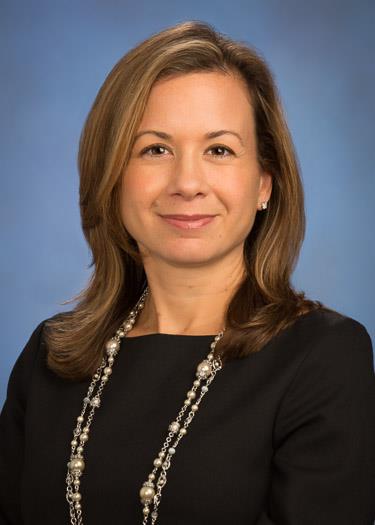
MariaCoyne2By Melissa J. Anderson (New York City)

“I wanted to be a banker my whole life,” said Maria Coyne, Executive Vice President, Business Banking Segment Group at Key Bank. Coyne graduated with a degree in finance from Notre Dame in 1982, and besides a three year foray into the non profit sector, has spent her 25 year career in banking. While she has worked in just about every part of the bank, she said, she’s always come back to small business.

“It’s where my heart was,” she said. “Particularly the women’s business sector.”

Among her proudest achievements, Coyne includes the work she’s done with the Key4Women program – Key’s program for female business owners, providing financial solutions, networking opportunities, and education. She explained that, going back to the late ’90s, Key Bank was studying the needs of women business owners. “We saw that they just weren’t applying for loans.”

“We identified it as a need and wanted to make it real.” She said the program has gone a long way in helping understand the economic value in women-owned businesses. “This is not just a “feel good” project,” she said. “These women have sophisticated business needs.”

She continued, “The most thrilling thing for me has been to see these companies grow and expand through the program.”

In 2005, Key Bank has committed to lending $1 billion over the next three years, and accomplished that goal early in 2007. “So we said, ‘Let’s double it.’” That goal, she said, was achieved in 2009. The bank is on track to achieve its next goal of 3 billion by 2012.

On the horizon, Coyne said, is a program for non profit entities similar to Key4Women. “We want to help non profits find financial solutions. We’re very excited about it.” Additionally, Coyne said, so many of the bank’s employees sit on non profit boards that the program is energizing the entire leadership team. “We’re well suited to serve non profits,” she added.

Coyne is particularly excited about the financial education portion of the two programs.

She said, “I think financial education is so important in virtually every aspect of our industry. On the consumer side, particularly in the “unbanked,” there is heightened awareness around people better managing their finances. One of the good things that came out of this bad cycle is that we are building the tools to help people manage their finances better.”

Read more

barbaranovickBy Melissa J. Anderson (New York City)

Right now, Barbara Novick, Vice Chairman at BlackRock, is focused energetically on change. “Companies and industries change, and very often change is an opportunity.”

Novick’s responsibilities have changed too – after twenty years working on the client side at BlackRock, she’s recently taken a new role leading public policy and government relations for the firm – and she feels strongly that change is leading to opportunities in this area too.

As the markets and regulatory structures evolve rapidly, she explained, people must be able to not only deal with change, but embrace it. She said, “Embracing change is probably the most important thing someone can do in their career, along with trying to turn that change into opportunity.”

Read more

By Melissa J. Anderson (New York City)

“I do really believe that once you get to a certain level of seniority, it is important to encompass into your role the development of other women,” said Sarah Lee, Managing Director, Global Head of Fixed Income Derivatives Legal, Bank of America Merrill Lynch.

Lee, who has spent her career developing award-winning expertise in derivatives law, is also passionate about the importance of passing on guidance and opportunities to other women.

She continued, “Mentoring… is critical for getting women into senior roles in the industry – and as women who are senior, we must bear that in mind.”

Read more

VivaHammerBy Melissa J. Anderson (New York City)

“I’ve been trying to get my driver’s license in the US for seventeen years,” began Viva Hammer, Principal at KPMG Washington National Tax. She continued, “I took the written test when I was pregnant with my daughter. Two weeks ago she graduated college and a week later I passed my road test.”

The story is emblematic of the careers of many women, Hammer said. “Sometimes for women, your career can seem like a long road with lots of detours. You need a lot of faith – or desire – to believe you’re going to make it.”

Hammer, a native of Australia, moved to New York City two days after graduating law school without a job prospect in sight. Now, twenty years later, with a high profile career in US tax law, having founded several non profits and begun her book Choosing Children – and, now with her driver’s license – Hammer can say she has made it.

“Never give up,” she exclaimed. “Never, never, never, never!”

Read more

jacquelineallenBy Melissa J. Anderson (New York City)

Jacqueline Allen, SVP of Finance, Equities Reporting, North America at Citi, said the achievement she is most proud of is going back to school for her MBA. She explained, “I finally took the leap after having breakfast with the CEO of Equities at Citi. It was three years ago, when Citi was entering the most tumultuous time of the downturn. The message I took away was that I needed to be the best I could be to propel my career. So I took inventory of myself and realized that to compete in the changing environment, I needed more education.”

Now that Allen has completed her MBA, she is looking for the next opportunity on the horizon.

Read more

SarahOdellBy Cleo Thompson (London), founder of The Gender Blog

British born Sarah Odell began her career in the USA thanks to her youthful prowess with a lacrosse stick. Whilst at school in Surrey, she played for the English youth lacrosse team, was spotted by a US college recruiter, and won a sports scholarship to Vanderbilt University in Tennessee where she studied Human and Organizational Development. This was followed by an MSc from Capella University in Minnesota which in turn enabled her to stay on and work in the US.

“I was very lucky! I started in the US in the telecommunications industry in learning and development, spending seven years with Sprint Nextel, primarily working to develop Learning & Development capabilities in its contact centres and delivering training to its employees all over the country.

“In 2007, I moved back to the UK with Accenture, and I now provide Learning & Development consultancy for clients in the fast-moving consumer goods industry. It’s the full cycle of consultancy, from building relationships with current and existing clients through to delivering strategic and operational services.”

Read more

christiesmithBy Melissa J. Anderson (New York City)

Christie Smith, Principal at Deloitte Consulting LLP, is a passionate supporter of women in leadership, and has been significantly involved in the firm’s women’s initiatives since joining the organization in 2001.

The former professional golfer said, “My advice to women is to be fearless.”

One of the firm’s most senior lesbians, she has also been involved in the Deloitte’s LGBT community for about five years. In fact, she said, being a more visible “out” leader has helped her be more confident in her career. She explained, “Being comfortable with who I am and bringing my whole self to work has been a fantastic experience at Deloitte”

Now taking on a new role building the firm’s life sciences consulting practice, Smith’s fearless attitude and devotion to authenticity have helped her build a notable career.

Read more

Shelley HurleyBy Melissa J. Anderson (New York City)

“Make sure that you understand what you want and also understand other’s expectations of you ,” advised Shelley Hurley, Executive Director of Risk Management and Global Resources lead at Accenture.

She explained, “Sometimes you’re asked to take on a role that you’re not comfortable with. But stretching yourself is important. Others may see strength in you that they need elsewhere in the organization.”

She added, “Flexibility will help you a great deal in the long run.”

Read more

Jennifer Barbetta“You should look at your career as a marathon, not a sprint,” advised Jennifer Barbetta, Managing Director and Chief Operating Officer for the Alternative Investments & Manager Selection business at Goldman Sachs. That’s one piece advice she said she likes to share with her junior team members and those she mentors.

In fact, Barbetta said, “Watching those I have mentored find success is one of my proudest achievements.” She believes in having candid and honest conversations with her team and mentees. “These conversations provide them with the tools to help lead them down the path to success.”

Read more

women smilingI learned a shocking statistic recently. According to a poll by the HRC [PDF], up to 51% of LGBT professionals on Wall Street are still in the closet. That means over half – half – of LGBT professionals are uncomfortable being themselves in their workplace.

We must ask why so many professionals are still afraid, in 2011, to be open about who they are and who they share their lives with. If anything, this statistic reveals some very shocking truths about the nature of inclusiveness in our top firms and companies. It’s time for those cultures to change.

This week and next, to celebrate PRIDE on Theglasshammer.com, we are featuring profiles of several amazing women who live their lives as openly gay/lesbian professionals – despite the challenges (perceived and real) that exist for LGBT individuals in the workplace. It is our hope that by shining a spotlight on these successful women, more LGBT professionals will feel inspired and empowered to bring their whole selves to work.

Theglasshammer.com was founded on the principle of creating professional networks where you can relate to people who are in the same situation as you – for example, being the only women on your team can be tough. Yet, many of us have other identities, such being a different color or nationality or being mothers. These are very visible differences, and are protected from discrimination by law. On the other hand, gay and lesbian professionals are often the invisible minority in the room, and in many respects LGBT is the last taboo in the workplace. Legal protections are still not up to par in the U.S. (In 29 states you are not protected from getting fired on the spot for being gay or “accused” of being gay.)

There are some very simple reasons why companies should work harder to create an inclusive culture for their LGBT employees.

1) You have gay clients – the business case.
2) You have gay employees – the retention case.
3) Generation Y (and many others) won’t want to work for you if you are doing nothing or doing evil around gay issues – the recruitment case.

Theglasshammer.com creates networking groups of women in financial and professional women, but perhaps one of our greatest challenges is to find senior lesbian business leaders who are “out” and visible in their firms. Why is it so hard to find a critical mass of role models to inspire other women who may be struggling to be themselves at work?

The cost or perceived cost of being “out” seems to be still very high for gay people, and the fear of negative consequences from employers or co-workers can be clearly seen in the HRC study “Degrees of Equality” detailing why gay employees don’t come out.

  • “Thirty-nine percent believe they will lose connections.
  • Twenty-eight percent believe they will lose promotion opportunities.
  • Seventeen percent believe they will be fired; this number increases to 42 percent for transgender workers.”

Everyone reading theglasshammer.com can do something to contribute to creating a better culture in your firm. Here’s are three ways to reach out.

Read more