
hillary-clinton-featuredBy Nicki Gilmour, Executive Coach and Organizational Pyschologist

It has been quite difficult to avoid the US election season this year, even if you do not live in the United States. I have avoided writing about it for many reasons including general fatigue with the whole topic and not wanting to further burden people who want to see some other topic discussed in the media. But, today is election day so how can we avoid it? Today is the day to talk about how it matters and how it should not matter that the potential next President of the USA is female.

Like her or loathe her, Hillary Clinton is doing it. She is determined, smart and driven. You should admire her ambition and her sheer stamina in trying to fulfil it. Equally, we should all understand our immediate blind spot that we have as we would never think about a man’s ambition level. We expect them to be ambitious whether they are or not, just as we expect them to be leader-like in their natural born traits whether they are or not. I have written about this many times and Virginia Schein has pioneered this research for 40 years in her “Think Manager, Think Male” work since the early 1970s.

Many countries including countries that do not have clean drinking water have had female premiers, so again no matter what your politics are or personal sentiments are towards Hillary; she is pioneering and going where no woman has gone before in the USA.

Why does it matter that she is a woman? And why does it matter that you are a woman at work?

Sexism is real. I want to thank Trump for helping us see the real and ugly effects of talk and actions that for too long have been described as innocuous. If he wins today, then we know the road ahead for what it is. The issue is on the table at last, a discussion that can be addressed, as it is most dangerous when subverted and it had lurked under the table pretending that we had already sorted it out when we clearly had not.

If Hillary wins today, then we know that she as one person has a lot of work as President and we should be careful that we do not project all our fears and hopes onto her. One woman in charge does not gender parity make and it will be fascinating to see what happens as research has shown that often a woman in charge is not necessarily great for the talent pipeline.

Asking her to run the free world and change gender inequity without help is a disaster waiting to happen. So, many will relish her being judged about the topic just as so many are questioning why Obama did not fix racism. Sometimes it is easier to not be the identity in question. Asking him to fix racism and asking Hillary to fix sexism is in fact racist and sexist and impossible without everyone doing behavior change yet this is pretty much what we ask diversity managers to do every single day at work.

We have written about assimilation and we have talked about the Queen Bee syndrome. Clinton has been given narrow behavioral parameters during the campaign battles from which she can operate, as all women are. The most encouraging element of this game show competition to be President, is that we can see that women are not going to put up with the sexist nonsense anymore and those who do are exposed for the role they play in what was previously covert collusion with the patriarchical status quo. Equally good men, truly good guys are also going to bat for women in their actions. Discussions can be had and progress can be made, as soon as we get out of the messy middle!

Save

Save

BoardRoomBy Nneka Orji

A mere five years ago in early 2011, few of us would have looked to the UK Public Limited Company’s boardrooms as beacons of gender diversity. Female representation in FTSE 100 boardrooms was just 12.5% and although many leaders in business and politics acknowledged that something had to be done, it was not clear what or how. Five years on now in 2016 women now fill 26% of FTSE 100 board roles – just over double their representation when the Davies Review (Women on boards) was launched. If we didn’t know before, we certainly now have a better idea about what it takes to turn the dial on this opportunity.

The Davies Review proved a successful catalyst for gender diversity in UK boardrooms; with a clear target and public commitment from senior leaders to achieve at least 25% representation over the course of five years, board directors were incentivised to proactively address unconscious bias in board selection and nomination processes among a number of other obstacles female leaders face on their journey to the boardroom.

Yes there has been progress – which we should be proud of – but it’s by no means time to congratulate ourselves. While a number of organisations now have female representation of 25% or more on their boards, some industries have a way to go. As identified by the New Financial’s most recent report, UK-regulated financial services companies have more work to do – both in the boardroom where women fill 23% of roles and in executive committees where they fill only 14% of leadership roles.

The Davies review focused on listed organisations, with the aim for other non-listed organisations to adopt the recommendations, so it is no surprise that more progress has been made by UK-listed companies. Unlike the boards of listed companies, only 14% of board positions of privately held financial services companies are filled by female board directors. For those still not convinced by the widely discussed benefits by advocates of gender diversity, why not consider what board directors have experienced as a result of enhanced diversity?

Chairs and board members say this isn’t just a nice-to-have; they continue to see the value of more diverse boards in the richness of board discussions particularly when it comes to making critical decisions, and they are less likely to be hit by scandals. In the current business landscape with increasing scrutiny of boards and greater focus on the importance of business’ role in society, surely this is welcome news? From a commercial perspective it also makes sense; research conducted by the index provider MCSI found that companies with more women “delivered a 36% better return on equity since 2010 than those groups lacking board diversity”.

The US may also do well to consider some of the progress achieved in the UK. According to the recently published “2015 Catalyst Census: Women and Men Board Directors”, female representation across S&P 500 stands at just 19.9%. Of even greater concern is that the glacial pace of change is likely to continue given new directorship appointments, of which 73% were held by men and 27% by women. Deborah Gillis, CEO’s President and CEO, stated; “Our new Census shows little progress has been made at the board level, and even less progress has been made in the pipeline for women officers and directors—suggesting women are nowhere near the path to parity with men. Men continue to be overrepresented, holding more than their fair share of board seats and, in some cases, all the board seats.”

The New Financial’s report also points to exemplary countries which others should aspire to – including countries in the Nordic region, France and Germany where female representation is 34%, 29% and 27% respectively.

These reports and others point to the merits of diversity and encourage leaders – both in business and government – to take bold action. What does bold action look like?

In the UK, the government commissioned the Ghadia Review which sought to make specific recommendations for UK financial services organisations to address gender diversity at both board and executive level. The Review recommended clear targets and enhanced transparency (including the disclosure of diversity data), increased accountability across all leadership levels within organisations, and the linking of remuneration to progress against gender diversity targets. New Financial found that only 26% of the financial services organisations included in the research sample disclosed gender diversity targets – and of these only 10% disclosed gender representation at board level, and 24% setting targets with deadlines.

It’s not enough to talk about gender diversity – it’s a case of committing to specific goals and maintaining the focus required to deliver against the goals. While aspirational targets show some level of acknowledgment of the need to address gender diversity, being specific and time-bound is more likely to have the desired impact. The Ghadia Review recommends 12 data points, including gender ratio of employees promoted and the percentage of maternity, paternity and shared parental leave returnees.

Just as importantly, targets need to be stretching. One of the five recommendations in the “Davies Review Five Year Summary” was around increasing the female representation target for FTSE 350 Boards to 33% – continuing with the voluntary approach. Incremental progress will only result in the next generation having the same debates we are having today. We owe them more.

To build on the progress made to date, we must look to the next generation of aspiring board directors, the behaviours we advocate and development opportunities we provide to both women and men. According to New Financial, women are better represented (36%) in support roles, but continue to be very under-represented in the roles that serve as springboards to board positions – CEO (6%), other C-suite roles (10%), and budget owners (9%). Without losing momentum on progress being achieved in the boardroom, there is a clear need to focus on female representation at the executive level.

This doesn’t just apply to Financial Services – although particularly acute in Fintech. According to a recent Deloitte report including participants across the globe, boards of financial services organisations in the UK lead manufacturing, and energy and resources industries.

Despite what many would deem as slow progress by boards in terms of gender diversity, it turns out that we have some positive lessons to learn from boards if we are to turn the dial on female representation at executive level: specific targets, enhanced transparency, public commitment, and role modelling desired behaviours.

Save

Save

Save

“When you begin your career, it’s easy to assume that you’ll choose your path, and that you’ll start at the bottom rung and work up in a linear fashion,” says Kristy Finnegan, a portfolio manager on the global equity team at Voya Investment Management.

Movers and Shakers: Kristy Finnegan, Portfolio Manager, Voya Investment Management“But the truth is, you determine your own progression by asking for responsibility and taking chances.”

This theory has propelled Finnegan from her initial career in investment banking after earning a BS in economics from Vanderbilt University. She moved to New York with the intent of landing a position on the sell side, but the 9/11 tragedy set off a hiring freeze.

Finnegan eventually joined the precursor firm to Voya, where she started pursuing her Chartered Financial Analyst® designation, initially working with the small cap value team.

A Courageous Meeting Yields a Career Break

When Finnegan realized she was not in her ideal role, she worked up the courage to pitch a stock, unsolicited, to the portfolio manager.

“It ended up being the best career move I ever made,” she says, since it set off a discussion that ultimately led to the manager recognizing what she wanted to do and moving her into a junior analyst role. To this day, she says the portfolio manager she spoke with was fundamental to her career success. “He believed in me and took a risk in promoting me into the analyst role. He guided me the first few years, during the start of my career path, and his investing style of avoiding group think formed my current approach to stock selection.”

That was her first break into equity research, which she followed with a stint as a technology analyst and then consumer staples analyst before becoming a portfolio manager. “That was a huge professional achievement, because it was a recognition of both my analytical abilities and interpersonal skills,” she says.

In her current role on the global equity team, she has been instrumental in forming a platform that brings together U.S. and international teams and portfolio engineering groups. “Joining these groups has been a really exciting process and we are off to a great collaborative start,” she says.

Learning Along the Way

For Finnegan, learning moments have come via mistakes, as they do for most. Equity analysts work with available data to form estimates for the future, which means there are inherent risks. “Early on I missed some lucrative opportunities because I deferred to others rather than trusting my own work,” she says. “Those misses taught me to be an advocate for my own stock picks and trust my instincts.”

Finnegan believes that success comes most naturally if you love your job. “I’ve always had career goals, but my major motivation is to excel for both myself and my team, and that breeds success.”

While she credits her portfolio manager as her sponsor, Finnegan knows that you can find mentors anywhere and everywhere, which is why she names Sheryl Sandberg as one of hers. “When I read her book Lean In, I felt like she was talking to me, with clear, tangible advice on how to overcome obstacles and the challenges that all of us face.”

Mentoring the Next Generation

Several years ago, Finnegan was part of the team that introduced the Voya Investment Challenge in collaboration with Girls Inc. She and another colleague were chosen as volunteers to lead a group of eighth grade girls. They worked with the same girls through sophomore year, educating and mentoring them on financial foundations and how to take charge of their financial future. The challenge took place over three years, concluding in their sophomore year. They were given $50,000 pretend dollars gradually over their first year, which they invested it in stocks, bonds and other funds. They tracked the investment performance and made buy/sell decisions as you would with a real portfolio.
“It is so important for girls to gain exposure to these situations where they might not otherwise have the chance to learn these principles,” says Finnegan. Her involvement came full circle when a colleague attended this year’s celebratory lunch and excitedly told her that one of the speakers was a girl whom Finnegan had mentored, now attending Cornell University. “It was so impressive to see the success she had become.”

These days Finnegan is still mentoring young people, but it’s her own children, a five-year-old daughter and three-year-old twins. She’s also an avid reader and runner, but spends most of her time having fun with her family.

By Cathie Ericson

woman looking at a finance chartBy Jessica Darmoni

The 34th Annual Options Industry Conference took place last week where representatives from exchanges, market makers, technology providers and regulators were just some of the attendees gathered in California. Hosted by the Options Clearing Corporation (OCC) and the International Securities Exchange (ISE), the conference focused on discussing communication between market participants and regulators, growth in the options industry as well as fragmentation and other current challenges the industry is facing.
The conference kicked off with a conversation between ISE’s Gary Katz and Stephen Luparello, Director, Division of Trading and Markets at the Securities and Exchange Commission (SEC).

Luparello recommended that market participants speak up more about issues impacting the markets to the SEC and Luparello referred to the notice and comment period within the rulemaking process and emphasized that when talking to Washington market participants should not “pick and choose” what challenges to discuss.

Another challenge addressed at the conference was the slow pace in which the industry is seeing growth. Exchange traded funds (ETFs), index and equity options volume has averaged about 14% growth in the past 40 years, according to Henry Schwartz, President at Trade Alert LLC who provided a State of the Union type presentation at the conference stating the growth figures from the industry are from 1.8 billion in contract volume in 2000 to 4.5 billion contracts traded in 2016.

Schwartz also explained that this growth may have opened the door for other exchanges to enter the market such as Nasdaq in 2008, BATS in 2010 and MIAX in 2012. While the current number of options exchanges has grown to 14 in 2016, while volume in ETF, index and equity options trading has only seen about 2% growth in the past 5 years.

This was discussed in detail at the exchange leadership panel with representatives from ISE, the Boston Options Exchange (BOX), Intercontinental Exchange (ICE), Nasdaq, BATS Global Markets, MIAX and the Chicago Board Options Exchange (CBOE).

Ed Boyle, CEO of BOX, believes that the industry needs to better engage the institutional side, such as hedge funds and advisors, with relevant products and market structures. Currently, these end users turn to the over-the-counter (OTC) markets rather than listed options contracts. Boyle believes that this switch in how people buy options can be achieved with more educational efforts.

To that end, the CBOE has recently invested in companies such as Tradelegs, a provider of advanced decision-support software that institutional investors can employ to optimize investment performance as well Vest Financial, an investment advisor that provides options-centric products and risk management solutions. CBOE also recently acquired LiveVol, a company that turns market data into options trading strategies. Andrew Lowenthal, Senior Vice President of Business Development at CBOE remarked that these investments were made to improve the end users experience.
CBOE also believes that bringing new products to the market will engage different participants. Recently the exchange launched FLEX options with Asian and Cliquet style settlements for insurance companies looking to hedge embedded exotic options risk.

While the industry looks for new means of growth, an area that may have swelled too large is the number of options exchanges. With 14 exchanges (and MIAX plans to launch a 15th this year), the industry experiences a lot of market fragmentation and players fighting for market share. As of publication, CBOE led the pack with 17% market share followed by Nasdaq’s PHLX with 16% and then ISE with 13%.

It is important to note that pending regulatory approval Nasdaq will acquire ISE in what is believed to be a play for more market share and, according to TradeAlert’s Schwartz, the industry will experience more exchange consolidation in the future.

Fragmentation, Auctions and Market Makers

The amount of options exchanges and its benefit or harm to the market was also discussed in a different, debate-style panel at the conference. Speakers were broken up into teams to argue the pros and cons of the issue.

One team believed that the 14 options exchanges was good for innovation and led to enhanced competition in the marketplace. They also fought that this brought stability to the markets. If one exchange experiences an emergency or had to close down, there are other venues participants can move to throughout a trading day. However, the opposing team found that the significant costs associated with connecting to various exchanges was prohibitive and that multiple venues also led to a more complex market structure.

Other hot topics in the debate included auction markets at exchanges. Auctions, which were introduced in the electronic options markets to mimic the flow of information that takes place on the trading floor, provide price discovery and best execution. However, they also inadvertently lead to less liquidity, wider spreads and a two-tiered market.

Finally, the debate also explored the decreasing number of market makers, firms which are required to provide a certain amount of liquidity at exchanges. With regulatory and technology costs making it hard to operate successfully in the current market environment, the industry has experienced a loss of liquidity and concentrates risk in fewer hands. It was concluded that the industry needs to find incentives for these types of firms and help them overcome costs as well as barriers to entry.

While the options industry has their work cut out for them, educational efforts and tools that will enhance the end-user’s experience as well new, relevant products will certainly bring different players to the market. Communicating with regulators, addressing challenges with the rule makers and keeping up with the competition will also make operating in the current environment more efficient. Heavy topics were discussed at this year’s options conference but it was productive and it seems everyone knows their part in moving this space forward.

glasshammer event

By Melissa Anderson

Women leaders from the financial and professional services industries, shared their advice on how women can be agents of change at The Glass Hammer’s fifth annual career navigation event at PwC’s headquarters last Wednesday, sponsored by PwC, TIAA and Voya Investment Management.

“Change leadership starts with people who want to do better,” said The Glass Hammer’s CEO Nicki Gilmour as she opened the event, encouraging the audience to probe the speakers with difficult questions.

“We’re here to talk about how we can lift as we climb.”

The panel was moderated by Mary McDowell, an Executive Partner at Siris Capital Group and was a panelist at theglasshammer.com’s women in technology event last Fall.

Panelists included Christine Hurtsellers, Chief Investment Officer of Fixed Income at Voya Investment Management; Liz Diep, Assurance Partner for Alternative Investments at PwC; Pam Dunsky, Managing Director of Client Services Technology at TIAA; and Deborah Lorenzen, Managing Director and Chief Operating Officer for Global Product and Marketing at State Street Global Advisors.

While the panelists’ careers varied significantly and were spread across different industries, one factor emerged that all of them seemed to have in common: intention. Whether describing their career paths, discussing their experience mentoring, sponsoring and networking, or talking about the ways in which they lead change toward workforce diversity at their companies, it was clear that the women went about their business with purpose.

For example, in discussing how she chooses junior staffers to mentor or sponsor, Diep says,

“You have to seek out those people you want to mentor and sponsor – you can’t be a passive participant if you want to see change,” she said. Mentoring someone means serving as their sounding board and offering advice on career advancement, while sponsorship involves putting forward one’s personal capital behind closed doors to expand their career opportunities.

Diep mentioned that a motivating factor to grow in her own career is to see more junior colleagues progress along with her and how walking the walk on “lifting as we climb” strategy is important to her When discussing how she keeps her network fresh, Diep described how she blocks time on her calendar months in advance for networking coffees and lunches, and fills in the “who” later on.

Hurtsellers described how she tries to proactively work with other leaders in her company to develop a business plan that increases diversity.

“Being a female business leader in a very male-dominated industry can be quite a lonely spot,” she said. Clients are beginning to require asset managers to disclose their numbers on staff diversity during the RFP process; but Hurtsellers said that’s not enough.

“We need more than a check-the-box mentality around diversity to effectively tackle the issue. I try to challenge a bit of the establishment thinking,” she said. “I ask the elephant-in-the-room-type questions like ‘How do you get women into financial services if they don’t think that the industry matches their values?’”.

Hurtsellers further stated that she felt being a woman in a male-dominated industry can also be a competitive advantage if you’ve worked to build a personal brand, like authenticity.

“But it has to come back to who you are – be true to yourself,” she said.

Similarly, Dunsky shared how she had established a brand for herself earlier in her career, only to revise it later on.

“Earlier, my brand was being really hard working – but, I realized, you don’t just want to be known as a hard worker,” she said. “After taking a step back, I realized it’s not the only thing I want people to say about me.”

Dunsky said she started thinking more critically about what she wanted to be known for: leadership, the ability to execute, being able to guide and direct and grow her team.

“You have to be conscious of what your strength is,” she said. Sometimes a strength can be a weakness if it bars advancement to the next level, she explained. That’s why it’s important to always be thinking of your strengths and what you can build upon to help get to the next level.

“You want your brand to be natural – so people can conceive of you doing it,” she said.

Lorenzen added that being true to yourself is critical to advancement. Trying to ‘be one of the guys’ to blend in can ultimately hold you back, and so will shying away from big opportunities. She advised to take calculated risks early and often.

“Show up and say yes when you are asked, even if you only have 50% [of the qualifications], because the men will say yes if they only have 25%,” she said.

Finally, during the question and answer segment, one audience member asked a question that must have been top of mind for many of the guests.

Being head of a business unit or a partner at a firm comes with a lot of power that enables women at the top to open difficult conversations about diversity, she reasoned so the question is ‘How can someone be a change agent earlier in her career when there is a greater risk of retaliation for speaking up?’

To get to the top as a woman in a male-dominated industry, you have to stand up for those conversations throughout your career, said Lorenzen.

“If you fail to raise your voice on matters of ethics and therefore accept a status quo at odds with your beliefs, you won’t be happy,” she said. Of course, she continued, there is a measure of balance to find. It’s important to choose the right battles to fight.

Lorenzen continued “You have to choose when to speak up. It never gets any easier, and opportunities arise throughout your career to do the right thing. It is about leading from where you are.”

Summing up the evening’s discussion, McDowell said, “Be of good courage, build great relationships, don’t forget your peers and be true to yourself.”

survey-network-women1

By Nneka Orji

Female friendships have always received perhaps more than their fair share of scrutiny; from frenemies to friends for ever, the spectrum of female friendships has been explored over the years. In their recent TED interview, actresses Jane Fonda and Lily Tomlin reflect on the “renewable source of power” which female friendships bring. Yet if it’s not the Queen Bee syndrome, society still leans towards finding some form of controversy in female relationships. Is this scrutiny justified?

As we celebrate this year’s International Women’s Day (#IWD2016 #PledgeForParity), it’s time to adjust the spotlight on female relationships to showcase the positive effects female-female relationships have had and continue to have on the journey to greater parity. The Canadian feminist and author, Nellie McClung said: “[w]omen are going to form a chain, a greater sisterhood than the world has ever known.” This chain – aka the sisterhood – manifests itself today in the form of female mentors, women’s networks and friendships. They serve not only to push the diversity agenda forward, but also to support women in overcoming those barriers that still exist and to promote women to ensure our societies reach their full potential.

Not just another talking shop

Although some dismiss women’s networks and events such as IWD as talking shops with no clear purpose and potentially detrimental to the inclusion of men in the debate, studies show the opposite. Turknett Leadership Group, a talent management organisation, published a study in 2012 which linked participation in women’s networks with “high levels of career-related social support, a greater sense of well-being and more positive attitudes toward the organisation or company for whom the woman works.”

Initiatives such as Sheryl Sandberg’s Lean In Circles serve to highlight the value some place on networking with other women – professionals and others. With over 26,000 Circles in 140 countries, women are engaging with each other in supportive networks across the globe. According to Sandberg’s Lean In website, 85% of Lean In Circle members “credit their Circle with a positive change in their life”.

As a result of the increased focus on diversity within organisations, leaders have invested more in gender-focused initiatives in the past few years. The added scrutiny organisations face as a result of reports such as the Lord Davies’ review in the UK, have led them to prioritise the gender inequalities – both real and perceived. Yet in their 2013 paper in which they shared the results of interviews within one global organisation, academics O’Neil, Hopkins and Sullivan found that there was a difference in the perception of the value of women’s networks in contributing to the organisation’s strategic goals. While the female network members felt that there was strong alignment between the network and the organisation’s wider goals, leaders in the executive teams “did not recognise the network’s possible effects on the firm’s bottom line”.

Out with the networks?

This idea on return on investment from diversity programmes and initiatives has been at the heart of the narrative – particularly across large corporates. However, according to a recent article in The Economist, organisations are starting to suffer from “diversity fatigue”. Diversity is becoming an over-used term and a tick-box exercise, leading to reduced levels of genuine engagement and more damningly, less significant impact on the sustainable change needed for a more inclusive culture. So should we tone down the emphasis on what remains a critical issue globally?

It is perhaps easy to fall into this cynical mindset; with the volume of articles such as this one and the number of women’s events (consider the number of IWD events you will come across), switching off may be the natural consequence of the increased focus on gender issues. However, it would be a missed opportunity to approach this important issue in such a passive manner.

Networks and networking are still important factors in career advancement, which in the long term should lead to the currently elusive goal of parity. Research has consistently shown that women network differently to men. Last year, Lily Fang of INSEAD published the results of her study which looked at the relationship between connections and career advancement across male and female colleagues. Despite being equally well connected, in terms of relationships with senior leaders and members of the executive team, female analysts were less likely to reap the rewards in terms of advancement than their male peers. However, the results did show that those women with a connection to a female executive outperformed those women with no female connection, albeit only marginally.

And it’s not just theoretical studies; examples abound of women who have been inspired, mentored and sponsored by more experienced female leaders. Oprah once told Barbara Walters during an interview: “Had there not been you, there never would have been me.”

Here’s to the sisterhood

Of course there will be situations where female colleagues don’t get along, in the same way that some male colleagues don’t gel. But why is there so much more coverage on the negative experiences of female colleagues and groups? Kelly Vallen’s experiences, which she shared in her book “The Twisted Sisterhood”, does resonate with a number of women. Yes there are “mean girls”, but there are “mean boys” too. The undue scrutiny on the former is misleading and detrimental to the general narrative around women in the workplace.

There are numerous studies which show that women do proactively support other women. A Catalyst report showed that far from pulling up the ladder behind them, 73% of women who are developing the next generation of talent, are focused on developing women.

In this enthusiasm to embrace the sisterhood, we must not forget the men. Some of the most committed sponsors of female leaders today have been or are currently being mentored and sponsored by men. Sheryl Sandberg and Larry Summers, Angela Merkel and Helmut Kohl. The role of men in achieving parity in the workplace and beyond is critical to success.

So this IWD, let us (men and women) celebrate the sisterhood – to keeping that chain unbroken and using it to pull up the next generation of women.

Save

business-woman-working-with-her-laptop-in-her-officeIn the age of modern technology, working in an office has its obvious drawbacks. And as the telecommuting business continues to expand, professionals are buzzing about whether offices are even necessary anymore, both fiscally and professionally.

So are they?

Technology now enables workers to access work servers, email, employee instant messenger services, shared folders, and more, practically allowing them to simulate an office environment. ‘Face-time’ can also be achieved by free services such as Skype.

Yahoo! imposed a ban on working remotely with the entry of Marissa Mayer as CEO, this move was not without criticism. As commented upon in an article in American Banker.

“Giving employees the flexibility to choose where they work is an endeavor far too nuanced for a simplistic approach.” Yahoo! may be one of the only companies, however, who are making such drastic decisions. American Express, Citigroup and Capital One are just a few of the large companies who are growing their work-from-home programs in the roles of field sales representatives and technology.

In fact, Citi has been exemplary in creating a hot desk system in their offices in Long Island, NYC and employees seem to be reaping the benefits of such flexibility.

Karyn Likerman, Head of Inclusion Programs and Work-Life Strategy at Citi Bank says she could virtually do her job offsite. “Most of my meetings are with others that work across the US and around the world,” she says. “I have a proper work space at home and can function fully from there, seamless to those that I work with.”

Averting the traditional office setup also undeniably cuts costs, and allows companies to maintain low overhead. When budget makers find themselves under earnings constraints, they often turn to telecommuting as a solution to cutting down on business real estate.

Those in favor of working remotely also argue that workers with strong creative minds can more likely come up with strategic and innovative ideas when they are in a more relaxed and comfortable environment. Depending on a company’s office culture, a stiff and conservative ambiance can stifle such productivity.

Forbes contributor Jacob Morgan argues against corporate office spaces, citing the 2013 Regus Global Economic Indicator, which states that “out of 26,000 business managers across 90 countries, 48% of them are now working remotely for at least half of their work-week.”

There is also the question of the worker’s daily commute, which can be quite lengthy for many around the world. The United States Census Bureau reports that 600,000 employees in the U.S. alone travel 90 minutes and 50 miles to work (each way) whereas 10.8 million of us travel 60 minutes each way. This is significant travel time that can be used to improve productivity and company growth.

Is it generational? Forbes contributor Morgan believes it is. On the topic of Millennials, he reminds us that by the year 2020, the majority of those in the workplace will be from their generation. “This is a generation that is used to being connected,” he writes. “Millennials grew up with social platforms…this is a generation that doesn’t know what it’s like to get 200 emails a day while sitting in a cubicle. Organizations need to adapt to this employee.”

Offices, however, still serve a number of useful functions and perhaps a balance of the two options is the answer. Citi’s Likerman can complete most of her tasks remotely; she admittedly enjoys “the in-person collaboration when working in the office.”

Likerman notes that, “Technology in meeting rooms (video conferencing, access to the internet and my desktop), dual monitors, higher quality video conferencing” are all reasons why an office environment still proves beneficial. She also notes that because she works for a bank, “we have certain systems that are not accessible outside of our firewalls so those employees must work in an office.”

She notes, most importantly perhaps, that customer facing employees can’t get around working from their place of employment. The need for people to connect directly with other people will never go away. Working physically among fellow employees can form important foundational relationships that telecommuting cannot achieve.

The spontaneity factor is also huge when arguing for the traditional office environment. A chance encounter with a colleague from another department while getting coffee, for example, leading to a new collaboration, could never happen outside the office.

A research study called the “Allen Curve,” which is named after MIT management/engineering professor Thomas J. Allen, began in the 1970s, which found that “the probability for frequent communications among engineers is greatest when they’re located within about 100 feet of one another.” Proximity tends to lead to speedier decision-making, some argue.

In truth, proper research has yet to hit the public on whether or not productivity increases or decreases due to telecommuting. And it is still tricky to ensure workers are being as productive as required when working from home, or outside the office. So this debate will likely continue. However, telecommuting will likely continue to grow because not only is it desirable to the employee, but to the company’s numbers.

By Gina Scanlon

women smilingHow easy is it for German woman to climb the corporate ladder in modern day Germany? Despite Germany’s reputation for cutting edge modernity, there still exists a big gap between men and women in Germany’s corporate world.

It may be surprising to learn that no other industrial nation has as few top female managers as Germany. Despite having a female Chancellor, there is a general sense that Germany today is stuck well in the past.

Only 11% of German companies have women within management positions. This is lower than the European Union average of 14% and way behind the United States and Canada who have around 40% parity. Many see Germany’s corporate culture and even German society as the biggest obstacle to German women gaining footing in the corporate world. Reinhild Engel, an equal opportunity official at the German company Schering says, “Women have to fight for lead positions. We have to change the company culture and the social culture.”

“Women have to fight for lead positions. We have to change the company culture and the social culture.”

Some say that Germany is simply stuck in the past. Gabriele Schaffran-Deutschmann, a recognized advocate for women also in Schering stated, “I think it’s true that Germany is 20 years behind.” Today’s Germany has a firmly entrenched masculine working culture. In Germany fewer women work full time than in France, Great Britain and all of the Scandinavian countries. Of those who do join the workforce, less than 4% reach positions of top management.

In politics German women are also lagging behind many of the other EU countries. Economist Ute Klammer, who led a study on German women and work which was presented to the federal government recently stated, “Most European countries have more women in leading positions.” There is a growing sense that Germany is behind its more gender progressive neighbours. Current German tax laws are also seen as responsible. Klammer also said, “If you look at West Germany in particular, there is a strong breadwinner model. There is still the idea that the man supports the family and the female works part-time, if at all.”

These systemic problems have had massive effects on the corporate world. Men still outnumber women in Germany’s boardrooms 8 to 1 despite a federal cabinet which is comprised of 40% women. According to the DIW economic think-tank, women occupy just 7 percent of executive board seats among the 30 largest companies on Germany’s blue-chip DAX index.

This problem is compounded by the lack of German women returning to work after having children. This is caused in part by the current parental leave law which states that an employer can return to the same or, an equivalent job up to 3 years after childbirth. However despite the law encouraging 98% of women back into the workforce, employers are often leery of both hiring women in the first place and of promoting them when they come back.

Hans-Olaf Henkel, the former president of the Association of German Industry says, “A very limited number of women advance after they have children. Women are more or less forced to quit in Germany.”

“A very limited number of women advance after they have children. Women are more or less forced to quit in Germany.”

These deeply entrenched gender roles are sometimes attributed to Germany’s turbulent history. A German female banking executive who refused to be identified recently stated, “After the war, so many men were lost, it was essential for women to raise their children as a duty to the Fatherland. If you left your children to others, you were a rabenmutter, a bad mother, like the raven bird pushing her little ones out of the nest.” Barbara Schaeffer-Hegel, founder of the European Academy for Women in Politics and Business stated, “The mother ideology of the Third Reich and the conservative women’s’ politics in the postwar time have left deep marks. The division of the areas of public and private were cemented with the exclusive responsibility of women for the private areas– caring for children and ensuring the welfare of the family.”

These cultural inclinations toward raising one’s own children singlehandedly have left their mark on Germany’s daycare systems. These factors make companies even more wary of promoting women. “It’s a lot harder to reconcile having a family and a career in Germany than it is in most developing countries and almost all industrial nations,” says Schaeffer-Hegel.

The present reality and the future progress

But there are signs that things are getting better for Germany’s corporate women. According to Fidar, a German initiative which promotes female managers, women held 11.1% of positions in executive and supervisory boards in 2013. This is a huge 4.6% jump from 2011. But while this is impressive, Fidar was quick to express that much more work needs to be done. Fidar president Monika Schulz-Strelow said, “It is not enough to bring one woman into the supervisory board. In order for things to change, several women must be in leadership positions of a company.” Fidar states that for actual change to occur and remain so, at least 20-25% of German management positions must be filled by women.

In 2014 the figure for women in supervisory positions rose to 16.2% causing great fanfare in the German media. However what was less promising is the mere 5.9% of women in executive boards. This figure rose just 3.4% from 2013. Schulz-Strelow went on to state, “Nearly a quarter of Dax companies are completely free of women in their leadership. The realization is spreading that having women in the executive and supervisory boards is very good for a company. Yet despite this, companies which simply bring one woman into a leadership position but do not change the culture will simply lose those women again.”

In order to avoid this, Chancellor Merkel and the German government have suggested installing female quotas for German corporate positions. These quotas are being taken very seriously by the media and during policy debates. Merkel has promised that from 2016 on, women must hold at least 30 percent of corporate board positions in some of Germany’s biggest listed companies. And while the debate for and against these quotas is still in heated progress, there is at least consolation in the fact that the argument exists at all.

By Ben Rozon

diverse women in the boardroomHow easy is it for French woman to climb the corporate ladder in modern day France? France is currently a regional leader when it comes to wage parity and the participation of women in top corporate positions. However there is still much that needs to be done to reach true gender equality in the French business world. Much of the recent work done by France to reach equality was started in 2011 when France officially set quotas regulating the amount of women present in directorial and supervisory boards on large French companies. The quota aimed for 20% female participation by 2012 and 40% by 2017. And while some companies and political bodies are still struggling to achieve the 2012 goal, several other large companies have hit the mark and are well on their way to the 40% female occupancy mandated by 2017.

Najat Vallaud-Belgakem, the French Minister of Women’s Rights said that quotas at top tier positions are only part of the solution. She cites training and increased opportunity at the bottom rungs of French companies are what’s truly needed to change French society. Currently, French women are over-represented in part-time jobs which have little chance for career advancement.

And of those women who are well represented, they seem to be concentrated in a few key areas such as the retail and service industries. Vallaud-Belgakem recently said that only 12% of France’s working population is employed within a mixed gender profession. This is evidence of a strong culture of professional segregation alive in France today. Most French industries are either overwhelmingly male or female dominated.

French politics today remains, like certain industries a definite old boys club. The Assemblée Nationale, the Lower House of France’s congress, remains resolutely male, with only 18 per cent of seats held by women. And with the introduction of the quotas in 2011 some big parties have shown they prefer to pay fines rather than introduce the mandatory numbers of women to their ranks.

A Socialist woman politician, who asked not to be named, recently told the Independent that macho attitudes remained dominant in French politics, even on the supposedly progressive Left. “If a man makes a mistake, he’s a poor politician or a poor manager. If a woman makes a mistake, then she is the mistake. She should never have been appointed in the first place.” This attitude is characterized by an incident where Cecile Duflot, the former Housing Minister, appeared in the National Assembly wearing a white and blue summer dress, she immediately received catcalls from other members of the national assembly. The anonymous Socialist politician said: “It is difficult for some French men. But the world is changing, whether they like it or not.”

This seems to characterize a prevalent belief in French society that women are not suitable for leadership. Florence Montreynaud, a leading feminist activist in France stated,“It is still very difficult for a woman to be accepted in a position of power in this country. It may not always be easy for women elsewhere but it is very, very difficult in France. Here, if a man has a strong personality, people say: ‘Isn’t he a powerful character?’ If a woman has a strong personality, they say: ‘isn’t she a difficult person? Isn’t she impossible to work with?’” Montreynaud says this feeling is sometimes characterized in the way French media refer to prominent French women. “Have you noticed, that prominent women in France are called by their first names? It is always Segolene, not Madame Royal. It is Atomic Annie, not Madame Lauvergeon. In a whole page of articles in Le Monde about Madame Nougayrède’s departure, she was constantly referred to as Natalie. That disgusts me. It is way of diminishing people, infantilizing them.” When it comes to high power business roles this attitude can make it hard for women to be taken seriously. “What is very difficult in France is for a woman to be both powerful and feminine. They have to dress like men, with severe suits and short hair, if they want to be half-way accepted,” said Montreynaud.

The present reality and the future progress

But attitudes in government and business seem to be changing. Initially many high profile businesswomen opposed the encroachment of quotas. Some believed that the tight deadlines would result in a wave of unqualified women into high level positions and result in even more discrimination. But after years of trying to change what is seen as the old guard, many now see the quotas a something of a necessary evil. Anne Lauvergeon, the chief of the nuclear power giant Areva said, “The situation in France is abnormal. If we cannot manage otherwise then let’s make things move with quotas.”

Since the introduction of the quotas back in 2011, the rate of women serving on boards of directors or supervisory boards of prominent CAC 40 companies rose by 7.4 points. In just 5 years this rise has tripled the amount of women in these key advisory roles. According to the Ethics and Boards Cabinet, on the 1st of June 2014, 30.3% of boards of directors and supervisory boards within CAC 40 companies were women. France as a whole has had the largest increase in its share of women in governance roles out of all countries within the European Union with an increase of 17.4%.

But despite the progress in general governance bodies within large French companies there is still a long way to go when it comes to the feminization of French executive boards. Between September 2013 and June 2014 the rate of women in CAC 40 companies and SBF 120 companies increased only 0.3 and 0.1 points respectively. This puts these executive boards as of June 2014 at a low 10.3% and 12.1%.

By Ben Rozon

By Melissa J. Anderson (New York City)

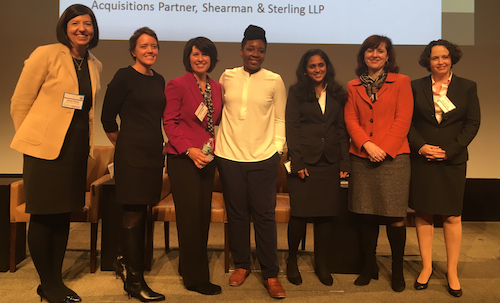
The Glasshammer 6th annual Women in tech eventThe women speaking at our 6th annual women in technology event last week emphasized the importance of taking risks to advance in your career.

“There is an infinite number of paths to a rewarding career in technology,” said moderator Dana Kromm, a senior partner in the Private Equity/ Mergers and Acquisitions practice in San Francisco at Shearman & Sterling.

“It’s up to you to pursue your own passion and take your career where you want to take it,” she added.

The panelists included Maureen Erokwu, founder and CEO of Vosmap and an advisor to Lesbians Who Tech; Lori Fellela, Senior Director of End User technologies at TIAA-CREF; Mary T. McDowell, former EVP and Head of Mobile Phones at Nokia and now a director on several corporate boards; and Sinead Strain, global head of Fixed income currencies, and commodities technology (FICC) at Goldman Sachs.

They shared stories from their own careers in tech and offered advice to the women in the audience on how to advance and thrive. Several of the panelists took risks on projects and even promotions changes early in their careers, which, they said, ultimately helped set them on the track to career growth and great learning even if in the moment, it didn’t feel that way.

Career Advancement- how can following your passion take you further?

Erokwu described how her passion for photography led to her to found Vosmap, a digital mapping company that has a contract with Google Street View. Similarly, Fellela began her career working in tech support, “climbing under desks,” before she decided to pursue a more creative path as a developer. She then switched into roles where she could interact with people more as well as work with technology. Fellela shared with how she believes hiring great people is really important to both enjoy and and advance at work.

McDowell described how she began her career developing products that began to become commoditized at Compaq and HP. When she got a call from a headhunter about an opening at Nokia in the completely different field of Telecoms, she jumped at the chance.

“Maybe it was hubris,” she said with a laugh. “I thought, I don’t know much about telecoms but ‘I’m smart – I’ll figure it out.” She did figure it out to become head of an entire business.

Strain also took a several risks in her career, including two big moves. The first time she moved from Dublin to London and then, later, she moved to New York City, for what was supposed to be a three month project. Instead, she found her new home.

Mentors and Sponsors

The women discussed how mentors and sponsors have also shaped their career paths. In turn, the panelists described what they look for in a mentee or someone who can mentor them.

Strain said she looks for passion, and someone who is looking for advice and is open to feedback.

“That’s the most powerful thing you can get,” she said, adding that sometimes feedback can sting but that’s the most powerful conversation someone can have.

McDowell said she looked for people with ambition.

“It’s more rewarding to help take the rough edges off someone who is pushing hard than to light a fire under someone,” she said.

Similarly, several panelists described how clients also helped them advance in their careers.

“Clients can be your biggest advocates,” Erokwu said. Relationships and referrals can help build business, and talk up your skills before you get the next job.

Networking

The panelists all agreed that both internal and external networking can be valuable to career advancement since it opens up opportunities to you build relationships with people who can help you in your industry and beyond.

my advice to women is to get out there, get away from your desk and meet people – Lori Fellela

For example, Strain described how she had initially approached her company’s women’s network with skepticism. But she quickly learned that it was a good way to find support from colleagues. Moreover, she said, participating in the group taught her a lot of organizational skills as well.

“It’s not enough to just come – it’s not like watching TV,” Fellela agreed. “You have to participate, my advice to women is to get out there, get away from your desk and meet people”.

Networking outside work can also help women advance. Fellela described making a business connection with a woman she met while volunteering with her daughter’s sports boosters club. Erokwu said being part of the Lesbians Who Tech community had also helped her grow in her career and make new connections that literally has given her product and firm real exposure which has translated into business.

“Inviting other women to those communities ultimately makes those communities stronger,” she said.

Additionally, advised McDowell, it’s important to build relationships with peers, not just people who are more senior.

“You never know where people are going to advance to,” she said. McDowell got her first board seat because one of the board directors was someone she had gone up against in an intense negotiation years earlier. He remembered her when he saw her name on a slate of candidates for the opening and recommended her for the job.

Advice

Finally, the panelists shared the advice they wish they’d heard earlier in their career.

“I wish someone had told me to find someone who’s been to where I’m going,” Erokwu said, adding that she thinks she has finally found that person.

“My advice is to get out and go meet people. Talk to people and make connections,” Fellela said. “Have those relationships before you need them.”

Kromm agreed. “The sooner you start building your network the better it can be,” she said.

McDowell discussed the importance of culture fit in an organization.

“Can you be your best self? Will your work be rewarded? Think of yourself as a valuable resource, ask yourself ‘what’s the best ROI’ for you”? she said.

Strain emphasized the importance of pursuing risks.

“When you’re confronted with two options where there is a safe one and a risky one, consider choosing the risky one if it makes sense, she said. She added with a smile, “It might be more fun.”

All panelists agreed that using networks like theglasshammer and technology specific organizations like Anita Borg Institute (ABI) are a great way to find support and strategies to advance as a woman in technology.