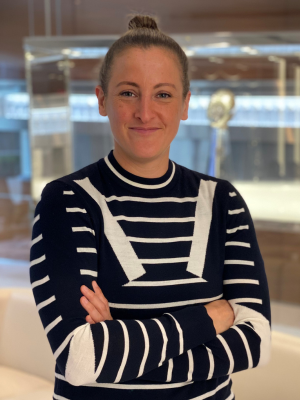
 “I tell people if you’re about to interview for a job, take our confidence language quiz because it will give you the words to advocate for yourself. You start to have the vocabulary for the conversation, including repositioning your weaknesses. When you understand your superpowers, you should feel seen, valued and heard – and in turn, you can advocate to be seen, valued and heard for your unique talents.”
We interviewed Lisa Sun, Founder and CEO of GRAVITAS, a company on a mission to catalyze confidence. In her first annual performance review, at 22 years old, Sun received what ultimately became life-changing catalytic words, “Lisa comes across as young and overly enthusiastic at times. She should seek to have more gravitas.”
After a decade of consulting with McKinsey & Company, Sun took a year-long travel sabbatical to step back from it all, before eventually launching her size-inclusive fashion brand in 2013. Within weeks of founding GRAVITAS, she was featured in O Magazine, People and on the TODAY Show, and later on CNN and in Forbes, Fast Company and more.
GRAVITAS has come to blend empowering professional clothing with inspiring content to help people show up as their full selves in full confidence from the inside out. As the national best-selling author of GRAVITAS: The 8 Strengths That Redefine Confidence, the podcast host of “In Confidence,” and a sought-after public speaker, Sun busts through the narrow cultural myth of one-dimensional confidence and inspires people to find their personal route to self-belief.
Based upon observation from thousands of diverse interactions across a decade and a 1,000 person quantitative study, Sun invites you to encounter your natural confidence language and identify your own superpowers at MyConfidenceLanguage.com.
Q: When you first made your career pivot from consulting, you started with fashion, so let’s begin there. Can you say more about the decision to lean into the external component of confidence?
For me, the unlock was realizing it’s not about how other people see you. It’s about how you see yourself and how you want to see yourself. That’s how outer and inner confidence are connected, because when you look in the mirror, you want to have a reminder you are powerful, self-assured, and bring talents and gifts to the world.
A lot of the work we’ve done is around the fact that, as children, we’re born fully self-confident. But then, something changes. We’ve identified six forces that enter our lives at adolescence, and then stay with us as the inner critic.
People find it weird we began in fashion because we see ourselves on a mission to catalyze confidence. But I started as a fashion company because I realized where women feel the most amount of insecurity is in the dressing room. It’s when you’re standing there half naked, in front of a mirror with poor lighting, that you start to think all the dark thoughts about yourself.
Inner confidence relates to how we see ourselves when we look in the mirror. Do we see ourselves in our best light? Most people think look at the new wrinkle or I could lose ten pounds. The conversation starts at the inner critic, and it’s a deep source of insecurity. Some people may never get to the point of thinking I have great eyes or I love the way I look and feel in this. Think about the difference in those two conversations.
When we do “The Confidence Closet,” what we call our fitting consultations, people come in with negative self-talk, pointing out flaws. I mirror to them three things I see that are beautiful, and we find something that brings those traits out.
A lot of the work is changing someone’s mindset. That’s why, in my book, I say confidence is a choice and a mindset before it becomes a behavior. And if you bring a negative mindset into any setting – dressing room, boardroom, any of those places – you’ve set yourself up to fail.
I envisioned we could change the chemistry of that dressing room moment of deep insecurity and instead give people clothing that reminds them of their own strengths and power. That’s why I started in fashion.
Q: Can you tell us more about these six forces and how they come to form the inner critic?
As children, we’re born self-confident. If you’ve ever been around a five-year-old, they are self-confident. Imagine you ask, “What are you the best at in the world?” They’ll say “I’m the best at soccer” or “I’m the best at hugs” or “I’m the best at everything.” At that age, we haven’t yet experienced setback or disappointment.
But in our adolescence, we start to become doubtful or self-conscious, so we identified six forces that enter our lives somewhere between the ages of eight and 12 years old. That inner critic stays. It’s nobody’s fault. It just happens because your social circle widens, you’re exposed to shame and embarrassment and you experience setbacks.
To be authentically self-assured, we need to make a choice to see those six forces, to choose not to take direction from them, and then to start to see ourselves for the talents that we bring to the table.
The six forces we identified are firstly, deficit mindset. This is where you see your flaws over your strengths. So, for example, when you look in the mirror, do you look for your beautiful eyes or the new wrinkle that formed?
Second, the shrinking effect. This is where you underestimate yourself or shortchange yourself. This is why people say “sorry” all day long when they haven’t done anything wrong. I tell people say “thank you” not “sorry.” Because if you say “sorry,” it assumes something is wrong with you. Shrinking effect is also why women will only apply for a job if 100% qualified to sit in the seat. They shortchange themselves. Whereas men will be like, “I’m 60% qualified, why not? There’s no harm.”
Third, the satisfaction conundrum. This is where we tie our self-worth to an external marker of success. I’ll be happy when I get that promotion, I’ll be happy when I get a raise. I’m not saying not to have goals, but when we tie our self-worth to an external marker, what happens? If we get it, it’s like a treadmill. We just chase the next one. I lost 10 pounds. I could lose another five. Or if we don’t, we beat ourselves up, and we don’t see all the abundance in our lives outside of that marker.
Fourth, the superhero facade. I got this. I’m awesome. Let me post on LinkedIn, so everyone’s reminded. Shonda Rhimes inspired me when she said, “Whenever you see me somewhere succeeding in one area of my life, that almost certainly means I am failing in another area of my life.” Because if you’re a superhero, no one is invited to have fingerprints on your journey. The most confident people in the world will say, “Here’s what’s going well. Here’s where I need help. Are you the person to help me?”
Fifth, the setback spiral. This is where a negative moment, a criticism, or a disappointment expounds to how you feel about your entire life. So, my boss just gave me some feedback, and that must mean I’m a terrible sister, mother, best friend. All parts of my life are off.
Sixth, systemic bias. This is the asymmetrical structures of power and the mirror it holds up to us. For example, it took me twice as long as my male colleagues to get to partnership in consulting. It should have taken me six years. It took me nearly 12. But when I joined my firm in the 2000’s, less than 13% of the partnership was women, so I can’t beat myself up over that, because it’s simply a reflection the scorecard wasn’t designed to see me.
We developed the six forces framework because it’s a great way for people to talk to their inner critic. We always ask people which they’ve ever felt and which have they felt most often. We find that when you can name why you feel insecurity or fear, when you can name what is going on, when you can have a conversation with your inner critic, it changes things.
For example, Why am I scared to apply for the job? It’s shrinking effect. I’m underestimating myself. When you can name it, you take away its power. You also come to realize everyone else has the inner critic, so you can have compassion. Ultimately, if you can face down the worst case scenario created by the six forces, then you can take your superpowers and look at the best case. And the most likely scenario is closer to your best case because you’re in control.
Objectively, these six forces are true for anyone except for systemic bias, right? But they affect women more. These forces get better for boys and worse for girls because men have historically created and controlled the system, so it favors men or boys as they go through it. Everyone has an inner critic – men, women, non-binary – but systems aren’t shaped to help women overcome these six forces.
Q: Now, on the flip side, tell us more about the eight strengths of gravitas, or eight superpowers, that you’ve been able to identify to diversify the understanding of confidence.
Our quantitative study into confidence was inspired by the conversation when Janet Yellen was nominated to be Chair of the Federal Reserve. There were all these articles repeating how she didn’t have the “gravitas” to lead the Fed. One op-ed in the Washington Post pointed out this was just because she was soft-spoken. She is also qualified, empathetic and collaborative. The op-ed questioned why we only label people as having gravitas if they’re outspoken and assertive. So this quantitative study was designed to recognize someone like Yellen has plenty of gravitas, even if she’s not the loudest voice in the room.
We found eight superpowers that came through in the data. The first two are Leading and Performing.
Leading is I’m in charge, I set direction, I inspire followership. It doesn’t mean you have to lead a team. It means you have clear vision, take agency and can command resources.
Performing is what I’m doing for you in this talk. I’m outspoken, charismatic, and I don’t mind an audience. I’m comfortable speaking in front of others.
Those two strengths are the most written about. In terms of confidence, they represent less than 20% of our data set, so 80% of people (not just women, people, as this is designed to be universal) in our data set do not have those two superpowers, and that means 80% of people have been made to feel lacking.
The next two are called Achieving and Knowing.
Achieving is I have an athlete mindset. I get things done on time. I meet or exceed targets. Practice makes perfect. If I fail, I get up again.
Knowing is I’m smart. I’m researched. I’m thoughtful. I’m the most detail-oriented person in the room. You want to build Ikea furniture with someone who has Knowing because they’re going to read the entire instruction manual and have the process set up.
The best example of these superpowers are the three black women in the movie “Hidden Figures.” They were the smartest human computers who could do all the math to put a man into space.
The next two are called Giving and Believing.
Giving is I’m nurturing, I’m empathetic, I care about others. I care about relationships.
Believing is I’m optimistic. If bad things happen, they weren’t meant to be. I see the best in everyone in every situation.
If you’re familiar with Ted Lasso, his form of confidence is Believing and Giving. In season 1 of the show, he says he’s been underestimated his whole life because he’s not a commander coach. He’s not here to win or to lose, but to help everyone be the best versions of themselves.
The last two strengths are Creating and Self-Sustaining.
Creating is my number one superpower. That is I believe in things before I can see them. I can will ideas new existence. I could create something from nothing.
Self-Sustaining is I like myself. I don’t need to impress you. External validation is nice, but it doesn’t define me.
Self-sustaining is particularly hard for women, and tends to appear most often in women over the age of 50, who are like, I’ve seen it and done it all. Nothing can harm me. It’s the quality most needed to ask for a favor, a raise or overcome criticism without spiraling.
The four superpowers that appear most often amongst women in our data set are Achieving, Knowing, Giving and Believing. What we don’t often say is the entire book is ultimately an exercise in building the Self-Sustaining superpower. Because when you have that strength, you just know your value.
Q: Are your superpowers based only upon capacity or also enjoyment?
It’s more around natural enjoyment! All eight superpowers are available to everyone with effort and intention. But the reason I call it a “route to self-belief” is your superpowers are the ones you’re distinctive at without trying, without effort. These are your talents. This is what you can bring to the table without pushing yourself.
It should feel joyful. It should feel impassioned when you get your quiz results. It feels like that’s why I am in the room. You bring these distinctive superpowers to leadership.
On this note, people are often shocked to find out I only have four and a half of the superpowers. My top ones are Creating, Leading, Performing. At first, I had only these three. I’ve been consciously working on developing Giving & Self-Sustaining. And for the ones I don’t have, I hire people around me.
For example, I don’t have Achieving or Knowing. People are often shocked and point out how I get things done or I’m super smart, but that doesn’t mean I enjoy the element underneath that! I have a spreadsheet that’s due this week, and it’s like pulling teeth. It’s not like I can’t do it; I just don’t like doing it, so that’s not my strength.
Q: Is it only about working with the strengths you naturally have or also about developing the other strengths?
To me, it’s an “and.” I say in life, everything is an “and’ instead of a “but” or an “or. When someone tells you to be more confident, what do you do? You speak up. You’re assertive. You’re outspoken. But if you look up the word ‘confidence’ in the dictionary, it has nothing to do with bravado or swagger. It’s an understanding of, appreciation of and trust in your own abilities. It’s your own mindset before it becomes an expression.
The analogy we use is the iceberg model. Only 10% of the iceberg is visible – it’s behavior. 90% of the iceberg is below the waterline – it’s thoughts, values, feelings, wants and needs. So much of authentic confidence comes from understanding what’s below the water line. How do you think and feel about yourself? Are your talents valuable to you even when not traditionally ascribed as worthy of noticing?
At the same time, you might be in an organization or cultural context where there’s one or two superpowers you’re being asked to develop. It doesn’t take away from the foundation of strengths you bring. Some things will never be natural to you, but you still may need to learn that particular skill set, because it will help you to advance.
From our MyConfidenceLanguage.com quiz, we find that as women climb the ladder, they go from having two superpowers to four, or more. It’s not a personality test. It’s an inventory of talents and abilities in the moment. Then you get to take ownership and control over which ones you want to develop and why.
Q: Are certain superpowers more important for advancing in leadership?
I will give you a fun little twist in the data. Self-Sustaining is a superpower needed for a raise but not for a promotion. If you’re asking for a raise, you want to say, “Here’s my external market value. You’re going to give it to me or someone else will. And if you say ‘no,’ I know my potential in the market.” You can actually say it with authority from a market standpoint.
Whereas asking for a promotion is more around Leading and Achieving. “Here are my accomplishments. Here’s why I deserve the title change. Here’s why…” In that context, you are actually making a case for proving your value. So it’s a little different than Self-Sustaining which is, “This is the money I deserve in the market, and we can negotiate about it, but I know my value and my worth.”
People who have the Giving superpower are really good at emotionally intelligent behaviors, but are less comfortable advocating for themselves. And it’s worth noting that any women in our segmentation who had Leading as a superpower was two-to-three times more comfortable in each of thirty diverse situations we proposed. We don’t often emphasize this correlation, because we don’t want people to lean on or overvalue this one traditionally valued superpower.
Q: In terms of systemic bias, talk about the gravitas scorecard against which women are being benchmarked.
Kelly Shue at Yale School of Management (and others) looked at 30,000 employee records and found that women were consistently rated the highest on results in performance but the lowest on promotability. Men were very promotable but didn’t rate nearly as high on performance.
When she double-clicked into promotion potential, it was based on extraversion, charisma, and assertiveness. And so 40% of the pay gap related to promotion can now be identified as an incomplete scorecard. The scorecard is not scoring for actual management potential and results, because it often overlooks things like Achieving, Knowing, Giving – all the things women over-index on in our data set.
My mom just says, “It’s okay. When tsunami happens, men make speeches. Women clean up the beaches. We give the hugs and we get the work done.” It’s funny, but true. If men created the system and they value things like Leading and Performing, but women’s highest frequency of superpowers are not that, this explains the scorecard difference.
For example, in our book, we share the example of Susan, who booked a “confidence closet” fitting with me. As VP of Finance for a health insurance company, she had her sights on the CFO role since the current CFO was retiring. But the CEO told her she didn’t have the gravitas. She was so upset, so I asked her to question what he meant by that statement. We found out her top superpowers were Knowing, Giving and Achieving. Her CEO grew up in sales, so his top superpowers were Leading and Performing. His version of gravitas would be those superpowers, which means he was probably not scoring her strengths.
I encouraged her to advocate for the talents she brought to the table and find out how he defined gravitas. She confirmed he wanted her to speak up and take charge more, and she expressed she is comfortable doing that with clear opportunities and was open to coaching. She also had the highest engagement scores in the company because of her Giving superpower, and I told her to put that in his face. She promoted the lunchtime membership program she held for her team of 100 people as a driver of those engagement scores and demonstrated Leading by bringing the program idea to other divisions. A year later, she got the CFO job.
You simply can’t leave anything to mystery. You need to find out what these broad statements really mean and not let the six forces take over. You need to find the language of confidence that can help you advocate for yourself.
Q: Let’s go more into your unique journey. What motivated you back when you were in consulting versus what motivates you now?
As a consultant, I was so obsessed with making partner, I missed out on simply taking in the experience of being with my teammates and my clients and making a difference. I missed out on all that abundance, because I was laser-focused on the brass ring of making partner. I loved my clients. I loved my team. And when you consider my superpowers, it makes sense that’s what truly I loved about it.
But I was not good at so many things about being a consultant, and I fought through them. What the firm wanted from me and what I was actually good at were very different things. The scorecard of a good consultant was not built for me. I know this now, but all I wanted was to be successful, and I got caught up in external validation (satisfaction conundrum in full force!).
As soon as I put down the measuring stick and the metrics that were imposed upon me, I started to create my own measuring stick: Am I making a difference in the world? How can I help women?
I don’t have as much wealth now, the fancy business card or the title. There’s so many things I was willing to walk away from when I changed the measuring stick. But now, I am 100% more aligned with what I should be doing. I’m finally doing my life’s work. I love and resonate with Jensen Huang’s sentiment in that I’m not always happy, but I definitely love what I do every day.
Q: You emphasize that “Confidence is a choice and a mindset before it becomes a behavior.” How does that compare with the notion that it’s taking action that creates the result of confidence?
To start, I am not a “fake it to make it” person. When I was on book tour, an old boss told me he was going to call BS on my origin story about being told I didn’t have gravitas, because I was a “very confident 25 year old.” My reply to him was that I was faking it. I was deeply insecure, overachieving, and I went home every night and hated myself in the hotel room, while everyone just told me to speak up more.
For eleven years, I played that role, but I fundamentally didn’t like myself. So sometimes, the doing is inauthentic to how you actually feel. If I could travel back in time, I would give my 23 year old self this book. I would tell her she has lots of reasons not to loathe herself.
So, part of our approach is advising if you’re going to do it, then do it from a place of strength. The word ‘pivot’ isn’t just about a change in direction. It’s a central point on which you turn, and you’re going to be that much more capable if you know what gas you have in the tank. If you know what that central point is made of, you’re going to be more able to handle the bumps and bruises along the way. The doing is better if your starting point is an awareness of how strong you are. Life doesn’t get easier. We get stronger. If you acknowledge the strength up front, the doing is not as bumpy.
Otherwise, you can go out and take risk, but the first time you experience setback or disappointment, are you going to be able to self-soothe? If you just do it and fake it, you won’t be able to handle the feedback, and you won’t be able to handle the growth. Are you going to be able to say to yourself, here’s what I learned, I’m still strong and valuable even though it didn’t go my way – and do it again? That’s the difference.
My friend, Dr. Wendy Borlabi, is a performance expert. She says it’s not win-loss; it’s win-learn. Win-learn is a more powerful methodology, but you can’t win-learn unless you already like yourself and unless you’re pretty self-assured about what you bring to the table. Then, you can handle the tough learning curve.
Instead of MVP, I think the best award to win is most improved player. I love the journaling practice of documenting gratitude. But, I also have a “how did I get stronger?” journal. I like to consider how did I get stronger from last year or from yesterday? Part of gravitas is acknowledging your strengths up front, and then when life doesn’t go your way, you can still see how you got stronger beyond the external outcomes.
Q: Sometimes, our confidence falters because we’re displaced. In your personal journey, you faced a crossroads where you stepped back from the work you’d done as a consultant and “connected the dots” about where life wanted to take you. What guidance can you offer to women who are there?
Firstly, ask this. What was the best moment in the last 12 to 24 months of your life? Often we are so focused on the summit, we don’t look back to see how much ground we’ve covered. So I ask people to find the best moment – personal and professional – and double-click into that moment to ask what you did to make that moment a reality. It did not happen by luck or chance. It was your strengths and talents that made it happen.
When things aren’t going our way, whether jobs or relationships or whatever, it’s good to tap into “core memories” that did not happen by chance. You can even pick a photo of a meaningful moment and keep it on your phone to remind you of what you’ve already done. Remind yourself that a momentary setback does not define you. Peak performance moments do.
Secondly, I went through my own journey where I asked three questions that are also in my book: What am I good at? What do I love to do? What am I passionate about?
They sound the same, but they’re different.
What am I good at? I am good at analytics, so in terms of superpowers, Achieving and Knowing. But I don’t love to do it.
What do I love to do? I love creating things. I love helping people. I love leading teams.
What am I passionate about? At the time, I would say I was passionate about fashion and content, and those are the two things I created my company around.
So connecting the dots, I really borrowed the Steve Jobs mindset of choosing these life moments that were formative to you and remind yourself of the important building blocks on your way to your path. For example, in his case, he dropped out of college which meant he could audit a class on typography, so the first Mac had really cool fonts.
When you step back and look at the peak performance moments, or even the disappointments, you can see what you’ve learned. You can see the reason you’re on path already. These are the building blocks – and then reminding yourself of what you love to do and what your unique talents are.
That’s really why we created the confidence language quiz. If I could go back again to my 23-year old self and give myself the quiz, I would have seen the things I’m good at and the things I love to do are completely different.
I’d be able to stop questioning my value and ask, hey, am I in the right job?
Interviewed by Aimee Hansen of thestorytellerwithin.com.

 If you’ve ever felt like the rules of advancement keep changing just when you think you’ve figured them out, you’re not alone. The challenge with “Merit” as we know it is that research demonstrates that people worldwide tend to believe their societies are more meritocratic than they actually are, and this blind spot particularly affects professional women, LGBTQ+ and people of color. Interestingly, studies show that when organizations emphasize meritocracy as a value, it can actually trigger implicit gender biases.