
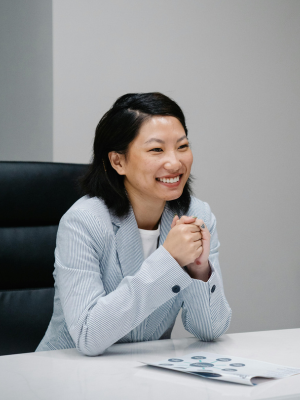
 There is a phrase that Ida Liu now CEO of HSBC Private Bank returns to when she talks about her career. “I have a double ceiling,” she has said, “the glass ceiling on one side and the bamboo ceiling on the other.”
Ida Liu built her career at Citi around this insight. After years in investment banking in New York and Hong Kong, she detoured through the fashion industry — serving as Global Head of Sales and Marketing at designer Vivienne Tam before returning to finance with an idea: a Fashion, Retail and Entertainment practice at Citi Private Bank, followed by the creation of the firm’s North America Asian Clients Group. Her cultural fluency, her language skills in Mandarin and Spanish, and her understanding of Asian ultra-high-net-worth families became a competitive differentiator that propelled her from managing director to Global Head of one of the world’s most prestigious private banks. Today, as CEO of HSBC Private Bank — which she has described as the one institution she would have considered joining — she oversees $566 billion in invested assets and customer deposits, with her background as a central part of her value proposition.
It is a formulation that captures the particular challenge facing Asian women who have risen to the top of financial services and the Fortune 1000. They have had to break through not one barrier, but two: the persistent underrepresentation of women in senior finance roles, and the equally stubborn phenomenon that leaves Asian professionals clustered in technical and mid-level positions while remaining conspicuously absent from boardrooms and C-suites.
Yet a remarkable cohort of Asian women has done exactly that, ascending to roles that were unimaginable a generation ago. Their paths differ, from investment banking to asset management, from private wealth to regulatory fintech but their hard-won lessons form a coherent body of wisdom for women navigating the same terrain today.
A new book, Walk Away: Step Out to Step Up by Singapore-based author and executive Sally J. Clarke and US based co-author Deborah Overdeput, adds a compelling dimension to that wisdom. They gather the stories of high-achieving women across Asia who discovered that sometimes the most powerful career move is not pushing harder, but instead stepping back with clarity and intention to then reach their goals more effectively.
The Landscape: Progress, But Not Parity
The headline numbers tell an optimistic story. Yie-Hsin Hung, president and CEO of State Street Investment Management, leads one of the world’s four largest asset managers with more than $5 trillion in assets under management. Lisa Su runs AMD. Susan Li is CFO of Meta. These names have become shorthand for a generation of Asian women who have reached the commanding heights of corporate America and global finance.
But the structural picture is more complicated. According to a 2023 study by KPMG and Ascend, a global network for Asian professionals, directors of Asian ancestry hold just 6.4% of Fortune 1,000 board seats, far below their share of the educated workforce. Research by MIT Sloan’s Professor Jackson Lu has found that East Asian Americans in particular advance to senior roles at lower rates than both white and South Asian peers, a disparity that persists even after controlling for qualifications. The bamboo ceiling, a term popularized by Jane Hyun in her 2005 book Breaking the Bamboo Ceiling, is not a relic — it is a present-day reality, shaped by cultural stereotypes, implicit biases, and leadership frameworks that were never designed with Asian women in mind.
“We’re chipping away at the glass ceiling,” Liu observed recently. “But when it comes to the bamboo ceiling, there’s still a lot of work to do.”
A Cultural Nuance: Visibility Is Not Vanity: It is Strategy
One of the most consistent themes among Asian women who have reached the top of financial services is the deliberate decision to make themselves seen and heard, even when cultural upbringing inclined them toward restraint.
Ida Liu has spoken openly about conducting “elevator pitch sessions” through Citi’s Asian heritage network, coaching Asian women in the art of self-advocacy. The inherited norms of humility that serve as virtues in many Asian families such as being modest, not boasting, and deferring to the group can quietly derail careers in an industry where visibility and sponsorship are currency.
“Communication is key, and networking is everything,” she has said, describing the advice she wishes she could give her younger self.
Yie-Hsin Hung’s trajectory illustrates what deliberate visibility can achieve. A mechanical engineering graduate of Northwestern and MBA from Harvard, she spent years at Morgan Stanley and Bridgewater before becoming CEO of New York Life Investment Management in 2015 — where she became the highest-ranking Asian American and female executive at the parent company. She was the first woman and first Asian American to chair the Investment Company Institute’s Board of Governors in its eight-decade history. These firsts were not accidents. They were the product of sustained engagement with the networks, associations, and platforms that allow leaders to be recognized beyond their immediate organizations.
The lesson is practical and simply put, attend the conference, join the board, take the speaking engagement, even when the instinct is to let the work speak for itself. In financial services, work rarely speaks loudly enough on its own.
Build Relationships Across, Not Just Up
Traditional career advice emphasizes the importance of senior sponsors and sponsorship remains genuinely critical, particularly in an industry where promotion decisions are often made in rooms that exclude the candidates being discussed. But the Asian women who have reached the top of financial services have often distinguished themselves by investing equally in lateral relationships: peers, direct reports, colleagues in adjacent functions.
Yie-Hsin Hung has described her leadership philosophy in terms that go beyond conventional hierarchy. She has spoken of the importance of “engaging people’s hearts” alongside their intellects, of leading organizations that live and breathe their values, not merely execute their strategies. At State Street Investment Management, she introduced performance management processes centered on career conversations and real-time feedback, and launched leadership development programs that explicitly teach communication skills and emotional intelligence. She has made building a diverse leadership team a stated priority, noting that the senior leadership of her organization is now more than half women.
The Walk Away contributors echo this orientation toward community and reciprocity. As Clarke writes in the book’s framing, recurring refrains heard from high-achieving women across continents include the necessity of mentorship, the importance of building networks, and the value of lifelong learning. These are not soft supplements to technical excellence; they are the architecture through which Asian and Asian American women in finance have most reliably built the sponsorship, the visibility, and the trust that formal credentials alone rarely confer.
The implication for women building careers today: the relationships you cultivate with people at every level and the reputation you earn as someone who develops others, not merely outperforms them will matter as much as any individual achievement when senior roles are being filled.
By Nicki Gilmour, founder and CEO of theglasshammer.com and Evolved People Coaching.