
Image via Shutterstock
Guest contributed by Stephanie Evergreen, PhD
Ever been in a meeting where each person’s presentation gets incrementally more boring, even though the data should be intrinsically interesting to everyone in the room. You present to a room where half of the folks around the table are checking email?
Are you capturing your audience’s attention with your presentation and more importantly, can they easily make sense of what you telling them? In fact, research shows that when we present decks with bullets and then proceed to speak to them, we literally interrupt our audience’s ability to make sense of what we are saying. This is because our brains aren’t wired to read and listen to the same content, delivered at two different paces, through two different avenues.
At worst, those around the table are overwhelmed by all of the information being presented and simply check out (or check email). You’ve lost control of your content and the agenda moves forward without your case being made and with decisions still left on the table, leaving you looking less than your totally awesome self.
Instead of the typical way slide decks are delivered, let me give you an effective alternative based on research of how human brains are wired. The brain is wired to first look at the pictures.
Researchers call this the pictorial superiority effect, which means we live in a pictures-first world. So if we focus our slideshow development on having clear, effective visuals, our content will be more readily understood. We will maintain control of the discussion. We will get decisions made. We will stand out.
Turning that slide into effective data visualization is surprisingly easy and can be done entirely within PowerPoint. The trick is to state your bottom line right up front.
I was a guest in an ops review meeting and I listened as the COO of this Fortune 500 company told his team that what he wanted to see on the slide was: (1) your claim, and (2) the visual evidence that supports the claim. What a lovely way of stating it.
In the example above, the bottom line is literally at the bottom of the slide: “Data suggests sales to women are improving.” This is key! It needs to become the title of the slide. We could also re-word it a bit to be more straightforward:
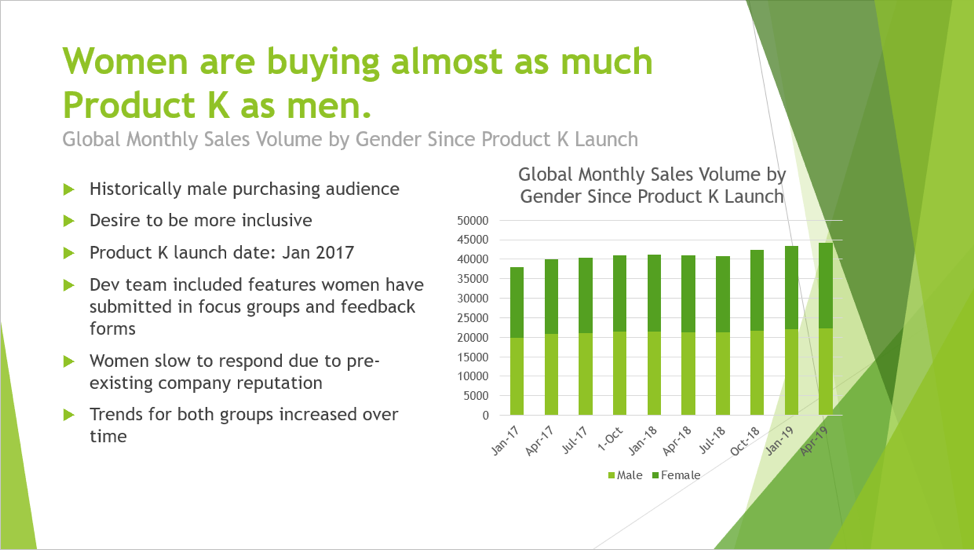
This, alone, will cut down on some meeting noise because people won’t be guessing at what you are trying to say.
But the visual isn’t really showing the evidence that supports that claim. It isn’t that easy to see the fact that women are buying almost as much as men. A better way to show data stories that have to do with closing the gap is a graph type I call a dumbbell dot plot.
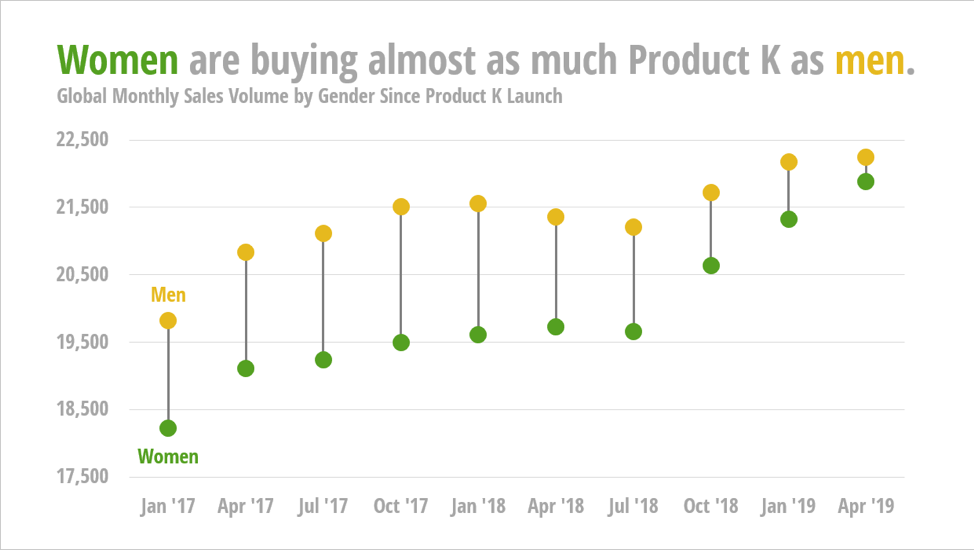
A dumbbell dot plot encodes the data by a dot’s position and research shows that a set of dots, positioned on a scale, is the easiest graph type for our brains to interpret. We then connect two of the dots like a tiny Popeye dumbbell, where the line draws the eye to the space, the distance, the gap between the two dots. This graph type makes it much easier to see that sales are trending up for both groups and that the gap between genders is closing.
Dumbbell dot plots are so easy for people to decode but we don’t see them very often because they aren’t a default graph type in PowerPoint. Want to see how easy it is to make one, though?
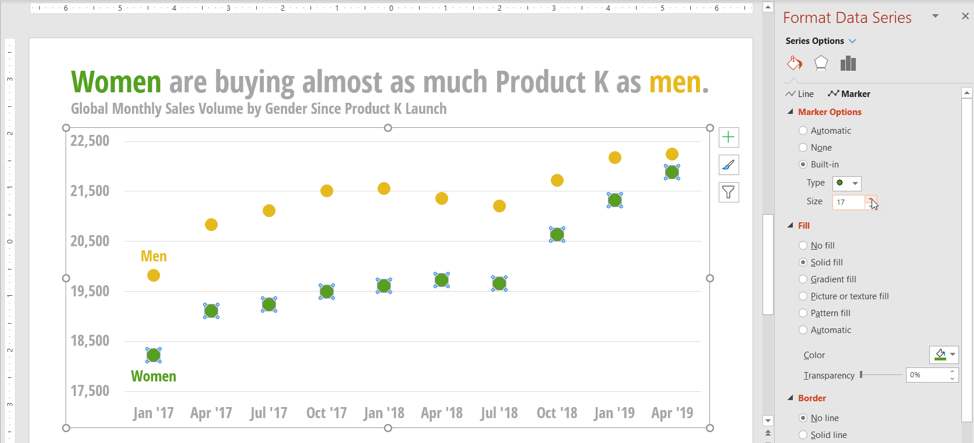
I just started with a line graph with markers. Then right-click on one of the lines and select Format Data Series. Make the line No Fill. Then make the markers large.
To make the dumbbell stick, look in the menu bar for the Chart Design tab. On the left is a button called Add Chart Element. Open it, navigate to Lines, and select High-Low Lines.
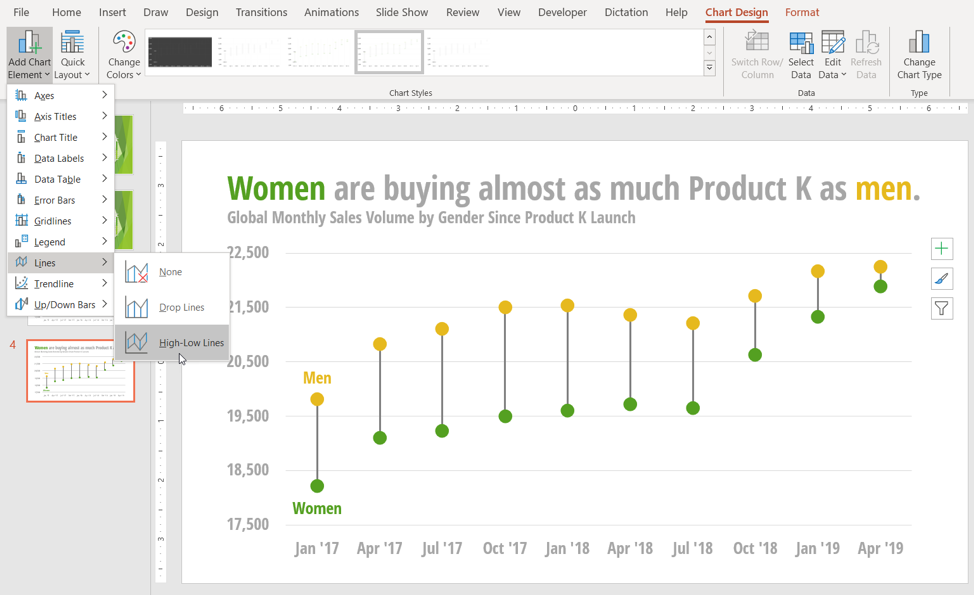
So easy. Such a small change that makes such a huge impact. Of course, I used a better font, ditched the clutter-y slide template, and removed the bullet points and those things will also make it much easier for the audience to see what I came to talk about.
One note, so that you don’t get surprised in a meeting: In some versions of PowerPoint, when you go into full screen mode, the lines appear on top of the dots and it doesn’t look as cool. If that happens to you, copy the graph and paste it as a picture right on top of the graph. Test this out ahead of time.
Knowing which chart type will best showcase your data story is an essential skill that isn’t taught in business school (yet). With million-dollar business decisions and your career on the line, you can come out ahead by adding this skill to your knowledge base and I show you exactly how to choose the right chart type (with the peer-reviewed research that backs up my recommendations) and how make it, step-by-step, right inside Excel and PowerPoint in my latest book, Effective Data Visualization.
A tiny investment into clear, effective slides, where we state our bottom line and then show the evidence that supports it, reaps dividends in meetings. We get our points across without distraction or interruption, we represent ourselves as clear and collected, critical business decisions get made, and we shine. That is how you set yourself up for a promotion.
ABOUT DR. STEPHANIE EVERGREEN
Dr. Stephanie Evergreen is an internationally-recognized speaker, designer, and researcher. She is best known for bringing a research-based approach to helping researchers better communicate their work through more effective graphs, slides, and reports. A Fulbright scholar, she holds a Ph.D. from Western Michigan University in interdisciplinary research.
Dr. Evergreen has trained future data nerds worldwide through keynote presentations and workshops, for clients including Mastercard, Verizon, Chick-Fil-A, Rockefeller Foundation, Brookings Institute, and the United Nations. Dr. Evergreen writes a popular blog on data presentation at StephanieEvergreen.com. Her two books on designing high-impact graphs, slideshows, and reports both hit #1 on Amazon bestseller lists weeks before they were even released. This May Dr. Evergreen has published the second edition of one of those bestsellers – Effective Data Visualization: The Right Chart for the Right Data and the brand new Data Visualization Sketchbook with templates for making infographics and dashboards.
The opinions and views expressed by guest contributors are their own and do not necessarily reflect those of theglasshammer.com

Calling Great Writers- Guest Articles Welcome!
NewsWe are planning content for the Late Summer and Fall already here at glasshammer2.wpengine.com
If you would like to be considered as a guest contributor, please send your pitch to jennifer@glasshammer2.wpengine.com and she can send you guidelines, deadlines and style tips.
We always appreciate academia dissected into useable advice when it comes to career advice for women in financial and professional services/big law/ Fortune 500.
We look forward to hearing from you.
We built the campfire so we can tell the stories that matter, together.
With Gratitude,
Nicki Gilmour – Founder and Publisher of glasshammer2.wpengine.com – smart women in numbers.
Mover & Shaker: Helen Campbell, Management Consultant, Implement Consulting Group
LGBT celebration, Movers and ShakersA career that allowed Helen Campbell to live and work in multiple countries gave her a unique view into culture and the way it should impact your working life.
For example she had always assumed that it was important to fit in and adhere to the company values, which was reinforced with her first professional role in Japan, where the culture was still then very much about dedicating yourself to a company for life.
“I realize now that especially in consulting, it should not be about signing up to a company’s way of working, but rather that by joining a company you should change and add to it and bring your own uniqueness to it,” she says.
A Career Spanning Multiple Countries and Roles
Campbell studied electrical engineering at Queen’s University of Belfast, as well as Japanese as she hoped to visit Japan. Her chance came at a career fair at the university, where she learned about an Irish government program that supported Irish graduates finding a job in Japan with companies that had a link with Ireland. She got a job with Fujikin, a Japanese manufacturing company, and flew to Japan with 16 other Irish graduates.
As the first female and non-Japanese engineer the company had hired, there was quite a bit of adjustment on both sides, but Campbell worked for them for six years—two in Japan, one in Dusseldorf in Germany and three in London, in a variety of roles that included engineer, key account manager and project manager. Realizing that was the role she enjoyed the most, she decided to look for another position where she could develop these skills and joined QinetiQ, a UK defense company, where she managed a range of defense and commercial projects and travelled to countries like Jordan and Brunei.
It was there that Campbell interacted with several consultants and became interested in the opportunity that consultancy provides to be part of transformational projects. She joined PwC in London in their Portfolio and Programme Management consulting practice and worked there for eight years, including transferring to Stockholm with them in December 2016.
Last year she decided it was time to try something new and left PwC to join Implement Consulting Group, a Nordic consultancy, as a senior consultant.
The company is growing rapidly and thus feels very entrepreneurial even with around 900 employees, Campbell notes. As it’s not as well-known in Sweden as Denmark, she is excited about growing the business, especially around supporting clients with the delivery of their largest and most complex transformations.
Starting an LGBT Network, Which Started a Movement
While her career has held an impressive mix of managing large efforts like a merger of two airlines’ finance functions and large-scale IT implementations, what Campbell is most proud of is the feedback she gets from junior consultants with whom she has worked. “I really enjoy teaching others and encouraging them to stretch themselves on projects, and because of that I’ve helped many consultants achieve promotions, which is extremely rewarding,” she says.
While working for PwC, Campbell co-founded the LGBT network for the UK; along with a small team she built a strong network—called GLEE@PwC (Gays, Lesbians and Everyone Else)—and developed a brand around it. That included hosting high-profile client events, where they got a majority of the UK employees wearing rainbow lanyards. Through running the network, she sat on several panel events and spoke at conferences about the value of being your true self at work.
In fact it was only when she joined PwC that she came truly out at work, and at that point there was a lack of LGBT role models and especially women. A turning point she remembers is when EY won the Stonewall LGBT Workplace of the Year Award, and Liz Bingham made a speech about her career at EY before and after she came out at work. “This was the first time I had heard a senior lesbian woman speak about the value of being herself at work,” Campbell says.
Developing GLEE generated a lot of attention internally in PwC with poster campaigns, a designated Twitter account, internal news articles and more, which meant that many on the committee were contacted by LGBT people across the country about coming out or about becoming more of an activist. Through those efforts, Campbell was able to mentor several LGBT men and women. “I have loved supporting them in their personal journey, both in and out of work,” she says.
Campbell believes there is still a big journey in the corporate world and in society around acceptance and normalizing trans-gender people. “Even in Sweden, which is fairly progressive, I am not sure I have seen any trans-supportive policies,” she says, although she notes that gender-neutral bathrooms are the norm.
For those reasons, it’s important to continue to be open and transparent—as a way to bring attention to LGBT issues and change hearts and minds.
LGBTQ Update: Building A Rainbow Pipeline
LGBT celebration, NewsBy Aimee Hansen
In this month of a historic milestone towards LGBTQ rights in Congress, supported by an unprecedented number of business allies, theglasshammer explores the increasing business case for – and arguable inevitability of – greater LGBTQ executive leadership in the C-Suite.
Status: real progress amidst real discrimination.
According to Catalyst’s 2018 Quick Take, “72 countries prohibit discrimination in employment because of sexual orientation.” The U.S. has no federal protection for LGBT, no state-level protection for sexual orientation in 28 states and no gender identity protection in 30 states. 50% of the LGBTQ community lives in the 30 states that do not offer clear protection.
Policy wise at a corporate level, 91% of Fortune 500 companies have non-discrimination policies that include sexual orientation. 83% include gender identity, 60% include domestic partner benefits and 58% include transgender-inclusive benefits. Interestingly as a comparable, only 21% of Fortune 500 firms offer paid family leave which is a very crucial topic that needs to be addressed regardless of who the primary caregiver is.
About a fifth of LGTBQ employees still experience discrimination when applying for jobs and have not been paid or promoted equally.
A recent study revealed that people who sounded ‘gay or lesbian’ (or gender a-typical) were less likely to be considered suitable for leadership positions, and were related to differently by heterosexual listeners.
Another study sent two virtually identical resumes to Fortune 100 companies that had both non-discrimination policies and LGBT ERGs, the only real difference in resumes being that one of the candidates indicated being president of a gay student alliance and the other president of a non-LGBT social club. The first resume was 40% less likely to get an interview.
According to Forbes and Todd Sears of Out Leadership, in 2019, “609 companies got a 100 on the Human Rights Campaign Corporate Equality Index, yet ‘46% of LGBT employees in the US are still in the closet.’”
Outlook: a rainbow pipeline for LGBTQ leadership.
“Less than 0.5% of Fortune 500 CEOs are LGBT,” says Sears in Forbes. Yet he argues that while current C-Suite representation is underwhelming, it’s also on the cusp of a greater LGTBQ influx.
“If you look at the average age and tenure of CEOs in the Fortune 500, it’s in the mid to late-50s and their tenure is significant with a turnover of less than 2%,”says Sears. “So, if you’re looking for where the LGBT leaders are, there are a significant number of LGBT leaders one-level below the C-Suite.”
Sears emphasizes focusing on this level, at regional CEOs in Fortune 500 companies and at the higher number of “out” CEOs in mid-cap companies. These leaders are in the pipeline to take executive leadership, such as Beth Ford, the new CEO of Land O’Lakes, and the first openly gay woman CEO to run a Fortune 500 company.
In other words, it would appear there’s a rainbow pipeline on its way to displace the current ‘rainbow ceiling’.
Stanford’s LGBTQ Executive Leadership Program, now in its fourth year, has a a high profile for preparing executive bound LGBTQ senior professionals, with training including leading as your “genuine self” in “authentic leadership”. According to FT, the program has “spawned one of the school’s most active alumni networking groups.”
OutNEXT is also the first global talent development program for emerging LGBT in the US, Europe, Asia and Australia. 1,100 young leaders have gone through this program in the last five years.
As part of the curriculum, Sears talks about helping emerging LGBT executives to comprehend their “gay vantage.” According to an Out study, 70% of tomorrow’s LGBT leaders see being gay as a positive influence on their careers (vs. less than 20% five years ago). Research has shown that LGBT people have a higher level of empathy, for example, an important quality in emotional intelligence and leadership.
Fact: businesses with LGBTQ representation in leadership perform better.
The business benefits of LGTBQ leadership are becoming increasingly clear, and Sear speaks to elevating the salience of “Return on Equality”, an economic benefit which “drives sustainable, bottom line growth.”
In a recent study by Marquette University, researchers looked at 88 companies that were members of the Wisconsin LGBTQ Chamber of Commerce, of which 61% had one or more LGBT people in a top position.
The study found that businesses with LGBT senior leadership had higher overall “firm performance”, as well as noticeably higher scores in corporate social and environmental responsibility, high performance HR practices and workforce quality.
“This study supports what we have been saying for years: Having LGBT people in leadership positions, whether it’s as a CEO, a business owner, a part of senior management or on the board of directors, is good for a business’ bottom line,” said Jason Rae of the Wisconsin LGBT Chamber of Commerce. “Simply put, diversity is good for business.”
Intrepid Woman: Stephanie Sandberg, Executive Director, Team LPAC
Intrepid Women Series“There’s so much energy that is consumed by not saying the things you are thinking,” she says. So right up front when she was at a business lunch and someone would ask what her husband does, she would blurt out early that she was with a woman. “It helped ease the conversation and provided me a sense of wholeness,” she says, in urging young gay people to be open with their reality.
A Career in Media As the Foundation for Her Current Work
Sandberg spent the first 25 years of her career in magazine publishing, working on marketing for titles like the L.A. Times, Newsweek and the New Yorker before becoming president and publisher of the New Republic and, later, executive publisher of the Columbia Journalism Review. Then she pivoted to consultant work.
After dabbling in a variety of projects, she realized she wanted to focus on one area and became interested in women’s leadership and the barriers to advancement women faced at the top echelons. Sandberg joined Out Leadership on a project basis, which aligned with her interests in diversity and inclusion.
But, she found, “inclusion” was often male-dominated.
“Lesbians are underrepresented, underleveraged and don’t have a voice at the table,” she says. “The gay world is very similar to the straight world in how gendered it is.”
So she helped the organization launch OutWOMEN, running discussion dinners to get people around the table.
“We realized that women don’t come together as intentionally around professional matters,” Sandberg notes, so they launched both formal and informal events. The satisfaction she derived from this work pointed her consulting in that direction, and she ended up at a holiday party for LPAC in 2018, where she learned they were looking for an executive director.
Leveraging the Voices of Gay Women
Today Sandberg heads LPAC as a political voice for the LGBTQ+ community. One of her first moves was officially shortening the name from “Lesbian Political Action Committee” to its acronym, as she found the name wasn’t embraced by everyone.
Then she began leveraging what she learned at OUTWomen about how women come together. Just as she had previously discovered that women prefer to socialize differently, she learned in her early days with LPAC that LGBTQ women’s political concerns are different, but rarely discussed as such. “Gay women don’t always have the same priorities as gay men,” she points out, adding that healthcare, choice and women’s equality are paramount to gay women. “We needed to carve out a place and build a voice for this subset from the LGBTQ community and address inequalities by championing candidates who support us.”
Right now her mission is to make sure the community knows about LPAC, particularly people who have the financial capacity to support the group. The biggest challenge, she finds, is building the group out to where potential donors not only know about it, but also choose it as a priority among so many worthy causes.
“If they understand that their investment is an investment in strengthening this community, and then convert that enthusiasm and awareness by including us in their giving, I will have done my job,” she says.
Sandberg believes that will come as they build empirical data about how they have amplified the effect for the candidates they endorse. To that end, they launched a nonprofit group Project LPAC and have a fundraising event—Levity and Justice for All –scheduled for June 25, the only official World Pride event specifically for women.
Sandberg has the benefit of knowing the work she does will benefit her personal life, too, including for her wife of 20 years and two daughters, ages 16 and 12, but she also knows the importance of making them the focal point of her life aside from work.
“While my work is important, a broader wholeness comes from have a balance; a lot of career people find themselves too deep in the work, and while it matters, it can’t at the expense of family,” she says. “You have to treasure being able to have family experiences at the end of the day; my main goal is to spend that time with my girls.”
Voice of Experience: Diane Bell, Partner, Katten Muchin Rosenman LLP
Voices of ExperienceFor example, she initially hesitated to bring her partner to firm events as she got to know the culture, but after several months, a more senior manager inquired as to why she didn’t bring her. “It was eye-opening to see that it was far more than acceptance that they were offering, in that they were almost offended I wasn’t bringing my partner, as though I wasn’t proud of the firm,” Bell said. And she has seen that culture embrace diversity throughout her tenure there.
Relationship Building Drives Career Satisfaction
Although Bell has been with Katten for 13 years, she originally joined a smaller firm right out of law school, selecting it due to its culture and people. However, after the tech bubble burst, she realized that the corporate group she had joined was going to be slow to recover, so she decided to look into another firm that would allow her to develop her skill set. She found a great opportunity in Katten’s Corporate practice, where she has honed her skills doing the challenging work of private company mergers and acquisitions, while delighting in the wonderful people she’s met along the way. “I’m really happy with the kind of lawyer I’ve turned out to be,” she says.
Bell values the firm’s emphasis on building relationships with their clients noting two transactions that have been particularly meaningful. In one, near the beginning of her time at Katten, she helped a small business owner, who immigrated with the proverbial “$20 in his pocket,” sell the wildly successful business he eventually built and receive the most appealing terms possible. “As a more junior member of the team, I got to know him and his wife well, and it was incredibly rewarding to act as a counselor for them,” Bell says. “When we got confirmation that the payment hit their account, they hugged each other, then bear-hugged me.”
Her second memorable moment involved another family-owned business that had gotten a valuation for estate planning purposes and were blown away by its size, leading them to consider an exit strategy much earlier than they expected. They initially decided to use a broker who didn’t seem up to the job. Bell felt that they could do better, and get a better price, with another broker, and the broker that Katten introduced the family to ultimately put together a package that led the business to realize almost twice what they had initially hoped for. “It was very rewarding to help guide this wonderful family through what to them was a very confusing process,” Bell says.
Being Open Pays Dividends
Bell always recommends that younger associates find senior attorneys willing to act as sponsors. She, for example, feels fortunate that the former managing partner of the firm’s Los Angeles office, who now serves as a Los Angeles Superior Court judge, took it upon himself to actively look out for newer professionals during the lean years of the recession—and in fact, she says it’s due to him she is still there. “You need those people up the food chain looking out for you,” she notes.
From the beginning of her career journey, Bell has made a conscious effort to be transparent about her orientation. “I thought that if potential employers weren’t accepting, then I didn’t even want to start down the road with them,” she said. For example, she noted on her resume that she interned at Lambda Legal, an organization that focuses civil rights impact litigation to benefit the LGBT community and individuals living with HIV impact while in law school.
In fact, Bell says that trying to conform in any way that’s against your authentic personality can be a hindrance to your career. She has found that as she let her true self shine through to her coworkers, she got along far better and gained more respect. Even more importantly, she says, she no longer had to expend the emotional energy on trying to be someone she wasn’t. “It frees up so much bandwidth to not try to assimilate into what I thought that the associate mold was supposed to be, which was against my character in a number of ways,” she said.
As co-founder of Katten’s LGBT Coalition, Bell says its purpose has morphed over time; it first was formed to ensure LGBT attorneys were on an equal playing field with respect to employee benefits and insurance coverage—that her wife, for example, would be recognized as family and receive the same benefits offered to spouses. When grappling with issues like this, she has found that at Katten typically it only requires explaining the concern before the issue is addressed. “If people don’t understand that there is a problem, they won’t know it needs to be fixed,” she said.
Over the years as marriage equality resolved many of those types of issues, the coalition now focuses on other aspects such as recruiting and retention of LGBT attorneys and organizing the firm’s biennial LGBT Attorney Retreats, which takes place in Philadelphia this coming year.
Away from the office, Bell enjoys spending time with her family; she has been with her wife almost 20 years, and they have two children, ages 9 and 1-1/2.
And she continues her work with civil rights organization Lambda Legal as a member of the board of directors. “Katten has played an important role in helping support this work financially and also allowing me time to travel for my duties,” she says.
Enjoy our LGBTQ and Ally coverage all of June
LGBT celebration, NewsJune is Pride Month in many countries in the world, with NYC hosting World Pride this year. This coincides with the 50th anniversary of the Stonewall uprising which is the place where civil rights for LGBTQ Americans began.
The bad news is that fifty years later, someone can be legally fired from a job, because a manager or business owner doesn’t approve of the person’s sexual orientation or gender identity, in a majority of US states. The Employment Non Discrimination Act or ENDA which has been in circulation since 1994 and has not yet passed despite a historic recent victory of the passing of the Equality Bill. This important bill was passed on 17th May by the House of Representatives to try prevent this type of discrimination but still has to clear Congress so LGBTQ people are far from safe from subjective decision making by a person who decides to create a ‘less than me’ dynamic.
The good news is that we will shine a light on amazing LGBTQ women and Allies this month as well as talk about what you can do to be a great Ally.
We will also look at how great companies are pushing for progress in the legislative vacuum and are making positive changes in the world. Sometimes, it is about changing the world and sometimes if all you can do it change your corner of the world to make it better for the people around you, then that is a good start.
Enjoy the articles and profiles.
And, walk the talk on your values.
Voice of Experience: Laura Raymond, Vice President and Business Development Officer, Wells Fargo Commercial Banking
Voices of ExperienceBy Cathie Ericson
“Be a horse with blinders on,” recommended Laura Raymond’s dad, who had had a successful 40-year career in banking.
It didn’t take long in Raymond’s career to learn the wisdom of that—to tune out the constant distractions and focus on the task at hand, rather than letting the highs and lows get in your way.
Reaching for Success
That solid advice has helped Raymond build an impressive career in sales. Over the years she has held roles in sales business development in diverse industries, starting in media advertising. After transitioning to the account side and a commission sales role, she embraced the challenge and learned to really hit the pavement, as she says.
Next she was presented with the opportunity to join Garda Cash Logistics in business development, where she partnered with treasury management sales consultants in her first exposure to banking, a field that interested her since she comes from a banking family. As cash management is just a fraction of treasury management, she set her sights on learning more, which she finds to be one of the elements that intrigues her most about any given job—the chance to always expand your knowledge in a quest to find your niche. Six years ago she was given the opportunity to join Wells Fargo in New York—and she jumped at the chance even though it was all new: new market, new product and new industry.
And that’s how she was able to attain the professional achievement she is most proud of to this day—earning a spot in the President’s Club, which is reserved for the top echelon of sales people, and which many tenured employees never achieve, in only her first year on the job. It was especially exciting because the final client that pushed her to the top came just in the nick of time on New Year’s Eve.
Since then she was recruited to join the commercial banking department, where she is currently a business development officer. As greater New York is considered an expansion market for the commercial side of Wells Fargo, she finds it exciting to be part of the growth initiatives and rewarding to onboard new clients and help them succeed.
As the banking industry is notoriously male-dominated, it can be easy for women to lose their identity and get discouraged, she finds. “But it’s important to take the lead and know your worth—to take initiative and speak up. There are times women keep their mouth shut when it’s important to voice your opinion,” Raymond says.
Embracing Diversity Inside and Outside the Workplace
Raymond says she has never worked for a company that’s so focused on diversity and inclusion as Wells Fargo. “They make an effort for everyone to feel at home, and it’s helped me find my niche and thrive,” she says.
One of her most pivotal moments was having the honor of meeting Stephanie Smith when participating in the Wells Fargo Diverse Leaders group. Raymond says that Smith shared how she came out as soon as she graduated from college so has spent her whole career being authentically open about her orientation. “It can be hard to find your confidence when you’re not being your true self.” She herself finds that there are a lot of assumptions around being a woman and being LGBTQ. “I often having people saying that I don’t look gay, and for me that’s an invitation to break the barriers down on a daily basis so we can treat everyone as equals.”
As cochair for the Wells Fargo Pride Team Member Network in New York City, she helps organize networking and mentoring opportunities within the organization and oversees the bank’s participation in Pride March and the AIDS Walk. “It’s great to be behind the scenes, helping making the ideas a reality,” she says. She also has joined a Wells Fargo team to participate in Cycle for the Cause in September, a three day bike ride from Boston to New York that raises funds to help find a cure for AIDS.
Always up for activity and adventure, Raymond enjoys traveling, and as a skiing aficionado has skied in the Alps and Canada and around the country. And, as a Philadelphia native with two older brothers, she says she is obsessed with Philadelphia sports. “But most of all I love spending time with my family, which helps me recharge and be ready to come back to work.”
Emotional Intelligence – Part 2: Do Women Have Higher Emotional Intelligence than Men?
Career AdviceBy Aimee Hansen
As Daniel Goleman, Ph. D, author of the New York Times bestseller Emotional Intelligence among other publications, highlights: “Members of a successful corporate team must, collectively, have a high level of emotional intelligence. On a team with high EI attributes, it is easy to spot those few who do not…”
But according to research, it would seem that women are significantly more likely to be amongst those who do.
Women Demonstrate More EI Competency More Consistently
Whether women have higher emotional intelligence than men has been a topic for debate by Goleman and others, though a Korn Ferry study of 55,000 professionals across 90 countries found that “women score higher than men on nearly all (11 of 12) emotional intelligence competencies, except emotional self-control, where no gender differences are observed.”
The authors, including Goleman, “found that women more effectively employ the emotional and social competencies correlated with effective leadership and management than men.”
According to the Korn Ferry results, women were 86% more likely than men to be seen as consistently demonstrating emotional self-awareness as a competency (18.4% of women compared to just 9.9% of men). Women were 45% more likely than men to be seen as demonstrating empathy consistently.
Women also outperformed men at “coaching & mentoring, influence, inspirational leadership, conflict management, organizational awareness, adaptability, teamwork and achievement orientation.” The most narrow margin was “positive outlook” (9% more likely), and the only gender neutral competency was “emotional self-control.”
When it comes to excelling at what we value, these findings complement research that shows that men are more likely to undervalue the relationship interaction with customers and clients, which women will tend to emphasize as important.
Closing the Gender Gap of Competency Perception
Generally speaking in the workplace, women tend to undervalue their skills competency and performance while men overvalue themselves on both.
These perceptual differences, reflected in the cultural mirror, can mean women preemptively take themselves out of the game. In one Hewlett Packard report, men went for the job if they were 60% qualified based on job criteria whereas women went for the job only if they were 100% qualified.
Zenger Folkman found that women’s confidence increases with age and experience so that by our mid-40’s, we’ve closed the gender confidence gap to meet men. But it’s the leaps we may have forgone in our 20’s and 30’s, when the gap was prevalent, that still factor in as lost opportunities.
Dr Richard E. Boyatzis, Distinguished University Professor, CWRU, spoke to women undervaluing, and men overvaluing, their competencies in the workplace: “Research shows, however, that the reality is often the opposite. If more men acted like women in employing their emotional and social competencies, they would be substantially and distinctly more effective in their work.”
“The data suggests a strong need for more women in the workforce to take on leadership roles,” said Goleman. “When you factor in the correlation between high emotional intelligence and those leaders who deliver better business results, there is a strong case for gender equity. Organizations must find ways to identify women who score highly on these competencies and empower them.”
Emotional intelligence is considered a key differentiator at the top leadership level, and it’s a competency asset women can deeply value even as we develop it.
How do you further develop your “EQ”?
According to a Forbe’s Coaches Council article from Cari Coats, there are four main attributes that can be recognized in emotionally intelligent leaders, paraphrased below.
Self-awareness of your own internal motivations and tendencies and emotions and both understanding and acceptance of “the good, the bad, and the ugly”. Emotionally intelligent leaders can take feedback without defensiveness. One practice that can help is to become aware of how you respond when challenged or when things don’t go well.
Transparency both in your own vulnerabilities and flaws and mistakes as well as in speaking with truth and clarity with others. As Dickson writes, “the key is showing up as a whole human and being unafraid of transparency, then working toward improving relationships within an organization, within team communications or with customers.”
Being present to perceive and listen and respond to the person or situation in front of them without judgment, while recognizing the emotional needs of others at play. An emotionally intelligent leader is able to appreciate and allow other’s emotions and handle them with empathy.
Self-mastery of emotional awareness so that they are not yanked into emotional reactions, but instead can more aptly choose how to respond in any given moment.
Want to go much further? For a comprehensive list of leadership training opportunities, books, tips, exercises, videos and assessments to help develop your emotional intelligence, please check out the Positive Psychology Program for resources.
Unpacking Stress at Work Part 1: Mismatched Expectations!
Career Tip of the Week!By Nicki Gilmour, Executive Coach, CEO and Founder of theglasshammer.com
As a coach, many clients come to me because they are somewhat dissatisfied at work. Often they have been happy for years and a new structure or a new job in the firm has made them question if they should leave the team or even the firm.
It is rarely ever the tasks that make people wrestle with the big question of “Should I stay or should I go” as senior people find ways of navigating and delegating where appropriate. In fact people can love their tasks, the day to day of what they actually do, but hate their role.
How come? Simply put, because a role can consist of responsibilities that are not aligned with the appropriate authority to execute leaving people feeling like they cannot succeed on their mission. This can show up as having no formal authority around managing the people who have to deliver on a product or a behavior, or having no budget or resources to make the goal happen.
If you suspect you are there, ask yourself three questions:
If you say yes to needing to see tangible results, your job requires it and your current position gives you the ability to execute on your responsibilities such as call clients, sell them a product and let a qualified and competent team fulfill on the order (or even deliver it yourself), then my guess is, things are good unless you are a horrible boss (which is for another day).
However, if you say yes to the tangible results piece and your job has you taking on a nebulous or aspirational mission, without any team, budget or ability to infiltrate and change core aspects of the company or system, then you might feel the tension.
Lastly, maybe you do not need or have not been given formal responsibilities around tangible results and in this case then advocacy or influencer work tends not create such a rub organizationally or for the individual except when the individual has a high sense of tangible achievements for their own validation.
If you would like to work with a coach because you are experiencing any of the above and want to talk through your options and make a plan of action, Nicki Gilmour is taking on 5 new clients for summer only and you can book a free exploratory chat with her here.
Nicki is a qualified coach and holds a masters from Columbia University in Organizational Psychology and is the Founder of theglasshammer.com
Make Better Presentations: How Good Data Visualization Can Advance Your Career
Guest ContributionImage via Shutterstock
Guest contributed by Stephanie Evergreen, PhD
Ever been in a meeting where each person’s presentation gets incrementally more boring, even though the data should be intrinsically interesting to everyone in the room. You present to a room where half of the folks around the table are checking email?
Are you capturing your audience’s attention with your presentation and more importantly, can they easily make sense of what you telling them? In fact, research shows that when we present decks with bullets and then proceed to speak to them, we literally interrupt our audience’s ability to make sense of what we are saying. This is because our brains aren’t wired to read and listen to the same content, delivered at two different paces, through two different avenues.
At worst, those around the table are overwhelmed by all of the information being presented and simply check out (or check email). You’ve lost control of your content and the agenda moves forward without your case being made and with decisions still left on the table, leaving you looking less than your totally awesome self.
Instead of the typical way slide decks are delivered, let me give you an effective alternative based on research of how human brains are wired. The brain is wired to first look at the pictures.
Researchers call this the pictorial superiority effect, which means we live in a pictures-first world. So if we focus our slideshow development on having clear, effective visuals, our content will be more readily understood. We will maintain control of the discussion. We will get decisions made. We will stand out.
Turning that slide into effective data visualization is surprisingly easy and can be done entirely within PowerPoint. The trick is to state your bottom line right up front.
I was a guest in an ops review meeting and I listened as the COO of this Fortune 500 company told his team that what he wanted to see on the slide was: (1) your claim, and (2) the visual evidence that supports the claim. What a lovely way of stating it.
In the example above, the bottom line is literally at the bottom of the slide: “Data suggests sales to women are improving.” This is key! It needs to become the title of the slide. We could also re-word it a bit to be more straightforward:
This, alone, will cut down on some meeting noise because people won’t be guessing at what you are trying to say.
But the visual isn’t really showing the evidence that supports that claim. It isn’t that easy to see the fact that women are buying almost as much as men. A better way to show data stories that have to do with closing the gap is a graph type I call a dumbbell dot plot.
A dumbbell dot plot encodes the data by a dot’s position and research shows that a set of dots, positioned on a scale, is the easiest graph type for our brains to interpret. We then connect two of the dots like a tiny Popeye dumbbell, where the line draws the eye to the space, the distance, the gap between the two dots. This graph type makes it much easier to see that sales are trending up for both groups and that the gap between genders is closing.
Dumbbell dot plots are so easy for people to decode but we don’t see them very often because they aren’t a default graph type in PowerPoint. Want to see how easy it is to make one, though?
I just started with a line graph with markers. Then right-click on one of the lines and select Format Data Series. Make the line No Fill. Then make the markers large.
To make the dumbbell stick, look in the menu bar for the Chart Design tab. On the left is a button called Add Chart Element. Open it, navigate to Lines, and select High-Low Lines.
So easy. Such a small change that makes such a huge impact. Of course, I used a better font, ditched the clutter-y slide template, and removed the bullet points and those things will also make it much easier for the audience to see what I came to talk about.
One note, so that you don’t get surprised in a meeting: In some versions of PowerPoint, when you go into full screen mode, the lines appear on top of the dots and it doesn’t look as cool. If that happens to you, copy the graph and paste it as a picture right on top of the graph. Test this out ahead of time.
Knowing which chart type will best showcase your data story is an essential skill that isn’t taught in business school (yet). With million-dollar business decisions and your career on the line, you can come out ahead by adding this skill to your knowledge base and I show you exactly how to choose the right chart type (with the peer-reviewed research that backs up my recommendations) and how make it, step-by-step, right inside Excel and PowerPoint in my latest book, Effective Data Visualization.
A tiny investment into clear, effective slides, where we state our bottom line and then show the evidence that supports it, reaps dividends in meetings. We get our points across without distraction or interruption, we represent ourselves as clear and collected, critical business decisions get made, and we shine. That is how you set yourself up for a promotion.
ABOUT DR. STEPHANIE EVERGREEN
Dr. Stephanie Evergreen is an internationally-recognized speaker, designer, and researcher. She is best known for bringing a research-based approach to helping researchers better communicate their work through more effective graphs, slides, and reports. A Fulbright scholar, she holds a Ph.D. from Western Michigan University in interdisciplinary research.
Dr. Evergreen has trained future data nerds worldwide through keynote presentations and workshops, for clients including Mastercard, Verizon, Chick-Fil-A, Rockefeller Foundation, Brookings Institute, and the United Nations. Dr. Evergreen writes a popular blog on data presentation at StephanieEvergreen.com. Her two books on designing high-impact graphs, slideshows, and reports both hit #1 on Amazon bestseller lists weeks before they were even released. This May Dr. Evergreen has published the second edition of one of those bestsellers – Effective Data Visualization: The Right Chart for the Right Data and the brand new Data Visualization Sketchbook with templates for making infographics and dashboards.
The opinions and views expressed by guest contributors are their own and do not necessarily reflect those of theglasshammer.com