
Tag Archive for: optimism

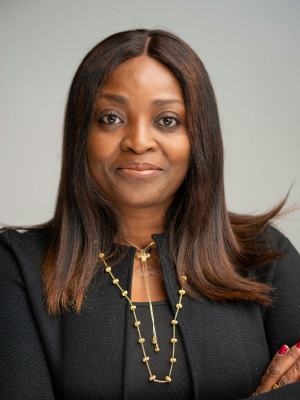
Bola Oyesanya“I take a daily dose of vitamin G for gratitude,” says Bola Oyesanya. “It’s intentional. I make sure to remind myself how fortunate I am to be here and be able to do what I love.”

It’s a fitting metaphor for how Oyesanya moves through both her career and her life: with deliberate optimism, an eye for other people’s strengths, and a belief that gratitude is an everyday practice.

We first profiled Oyesanya in 2018. Since then, she has changed firms and stepped into a new leadership role. She shares the lessons she has learned in stepping into a leadership role at a market-leading firm, the lasting legacy of her mother, and why caring will remain an essential leadership skill, no matter how much AI changes the landscape.

Scaling Up

When we last spoke with Oyesanya, she was a mid-level executive at a different firm. Today, she is a Managing Director at J.P. Morgan, where she has spent the past three years leading the Law Firm and Professional Services Group.

What drew her to JPMorgan was the scale of the opportunity. “It was the allure of doing this with a bank of this brand and stature,” she says. “The opportunity to serve clients on this scale was too good to pass up.”

Today, she leads a team of bankers and specialists serving the wealth management needs of professionals in the legal and professional services industries. Her group supports clients across the balance sheet, from investments and estate planning to liquidity and financing.

“Our clients are sophisticated but incredibly busy people,” Oyesanya says. “Most of their time is spent focused on their own clients. My team’s job is to be the ones thinking about their finances, so they don’t have to.”

For Oyesanya, the role is “a happy marriage” of everything she has studied and done: law, banking, and now leadership.

Fighting Adversity With Optimism

Speaking of challenges, Oyesanya’s perspective on adversity has been shaped by experiences that tested her both personally and professionally. Years ago, she was diagnosed with cancer and survived it. Last fall, what was supposed to be a routine mammogram led to a biopsy and a second diagnosis.

“Everything comes to a grinding halt,” she says of receiving the news.

What carried her through was a combination of faith, family, and friends. Her manager and HR told her simply to take the time she needed and not worry about work. “Being in an organization where you hear that, it puts your perspective in the right place,” she says. “And my team really rallied around me.”

In the aftermath of her second diagnosis, a friend’s words crystallized something for her: “You fight adversity with optimism.”

Oyesanya came back from treatment with a small plaque on her desk that reads Grace and Gratitude. “There’s always room for grace,” she says. “There are things that may go wrong, but how we approach them, what we say, can still leave a positive impact.” More than ever, she says, “I’m filled with a sense of grace and gratitude.”

The experience has also made her more intentional about how she leads. She believes in the mantra: work hard, play hard. When she takes a vacation, she truly steps away, and she encourages her team to do the same.

“It’s informed how I choose to be intentional day to day and how I bring that same intentionality to my colleagues, peers, and the team as a whole.”

Her Mother’s Secret

That intentionality has deep roots. Oyesanya traces much of it to her mother, who passed away in 2019 but, she says, left her with a legacy she brings to work every day.

“My mother died with a secret,” she says. “Each of her children thinks they were her favorite.”

One of eight children herself, Oyesanya says her mother made each of them feel uniquely valued without making the others feel less so. “What she did instead was to celebrate everybody’s strengths.”

Oyesanya carries that lesson into her own leadership.

“I’m very intentional about celebrating and cheering my team on and playing to everybody’s strengths.”

One of her favorite desk items is an applause button, given to her by one of her bankers before she went into surgery. It captures the culture she tries to create: “Everybody knows they will have their day of applause. And when you know your day is coming, it’s easy to cheer for someone else.”

What AI Can’t Do

Asked what skills will matter most for future leaders, Oyesanya doesn’t hesitate. “The one thing AI will never get is caring. That’s a human trait.”

In a business becoming increasingly high-tech, she believes the human side of leadership will only become more important.

“AI will never be able to emote like we can. That’s where we need to spend a lot of our attention, showing that care. That’s how we earn business, that’s how we keep business.”

She sees the same principle at work in leadership and retention. “Showing a team, as a leader, that you care, more than anything else, is the number one retention tool.”

That philosophy extends beyond her own team. She recalls interviewing a candidate who arrived late and visibly rattled after helping his mother open her store that morning. Rather than let him carry that anxiety into his next interview, she sent him to straighten his collar and tie and start fresh. “I’m the only one who knows you were late,” she told him.

He later thanked her on LinkedIn for the moment. “That caring, showing up, and making an impact in people’s lives, I hope those are the things I’m remembered for.”

For Oyesanya, legacy is something considered in everyday decisions. “I always ask myself: long after I’m retired, what would people say? What would people remember? Keeping that legacy in mind helps inform decisions and not make shortcut decisions.”

Staying Present and Dancing in the Kitchen

Two unlikely mentors have also shaped how Oyesanya stays grounded. One was a mailroom clerk, whose calm she once asked about. “I don’t focus on the things I cannot control,” he told her.

“It seems very simple, but it was profound,” she says. “Markets rise and fall, portfolios fluctuate, there are countless things we cannot control in the course of a day, but we sometimes allow them to really determine our moods.”

The other was a shoeshine man Oyesanya encountered in an elevator after an exhausting day. When he asked how work was going, all she could manage was a deep breath. “Work doesn’t finish,” he told her. There would always be more to do tomorrow.

The line changed how she leaves the office. Rather than carrying home everything left unfinished, she takes stock of what she accomplished that day before turning her attention to her family.

These days, she finds her own ways to step away and recharge, including dancing in the kitchen.

“If you wait to find the right time for fun, honestly, you will miss a lot,” Oyesanya says. “Don’t wait until a vacation before you take five minutes to decompress and celebrate. Find a moment to pat yourself on the back and remind yourself how great you are, because each of us is phenomenal in our own way, and we should celebrate who we are.”

By Jessica Robaire
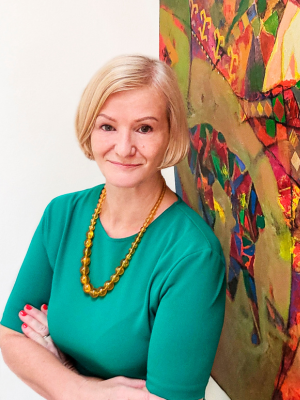
Sally J Clarke“It took me a long time to realise that I am a verb, not a noun,” says Sally Clarke. “That’s why I now have a portfolio career.”

From leading communications at some of the world’s largest fintech companies to writing novels, building a business, and advising boards, Clarke has consistently evolved while staying true to her values of creativity, integrity, and impact.

Clarke shared with The Glass Hammer her experiences in shaping a career defined by movement, meaning, and a refusal to be boxed in.

On embracing a portfolio career:

“At the world’s largest financial technology companies, I led global marketing and communications over an eleven-year period. I’ve built and sold an online arts business, won multiple awards in the technology industry, published my fiction novel  Ringside Gamble, established the advisory practice of Asia’s leading think tank, visited Iran and Kazakhstan on writing assignments, sat on several boards across both the arts and technology sectors, and am now writing two new books. One non-fiction and the other fiction.

“It took me a long time to realise that I am a verb, not a noun. That’s why I now have a portfolio career. From my home in Singapore, I divide my time between advising technology companies solving complex problems, writing, and participating on boards.  My career continues to be an evolutionary process, not a ladder, but a landscape.”

On the personal qualities that shaped her path:

“I’m an optimistic team player — resilient and reflective. I was born into a working-class family and had my first job at the age of 14, delivering newspapers in rain, sunshine, sleet, and snow on my not-so-trusty, rusty bicycle. To this day, I can still remember the click-clacking sound the pedals made! I supported myself and earned scholarships through university and two postgraduate Master’s degrees — one in International Finance and the other in Asian Art History. I work hard to stand in the other person’s shoes.”

On living her values in high-stakes moments:

“Thanks to my parents, I have an internal compass forged in tungsten, a North Star I’ve trusted throughout my life.  I take time to reflect and rely on qualitative as well as quantitative data when forming decisions.

“In Singapore, I faced significant pressure to tell a potential customer at one firm that we had paid pilots — when the company did not. The same founder misinformed about the readiness of the software, employed bullying tactics and took credit for other people’s achievements. As a consequence I found opportunities aligning to my integrity and transitioned from the firm.

“The second challenge was leading the development and rollout of a content management system (CMS) and the front-end client interface. I pitched and secured USD two million in funding to lead a team of developers, designers, and project managers to rapidly build a web platform for data distribution. When it came time to go-live, self-doubt crept in. Many people told me the CMS would be rolled back — I had countless sleepless nights. But I trusted the process, and the so-called Greek chorus of naysayers was wrong.”

On mentorship and the power of stories:

“I’ve had the honour of working on the teams of some incredible people, such as Michael Rushmore who was pivotal in contributing to the growth of IHS Markit, a company I joined as head of marketing and communications in 2007.  Data giant S&P Global agreed to buy IHS Markit in a deal worth $44 billion in November 2020.  Michael had phenomenal insights, which I still share to others.  For example, “don’t make them have to work it out.” This golden nugget refers to the importance of communicating in such a way that your ideas land.

“Cristobal Conde former President, Chief Executive Officer and FIS and Chief Executive Officer at SunGard is a leader I admire.  He was incredibly supportive of the sustainability framework I helped build during my time at the latter firm.  At SunGard I won the President’s 100 per cent award.

“I read. A lot. Both fiction and non-fiction. Some of my favourite start up books, Shoe Dog by Nike co-founder Phil Knight,  Start Up CEO, by Matt Blumberg,   Play Nice but Win, by Michael Dell, and  Venture Deals: Be Smarter than your Lawyer and Venture Capitalist by Brad Feld and Jason Mendelson are examples.  I am inspired by stories. Indra Nooyi , former Chairman and CEO of PepsiCo, is another business leader I follow, and can thoroughly recommend My Life in Full.”

On how she leads with positivity and empathy:

“One piece of advice that shaped me early on was: “Don’t wait for permission.” It gave me the confidence to lead with conviction, long before I had a formal title. That mindset has served me well: whether I am building global brands, launching a start-up, or navigating difficult company mergers.

“But perhaps more influential than any single piece of guidance has been the example set by the leaders I’ve most admired. They led with clarity, composure, and care, especially in high-pressure situations. They didn’t command attention with noise; they earned respect with consistency. And they made people feel seen.

“Something I’ve carried with me through every chapter of my career is this: always role model the positive. Culture is shaped by what we tolerate, and by what we choose to amplify. So even when things are tough, I make a conscious choice to lead with optimism, empathy, and purpose. It’s not about pretending everything’s perfect; it’s about showing up in a way that helps others believe in what’s possible.

“And finally, I’ve learnt that how you leave matters as much as how you lead. It’s easy to focus on beginnings, but endings reveal who we really are. Whether moving on from a role, a company, or a chapter, I try to exit with the same integrity and thoughtfulness I brought to work itself.”

On redefining success:

“I often tell those I mentor that you can define success on your own terms, but only if you’re brave enough to step outside the conventional path. Early in my career, I tried to fit into other people’s expectations. It wasn’t until I started backing myself that I truly began to build things of value.

“I’ve learnt that leadership isn’t about knowing everything; it’s about being willing to go first, to take risks, and to bring others with you. I’ve built global brands, scaled start-ups, and now manage a portfolio career, and through it all, what’s mattered most is clarity of purpose, emotional resilience and having smart colleagues who challenge you.

“I would also say this: creativity is not a luxury; it’s a leadership superpower. Whether you’re building a business or writing a novel, the ability to imagine something that doesn’t exist yet and make it real is what sets great leaders apart. That, and the ability to walk away from what no longer serves you.

“Your career is not a ladder, it’s a landscape. Don’t be afraid to move sideways, take a leap, or build something of your own and test a hypothesis. Solving a big problem is where the real growth lies. If you opt to build a hobby business that’s fine too.  Just define what success means to you.”

On blending purpose with creative pursuits:

“I aim to continue supporting the efforts of sustainable companies using technology to make the world a better place. One particularly impressive firm I have worked with is Yokahu, a leading innovator in parametric insurance.

“That same sense of purpose carries into the passion projects that are a part of my portfolio career. In 2023, Ringside Gamble, a universal story about a young boy with a big dream, was published. Christopher Hatton (Star Trek: The Next Generation, Raven’s Hollow) is attached as producer for the feature film adaptation. I donate a percentage of the royalties to support the purchase of books and school equipment for children in Khao Lak, Thailand.

“With Deborah Overdeput, Chief Operating Officer of Innovative Systems, I’m currently working on a non-fiction book. It features a series of interviews with C-suite women, many of whom have founded their own successful companies or hold senior roles at the world’s leading banks and technology firms. More than a series of personal narratives, it is a testament to resilience, ambition and the power of choice. Each story shares hard-won insights, lessons in leadership and practical guidance for those looking to shape their own future. We’re currently seeking a publisher, with submissions expected to begin in September 2025.

pessimist1Is the office coffee maker half empty or half full? Does simply ‘thinking positively’ help to achieve the desired outcome, or does being too upbeat remove your ability to critically analyze and learn from business and life situations? Does pessimism allow you to spot the obstacles lurking ahead in the distance?

Read more